AI Receptionist for Real Estate Law Firms: Closings, Agents and Wire Safety
A real estate law answering service is a service that answers a real estate practice's phone day and night, sorts new buyers and sellers from agents, lenders, and title companies on open files, and moves closing-week problems to the staff member who can fix them. Below we walk through each piece of that work for an AI receptionist: caller routing, intake questions, wire instruction calls, closing dates, ethics rules, and setup, with sources checked Nov 5, 2026.
Why it matters: a real estate practice gets calls from people who are not clients yet and from professionals on deals already in motion, often in the same hour. Clio's 2019 Legal Trends Report ran a secret-shopper test: 39% of calls to law firms went to voicemail, while 79% of consumers surveyed expected to hear back within 24 hours (Clio press release, Oct 21, 2019). A buyer whose offer was just accepted usually has a short list of attorney names and calls until someone answers.
What is an AI receptionist for real estate law firms?
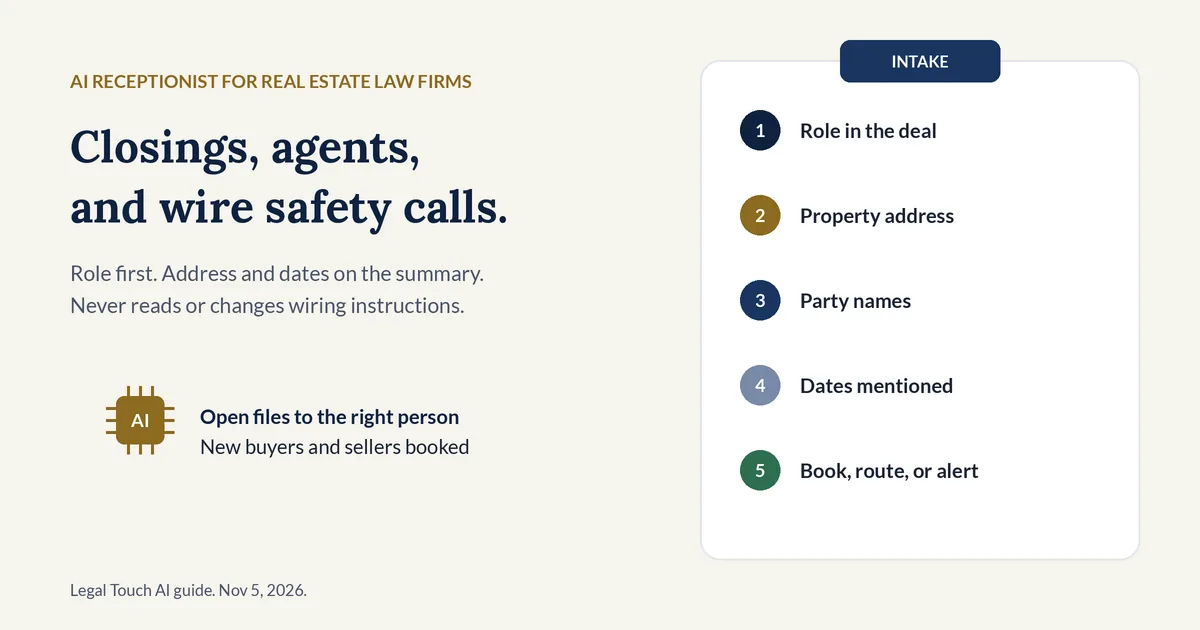
An AI receptionist for real estate law firms is software that answers a real estate practice's phone, says it is an AI, asks each caller's role in the deal, collects the property address and party names, records dates the caller mentions, routes open-file calls to the right staff member, and books consultations for new buyers, sellers, landlords, and owners.
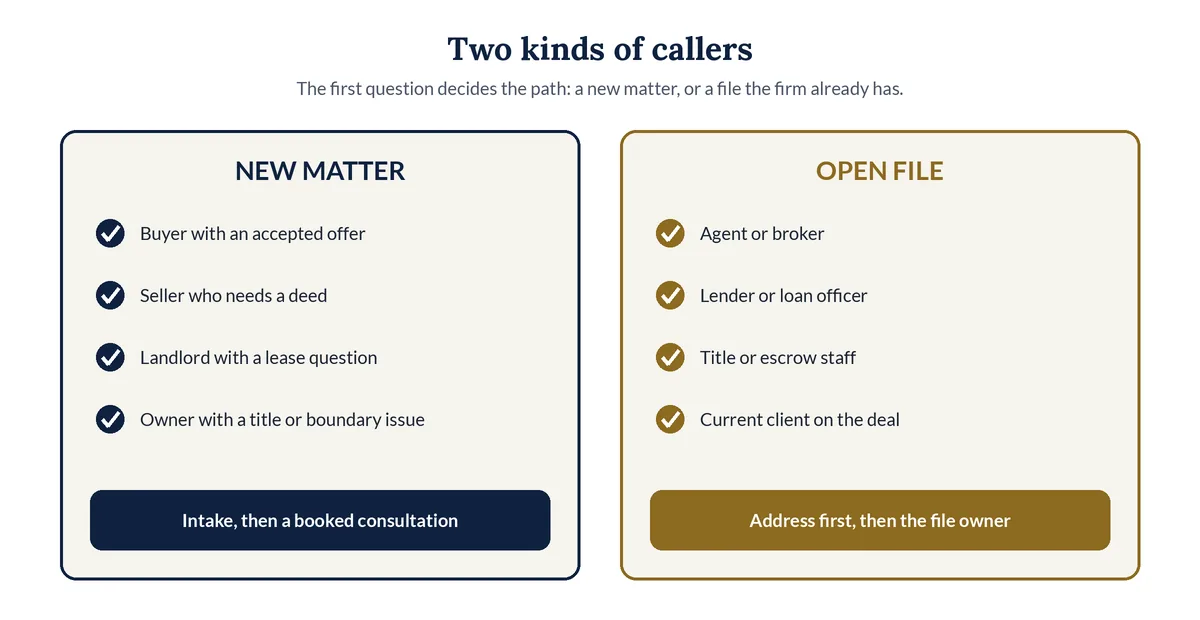
A real estate practice has two kinds of callers, and the AI treats them differently:
- New matters. A buyer who needs a contract reviewed, a seller who needs a deed prepared, a landlord with a lease question, or an owner with a title or boundary problem. These callers get your intake questions and a booked consultation.
- Open files. Agents, loan officers, title and escrow staff, the other side's attorney, and current clients. These callers need the paralegal or attorney on the file, not a new intake.
- Everyone else. Vendors, surveyors, and inspectors usually leave a short message for the file.
New to the idea? Our step-by-step guide to AI receptionists for small law firms explains greetings, screening, transfers, and summaries for any practice.
Why do real estate law firms need every call answered?
Real estate law firms need every call answered because deals run on fixed dates and many parties call at once. A new buyer with an accepted offer often phones several attorneys the same day, and Clio's secret-shopper data found that 39% of law firm calls reached voicemail while 79% of consumers wanted a reply within a day.
Clio measured all practice types, so treat those numbers as a general signal. Two things make real estate calls more time-bound than most:
- Closing schedules are tight. The Consumer Financial Protection Bureau says that, by law, a borrower on most home mortgages must receive the Closing Disclosure at least three business days before closing (some loan types, such as reverse mortgages and HELOCs, use other forms). A Closing Disclosure is the lender's form that tells a borrower how much they will pay for the loan. When a number on it looks wrong, the buyer calls the attorney right away.
- Professionals call on behalf of others. An agent moving a closing time, a lender asking for a signed document, and a title officer with a payoff question all need an answer before the end of the business day.
Before choosing coverage, pull a month of call logs and note how many rang in during closings, lunch, evenings, and weekends.
Who calls a real estate law firm, and how should each call be routed?
Most calls to a real estate law firm come from new buyers and sellers, agents and brokers, lenders, title or escrow staff, the other side's attorney, and current clients. The first question should identify the caller's role, because professionals on an open file need the assigned staff member, while new callers need intake and a consultation.
Who calls a real estate practice, and a sensible default route (our recommendations)
| Caller | Typical need | Suggested first route |
|---|---|---|
| New buyer with an accepted offer | Contract review and a closing attorney | Role, property address, party names, dates mentioned, then book a consultation |
| New seller listing or selling a home | Deed, contract, or closing help | Same intake; book with the attorney who handles sales |
| Landlord or tenant with a lease question | A consultation | Intake by your rules; flag any notice or hearing date the caller mentions |
| Agent or broker on an open file | The paralegal or attorney on that file | Property address and file number, then a transfer or detailed message |
| Lender or loan officer on an open file | A document or a status answer | Short message to the file owner; the AI shares no file details |
| Title or escrow staff on an open file | Signatures, payoffs, or scheduling | Short message or transfer by your rules |
| Anyone asking about wiring instructions | Verification by a person | No details on the call; urgent alert by your rules |
| Someone with a matter outside your practice | Another office | Polite reply plus the referral number on your list |
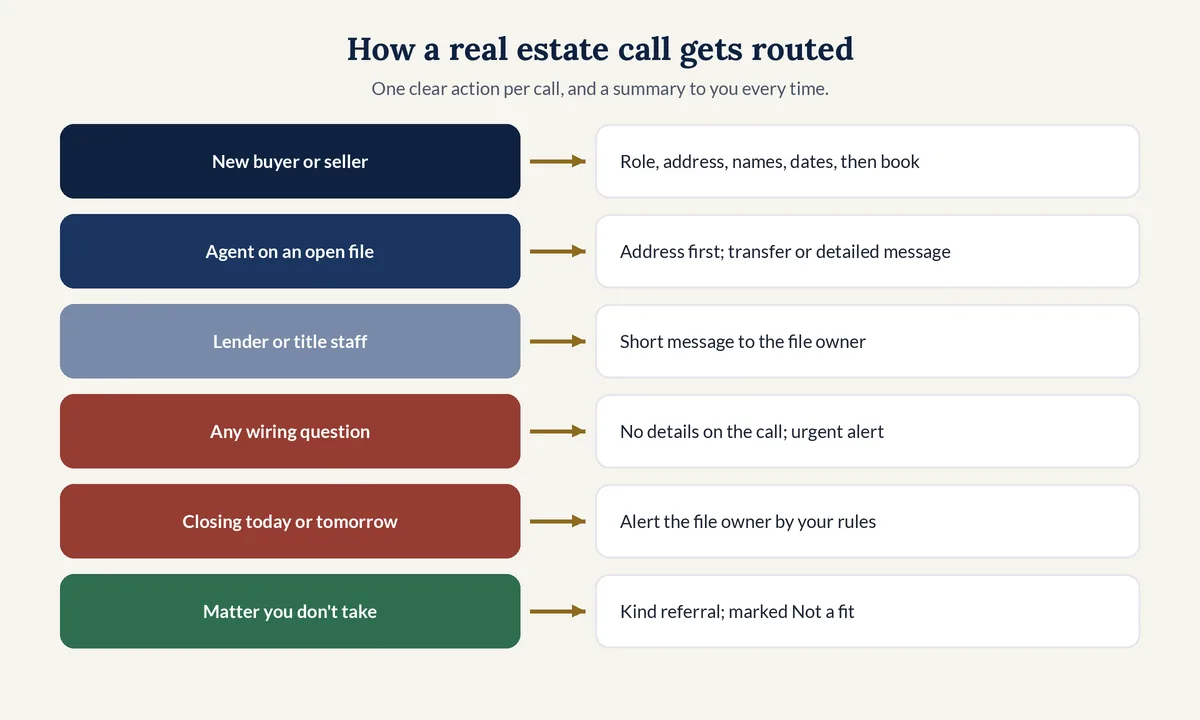
A good script asks the role question in plain words: "Are you calling about a new matter, or about a closing the firm is already handling? If it's an open file, what's the property address?"
What should a real estate law intake call ask?
A real estate law intake call should collect just enough for a conflict check and a callback: who is calling and how to reach them, their role in the deal, the property address and county, the names of the other parties, the type of matter, dates the caller mentions, and whether another attorney is already involved.
Intake fields: ask or skip (our recommended starting list)
| Field | First call? | Reason |
|---|---|---|
| Caller's name, phone, and email | Ask | Lets staff check conflicts and return the call |
| Role in the deal: buyer, seller, landlord, tenant, owner, agent, lender, title | Ask | Decides whether the call is new intake or an open file |
| Property address, city, and county | Ask | Matches the call to a file and to the right attorney |
| Other parties' names (buyer, seller, landlord, tenant, neighbor) | Ask | The core of a real estate conflict check |
| Type of matter: purchase, sale, lease, deed, title, boundary, or other | Ask | Routes the consultation |
| Dates the caller mentions (contract signed, inspection deadline, closing, notice received) | Ask | Gives the attorney the timeline at a glance |
| Already working with another attorney on this deal? | Ask | Avoids stepping into another lawyer's matter |
| Agent or lender names, if the caller offers them | Ask, if your firm wants it | Helps staff reach the right professional |
| Wiring instructions, account numbers, or "where do I send the money?" | Skip | Never handled on a phone script; verified by people only |
| "Should I sign?" "Can I back out?" "Is the title clean?" | Skip | Legal judgment belongs with the attorney |
| Social Security, bank, or card numbers | Skip | No first call requires them |
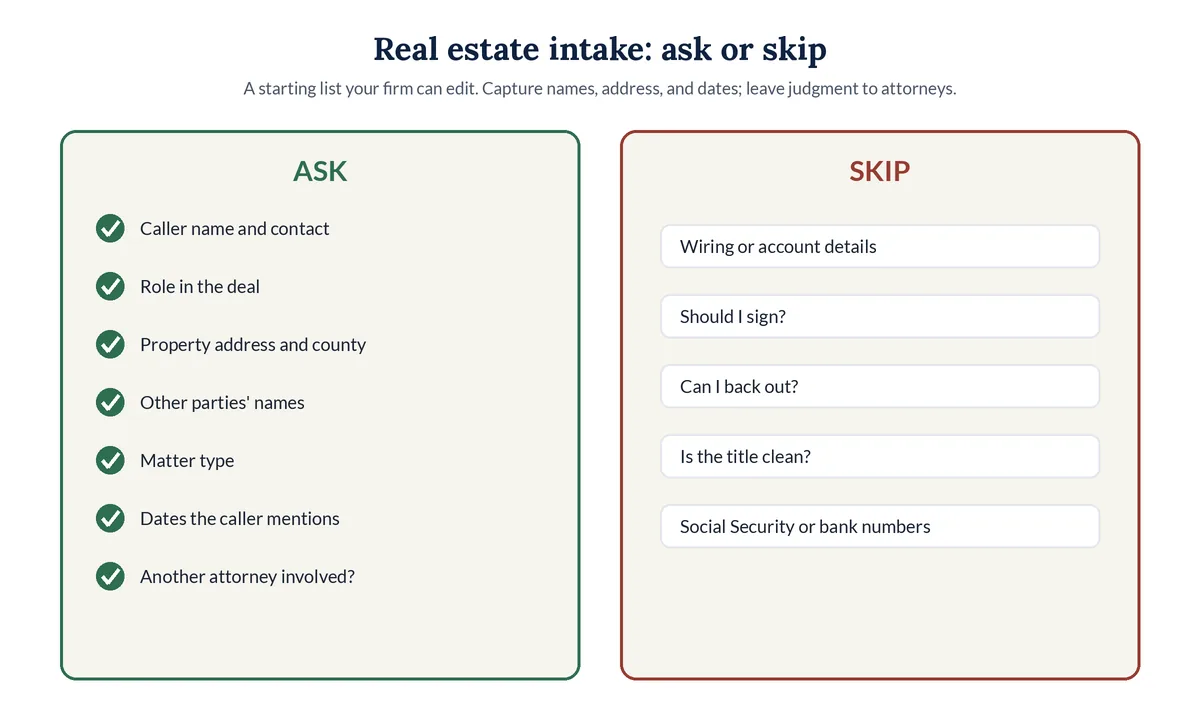
Comment [4] to ABA Model Rule 1.18 tells lawyers to "limit the initial consultation to only such information as reasonably appears necessary" to decide whether to take the matter. In real estate work that usually means names, address, role, and dates. To turn this list into words the AI says out loud, start from our fill-in intake script templates for law firm phone lines.
How should an AI receptionist handle wire instruction calls?
An AI receptionist should never read, confirm, or change wiring instructions, and it should never take bank details on a call. When a caller asks where to send money or reports new instructions, the AI should say a person at the firm will verify by a known number, then send an urgent alert under your rules.
Wire fraud in a real estate closing is a scam in which a criminal poses as someone the buyer trusts and sends false instructions so closing funds land in the criminal's account. The Consumer Financial Protection Bureau describes scammers who send spoofed emails to homebuyers posing as the real estate agent, the closing agent, a legal representative, or another trusted person.
Public facts your firm may care about (checked Nov 5, 2026):
Wire safety facts from public sources, and what the AI should do
| Source | What it says | What the AI should do |
|---|---|---|
| CFPB, Mortgage Closing Scams | Before wiring money, always confirm instructions with your trusted representatives. Never follow instructions contained in an email | Never confirm or read instructions; refer the caller to the person and number the firm already gave them |
| CFPB, Mortgage Closing Scams | Scammers may call and ask you to verify your personal or financial information | Never ask for account numbers; say so in the greeting rules |
| CFPB, Mortgage Closing Scams | If it happens, contact your bank or wire-transfer company immediately and ask for a wire recall, then file a complaint at ic3.gov | Flag the call as urgent so a person calls back at once |
| FBI IC3 2024 Internet Crime Report | Business email compromise: 21,442 complaints and $2,770,151,146 in reported losses in 2024 | Treat every wiring question as a staff task, not a phone script task |
| FBI IC3 2024 Internet Crime Report | Denver, March 2024: buyers wired $956,342 after a spoofed email from their supposed real estate agents; $955,060 was stopped and returned | Get suspected fraud calls to a person fast |
Sources: CFPB, Mortgage Closing Scams and FBI IC3 2024 Internet Crime Report. Pulled Nov 5, 2026. IC3 figures are complaints reported to the FBI, across all industries, not real estate alone.
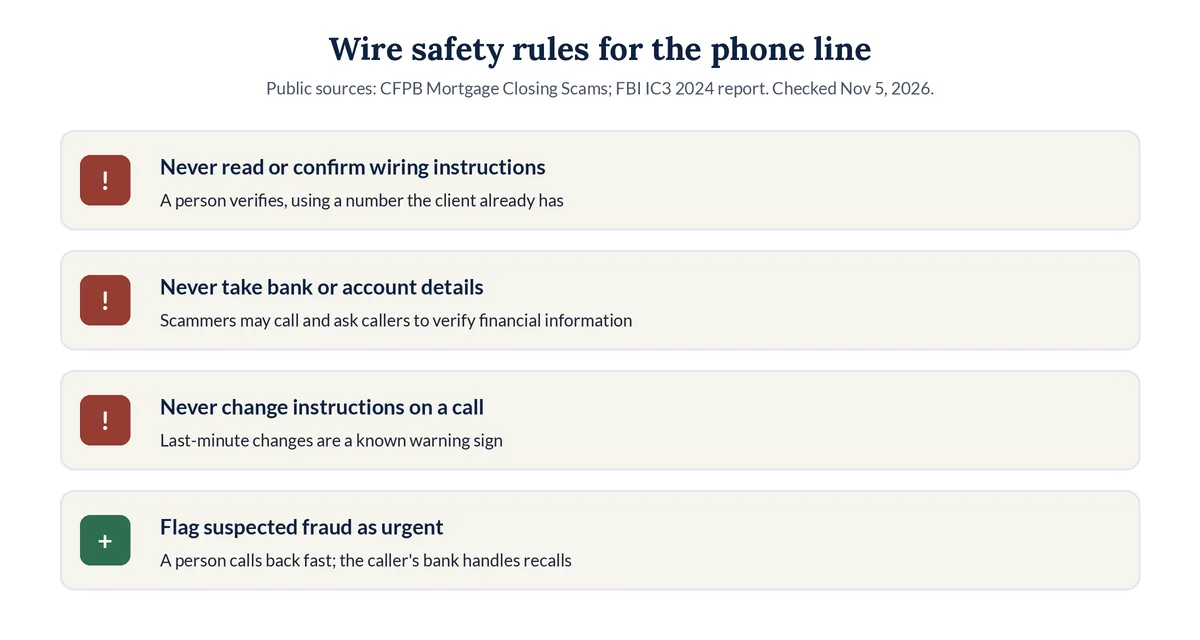
A sample line for your script: "For your safety, I can't discuss wiring or payment instructions on this line. I'm sending an urgent note to the closing team now, and a person will call you back at the number the firm has on file."
How should an AI receptionist handle closing dates and deadlines?
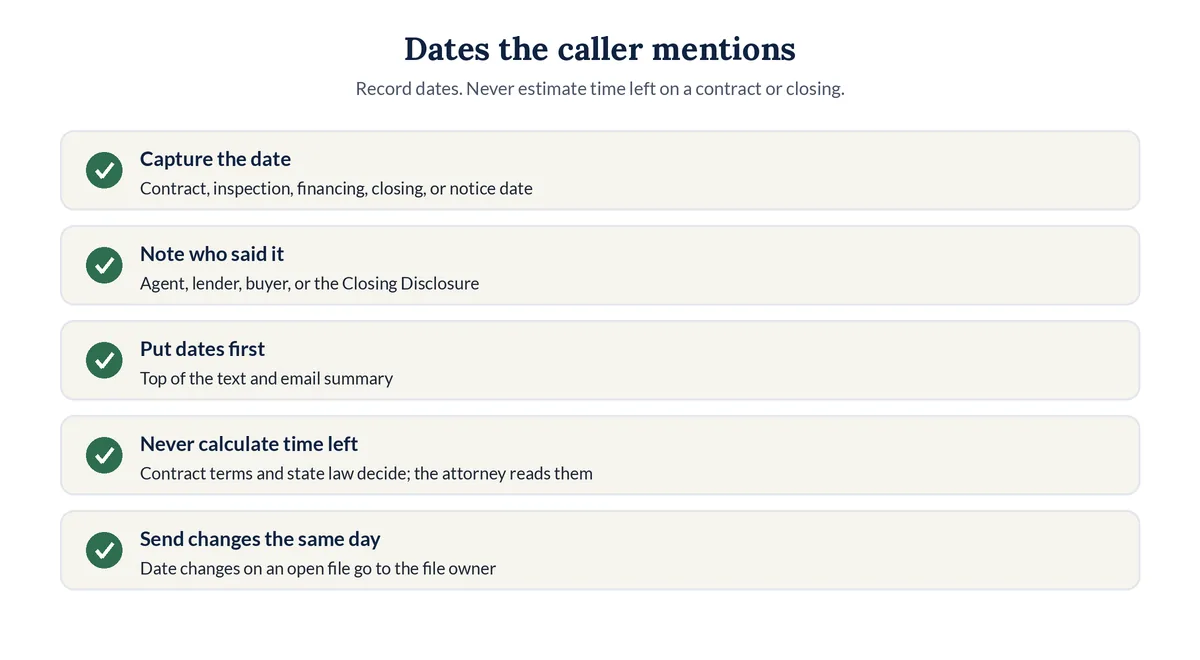
The AI should write down each date a caller gives, such as the contract date, inspection or financing deadline, closing date, or notice date, and put those dates at the top of the summary. It should never say whether a closing will happen on time or how many days remain on a contract deadline.
- Capture, don't calculate. Contract deadlines depend on the contract and state law. The AI writes down what the caller says; the attorney reads the contract.
- Note the source of the date. "Agent says closing moved to Friday" is different from "Buyer read it on the Closing Disclosure."
- Send it to the file owner. Date changes on an open file go to the paralegal or attorney on that file the same day.
Which real estate calls should be flagged as urgent?
Urgent is whatever your attorneys say it is; the AI just applies the list. Real estate practices often include any question or report about wiring instructions, a closing set for today or tomorrow, a document a lender needs before funding, a notice with a short response window, and a current client who says something on the deal has changed.
A simple routing plan:
- Wiring question or suspected fraud: urgent alert to the closing team; no details on the call.
- Closing today or tomorrow: text the file owner, and put the call through if your rules permit and the line is answered.
- Agent, lender, or title staff on an open file: detailed message or transfer, with the property address first.
- New buyer, seller, landlord, or owner: intake, then book a consultation.
- Outside your practice: give the approved referral number; the summary labels it "Not a fit."
What do ethics rules say about AI receptionists for real estate law firms?
In real estate intake the ethics questions center on who the parties are and how much of the deal the caller describes. ABA Formal Opinion 512, issued July 29, 2024, applies the confidentiality duty, the prospective-client rule (Model Rule 1.18), and the duty to supervise nonlawyer help (Model Rule 5.3) to generative AI tools.
This is general information, not legal advice. State rules control, and several state bars have issued AI guidance of their own. For a real estate practice:
- Names before details. Rule 1.18(c) can bar a firm from a related matter if a would-be client shared information that "could be significantly harmful" to them. Collect the buyer, seller, and other party names first so staff can check them.
- No legal answers from the phone. Opinion 512 is direct that lawyers "may not leave it to GAI tools alone to offer legal advice" to clients, so "Should I sign the addendum?" goes to an attorney.
- Professionals are not clients. Agents and lenders call about the deal, but they may not be the firm's client. Keep the AI from sharing file details with any caller.
- Vet the vendor. Opinion 512 points lawyers to reference checks, vendor credentials, and the vendor's security policies and protocols before the tool handles client information.
If you record calls, our state-by-state guide to call recording consent for law firms covers one-party and all-party states. Real estate practices that also prepare wills and trusts can compare our guide for estate planning attorneys.
How do you set up an AI receptionist for a real estate law firm?
Setting up an AI receptionist for a real estate practice means picking coverage hours, writing a role-first greeting, listing intake fields and never-discuss topics such as wiring, mapping open-file calls to the right staff, defining urgent rules, connecting the calendar, forwarding the number, and testing buyer, agent, and wiring calls.
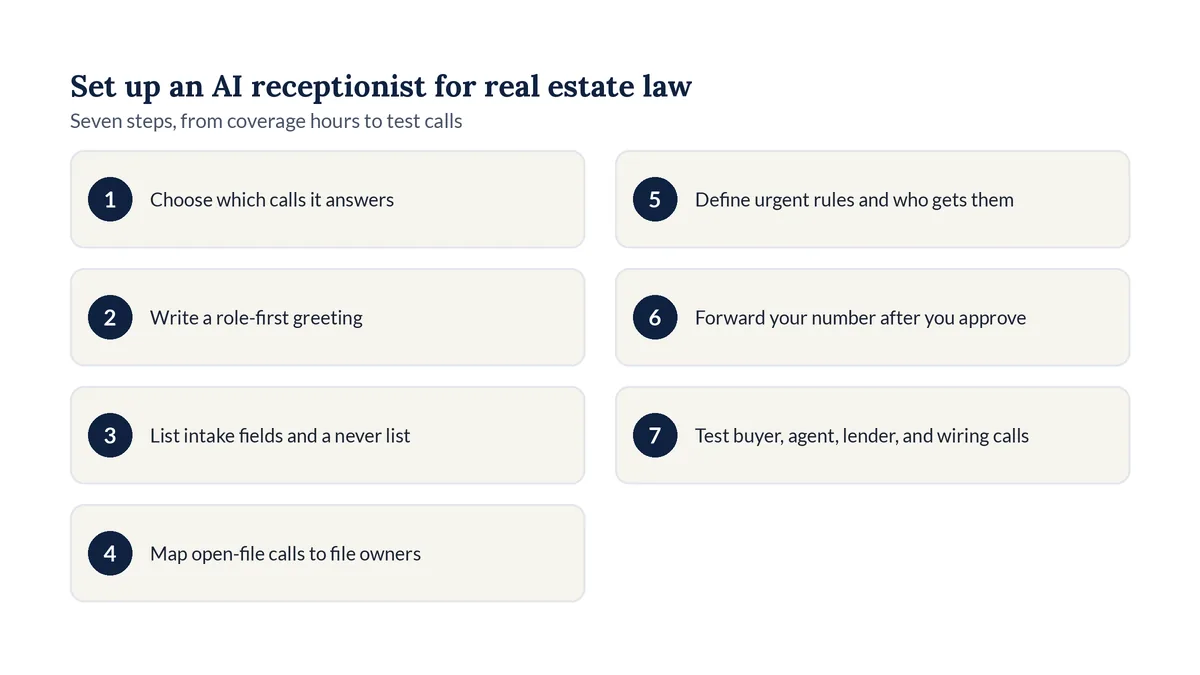
- Choose the coverage: every call, overflow when staff are busy, or only nights and weekends.
- Write a role-first greeting that separates new matters from open files before any intake starts.
- List the intake fields and the topics the AI must never discuss, including wiring instructions and "should I sign?"
- Map open-file calls from agents, lenders, and title staff to the paralegal or attorney who owns each file.
- Define urgent calls, such as a wiring question or a closing today, and who gets the text or transfer for each one.
- Forward the main number once the script is approved; clients, agents, and lenders keep using the number already on their paperwork.
- Test a new buyer call, an agent moving a closing, a lender asking for a document, and a wiring question, and review every summary before going live.
How does Legal Touch AI handle real estate law calls?
Legal Touch AI is an AI phone receptionist for small U.S. law firms, and a real estate practice can set it up around the new-matter and open-file split. You pick the screening questions and their order, and you list the situations, such as a wiring question, that trigger an "URGENT" text and email or a ring to your cell.
What a real estate call looks like with it:
- The greeting is honest. The caller is told the line is answered by the firm's AI assistant and that the call is recorded; if they decline, it follows the option you picked.
- Questions come one at a time. Plain words, in your order, so role, property address, and party names lead.
- Done for You plans add live transfers. During office hours you get a text, then your phone rings; no pickup by the third ring means it returns to the caller and books a time.
- Done for You plans also book. After hours it looks at your Google or Outlook calendar and offers the caller two open times.
- A record follows every call. A short text with name, phone, need, and outcome, and an email with every answer, the recording, and the transcript.
The live site lists what it never does: give legal advice or predict a result, decide conflicts or promise the firm will take a case, pretend to be a person, or ask for Social Security numbers, card numbers, or passwords. Your number stays yours. Read how Legal Touch AI handles a call, step by step or compare Legal Touch AI plans and pricing.
Why we wrote this guide
Before offering it to anyone else, the Legal Touch AI team ran Legal Touch AI on our own lines. For this guide, on Nov 5, 2026, we read five page-one pages selling AI receptionists to real estate law practices. All five covered the property address, agent and lender callers, and closing dates. Only one warned about wiring instructions. Two said they do not give legal advice. Only one mentioned conflict checks. None cited the CFPB, the FBI, or an ABA rule. So we built this page on public CFPB, FBI, and ABA sources, plus a plain list of what to ask and what to skip.
Real estate AI receptionist pages: what five page-one pages covered (our review, Nov 5, 2026)
| What the page did | Count (of 5) |
|---|---|
| Mentioned capturing the property address | 5 |
| Mentioned agent, lender, or title company callers | 5 |
| Mentioned closing dates or deadlines | 5 |
| Warned about wiring instructions | 1 |
| Said it does not give legal advice | 2 |
| Mentioned conflict checks | 1 |
| Linked to a .gov source | 0 |
| Cited an ABA Model Rule or opinion by number | 0 |
| Showed prices or dollar figures | 1 |
How we counted: two searches ("ai receptionist for real estate law firms" and "real estate attorney answering service"), five separate vendor pages saved from the first page of results, each read by hand against the list above. We do not name the vendors.
Test it on real estate calls. Book a 15-minute Legal Touch AI demo, then play a new buyer, an agent moving a closing, and a caller asking where to wire funds.
Frequently asked questions
Can an AI receptionist give out wiring instructions for a closing?
No, and it should not try. The CFPB tells homebuyers to confirm wiring instructions only with trusted people, in person or at a phone number agreed on earlier. Set the AI to decline any wiring or payment question, take no bank details, and send an urgent alert so a person calls back.
Can the AI tell an agent or lender the status of a closing?
Not by default. Agents, lenders, and title staff may not be your client, and file details are confidential. The AI can take the property address, the file number, and the request, then transfer the call or send a detailed message to the paralegal or attorney on that file.
Can an AI receptionist run a conflict check for a real estate law firm?
It can gather the names your script lists, such as the buyer, seller, landlord, tenant, or neighbor, before the caller tells the full story. Staff then search those names against open and closed files. Whether a conflict exists, and whether to offer a consultation, is an attorney's call alone.
Should the AI tell a buyer whether they can still back out of a contract?
No. Contract deadlines depend on the contract and state law, so the AI should never estimate time left or advise on cancelling. It can record the contract, inspection, and closing dates the caller mentions, flag a close date by your rules, and book an attorney consultation.
Is a real estate intake call with an AI receptionist confidential?
Treat it that way. Rule 1.18 protects what a would-be client tells the firm even if the firm never takes the matter, and Opinion 512 asks lawyers to vet how an AI vendor secures information. Limit the first call to names, role, property address, and dates until staff clear conflicts.
Legal Touch AI is not a law firm and does not provide legal advice. Nothing here is legal advice on real estate law, closings, or lawyer ethics rules. Using Legal Touch AI does not create an attorney-client relationship. Check your state's rules of professional conduct and recording laws before you put any AI on your phone line.
Sources (checked Nov 5, 2026)
- Consumer Financial Protection Bureau, Mortgage Closing Scams: How to protect yourself and your closing funds: https://www.consumerfinance.gov/archive/blog/mortgage-closing-scams-how-protect-yourself-and-your-closing-funds/
- Consumer Financial Protection Bureau, When do I get a Closing Disclosure?: https://www.consumerfinance.gov/ask-cfpb/when-do-i-get-a-closing-disclosure-en-179/
- Federal Bureau of Investigation, Internet Crime Complaint Center, 2024 Internet Crime Report: https://www.ic3.gov/AnnualReport/Reports/2024_IC3Report.pdf
- Clio, Legal Trends Report press release (Oct 21, 2019): https://www.clio.com/about/press/clios-legal-trends-report-reveals-law-firms-struggle-to-respond-to-client-inquiries/
- ABA Formal Opinion 512, Generative Artificial Intelligence Tools (July 29, 2024): https://www.americanbar.org/content/dam/aba/administrative/professional_responsibility/ethics-opinions/aba-formal-opinion-512.pdf
- ABA Model Rule 1.18, Duties to Prospective Client: https://www.americanbar.org/groups/professional_responsibility/publications/model_rules_of_professional_conduct/rule_1_18_duties_of_prospective_client/
- ABA Model Rule 1.18, Comment: https://www.americanbar.org/groups/professional_responsibility/publications/model_rules_of_professional_conduct/rule_1_18_duties_of_prospective_client/comment_on_rule_1_18_duties_of_prospective_client/
- Legal Touch AI, how it works: https://legaltouchai.com/how-it-works/
- Legal Touch AI, pricing: https://legaltouchai.com/pricing/