Call Recording Consent for Law Firms: A State-by-State Guide With AI Disclosure Scripts
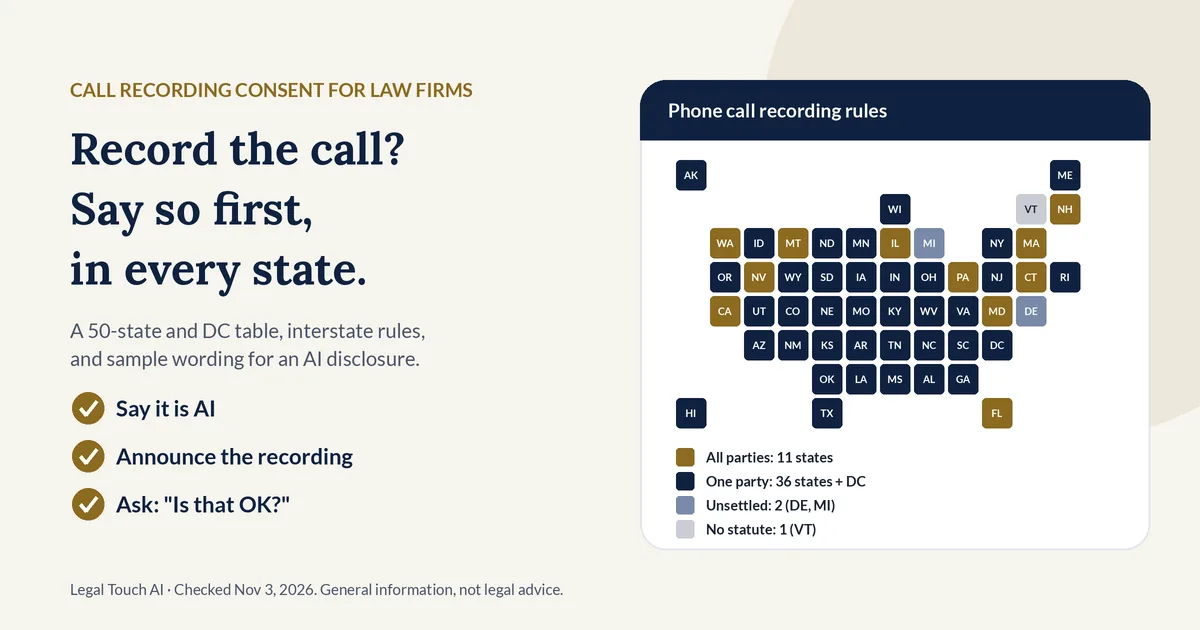
Call recording consent is the permission a wiretap or eavesdropping law requires before someone may record a phone call. For a law firm, the short answer is this: federal law and most states let one person on the call consent, but 11 states require consent from everyone on a phone call, and two more are unsettled. A clear recording notice at the start of every call is the simplest way to cover callers from any state. This guide has a table for all 50 states and DC with the statute numbers we read on Nov 3, 2026, plus sample wording for a recording notice and an AI disclosure.
Do law firms need consent to record phone calls?
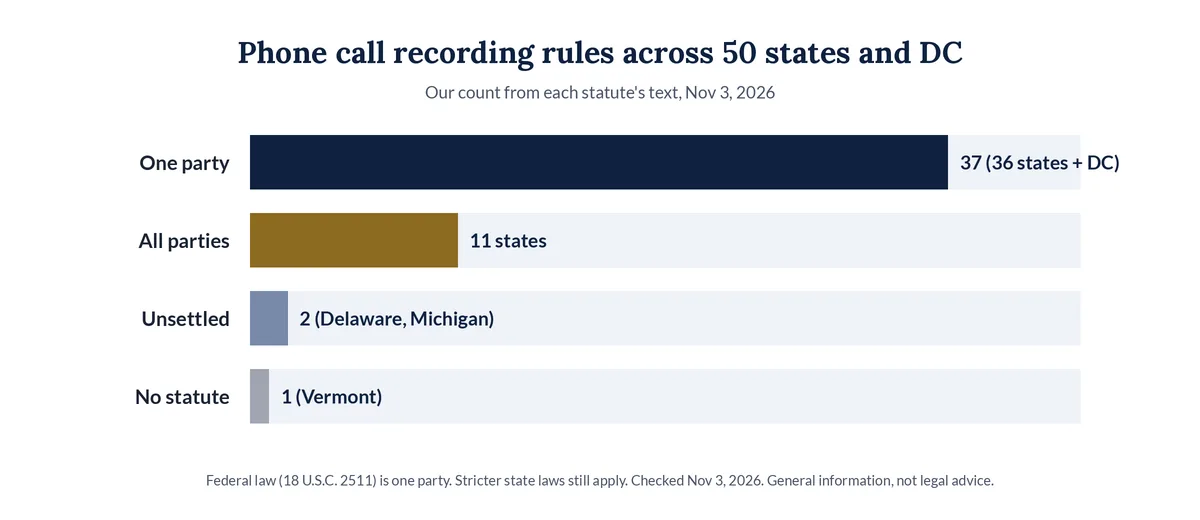
Yes. Every U.S. jurisdiction requires at least one party's consent to record a phone call, and 11 states require consent from everyone on the call. When a firm's own phone system records the calls it answers, the firm is a party, so its consent covers one-party states. In all-party states, the caller must also agree.
Federal law sets the floor. Under 18 U.S.C. 2511(2)(d), it is not unlawful for a private person to record a call when the person is a party to it "or where one of the parties to the communication has given prior consent," unless the recording is made to commit a criminal or tortious act. States may be stricter, and many are.
Three questions decide whether a particular recording is lawful:
- Who is on the call, and where are they? The caller's state can matter as much as the firm's.
- Is the conversation private? California's statute protects a "confidential communication," and Illinois protects a "private conversation."
- Was there notice or consent? Several all-party statutes treat a clear announcement at the start as consent, as covered below.
For a law firm, the rules don't stop at the wiretap statute. Ethics rules on confidentiality and supervision also apply, which our guide to whether a law firm may use an AI receptionist under the ethics rules covers in depth.
Which states require all-party consent to record calls?
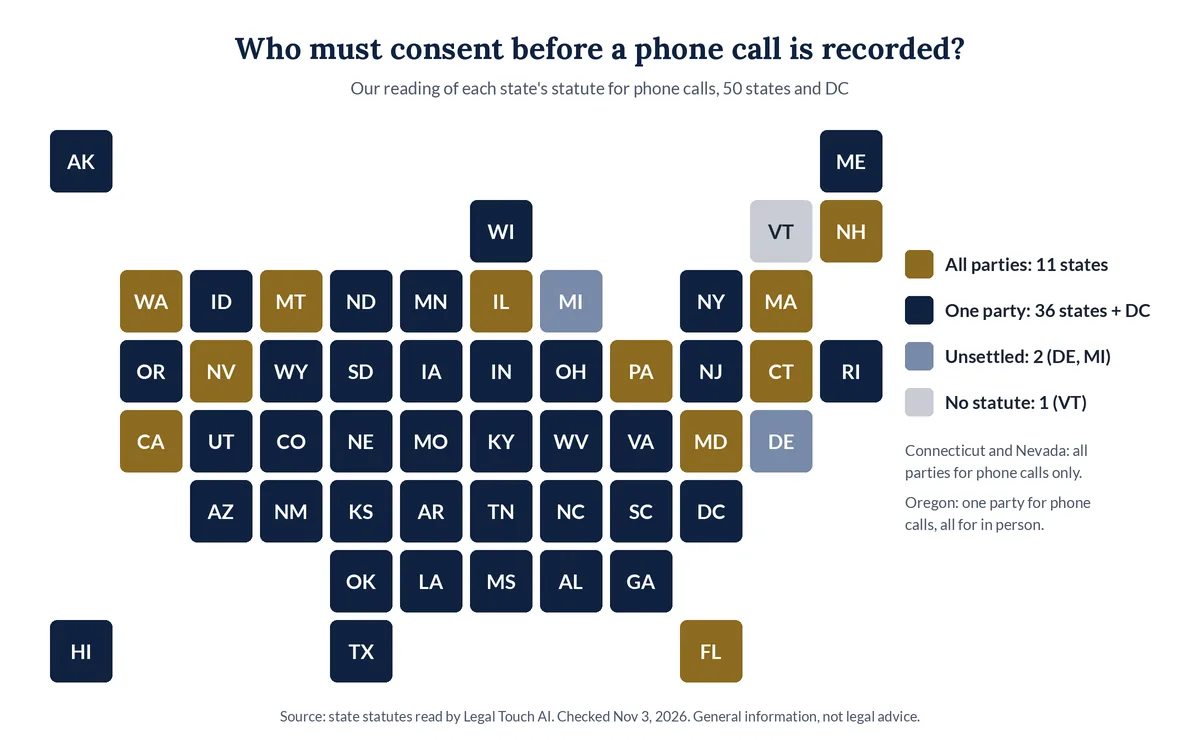
By our reading of each statute, 11 states require consent from everyone on a phone call: California, Connecticut, Florida, Illinois, Maryland, Massachusetts, Montana, Nevada, New Hampshire, Pennsylvania, and Washington. Delaware and Michigan are unsettled. Lists online differ because Connecticut, Nevada, and Oregon treat phone calls differently from in-person conversations.
What each all-party or unsettled statute says, in its own words:
| State | Statute language (short quote) | Statute |
|---|---|---|
| California | "without the consent of all parties to a confidential communication" | Penal Code 632(a); also 632.7 for cell and cordless calls |
| Connecticut | Recording a phone call needs "consent of all parties," or a verbal notice recorded at the start | Gen. Stat. 52-570d (civil) |
| Florida | Lawful when "all of the parties to the communication have given prior consent" | Fla. Stat. 934.03(2)(d) |
| Illinois | Bars recording a private conversation "in a surreptitious manner" without "the consent of all other parties" | 720 ILCS 5/14-2(a)(2) |
| Maryland | Lawful when "all of the parties to the communication have given prior consent" | Cts. and Jud. Proc. 10-402(c)(3) |
| Massachusetts | Bars anyone to "secretly hear, secretly record" a call without prior authority from all parties | Gen. Laws ch. 272, sec. 99 |
| Montana | Bars recording "without the knowledge of all parties to the conversation," except for persons given warning | Mont. Code 45-8-213 |
| Nevada | Allows one-party interception of a phone call only in an emergency when a court order is impractical | Nev. Rev. Stat. 200.620 |
| New Hampshire | Bars interception "without the consent of all parties to the communication" | Rev. Stat. 570-A:2 |
| Pennsylvania | Lawful when "all parties to the communication have given prior consent" | 18 Pa. Cons. Stat. 5704(4) |
| Washington | Bars recording a private phone call "without first obtaining the consent of all the participants" | Rev. Code 9.73.030 |
| Delaware (unsettled) | The wiretap act allows one-party consent, but another section says "without the consent of all parties thereto" | 11 Del. C. 2402(c)(4) and 1335 |
| Michigan (unsettled) | The statute says "without the consent of all parties thereto," but defines eavesdropping as recording "the private discourse of others" | Mich. Comp. Laws 750.539c and 750.539a |
Statute text checked Nov 3, 2026, on state legislature websites, or on FindLaw's copy of the official code where a state site blocked automated access.
Why lists disagree, state by state:
- Connecticut. Its criminal wiretap law is one-party (Gen. Stat. 53a-187), but its civil statute, 52-570d, makes recording a phone call without all-party consent, a recorded verbal notice, or a warning tone repeated about every fifteen seconds a civil wrong. For a firm's phones, treat it as all-party.
- Nevada. The Nevada Supreme Court read NRS 200.620 in Lane v. Allstate (1998) to bar taping your own phone calls with only one party's consent. In-person conversations fall under a different, one-party section, NRS 200.650.
- Oregon. ORS 165.540 allows one participant to consent for a phone call, but everyone must be told before an in-person conversation is recorded. We list Oregon as one-party for phone calls.
- Michigan. A 1982 appeals court ruling, Sullivan v. Gray, held that a participant may record, because the statute covers "the private discourse of others." A federal appeals court noted in 2022 that the Michigan Supreme Court has not decided the question.
- Delaware. Section 2402 of its wiretap act allows one-party consent, while section 1335 says all parties. A federal court read section 1335 like the federal one-party law, but the conflict has not been settled by the state's own courts.
What is the call recording rule in each state?
The table below lists the rule for phone calls in all 50 states and DC, with the statute we read for each. In short, 36 states and DC allow one-party consent, 11 states require all parties, Delaware and Michigan are unsettled, and Vermont has no recording statute. Notes flag states where the answer depends on the situation.
| State | Rule for phone calls | Statute | Note |
|---|---|---|---|
| Alabama | One party | Ala. Code 13A-11-30, 13A-11-31 | |
| Alaska | One party | Alaska Stat. 42.20.310 | |
| Arizona | One party | Ariz. Rev. Stat. 13-3005, 13-3012 | |
| Arkansas | One party | Ark. Code 5-60-120 | |
| California | All parties | Cal. Penal Code 632, 632.7 | Covers confidential calls (632) and any call with a cell or cordless phone (632.7) |
| Colorado | One party | Colo. Rev. Stat. 18-9-303 | |
| Connecticut | All parties | Conn. Gen. Stat. 52-570d; 53a-187 | Criminal law is one party, but 52-570d makes recording a phone call without all-party consent or a recorded notice a civil wrong |
| Delaware | Unsettled | 11 Del. C. 2402; 11 Del. C. 1335 | The wiretap act allows one party, but section 1335 says all parties |
| District of Columbia | One party | D.C. Code 23-542 | |
| Florida | All parties | Fla. Stat. 934.03 | |
| Georgia | One party | Ga. Code 16-11-66 | |
| Hawaii | One party | Haw. Rev. Stat. 803-42 | |
| Idaho | One party | Idaho Code 18-6702 | |
| Illinois | All parties | 720 ILCS 5/14-2 | Applies to private conversations recorded in a surreptitious manner |
| Indiana | One party | Ind. Code 35-31.5-2-176 | |
| Iowa | One party | Iowa Code 808B.2 | |
| Kansas | One party | Kan. Stat. 21-6101 | |
| Kentucky | One party | Ky. Rev. Stat. 526.010 | |
| Louisiana | One party | La. Rev. Stat. 15:1303 | |
| Maine | One party | 15 Me. Rev. Stat. 709, 710 | |
| Maryland | All parties | Md. Code, Cts. and Jud. Proc. 10-402 | |
| Massachusetts | All parties | Mass. Gen. Laws ch. 272, sec. 99 | Bars secret recording without prior authority from all parties |
| Michigan | Unsettled | Mich. Comp. Laws 750.539a, 750.539c | The statute says all parties, but a 1982 appeals court ruling lets a participant record |
| Minnesota | One party | Minn. Stat. 626A.02 | |
| Mississippi | One party | Miss. Code 41-29-531 | |
| Missouri | One party | Mo. Rev. Stat. 542.402 | |
| Montana | All parties | Mont. Code 45-8-213 | Requires the knowledge of all parties; a warning by one person is enough |
| Nebraska | One party | Neb. Rev. Stat. 86-290 | |
| Nevada | All parties | Nev. Rev. Stat. 200.620 | All parties for phone calls under the state supreme court's 1998 reading; one party for in-person talks |
| New Hampshire | All parties | N.H. Rev. Stat. 570-A:2 | |
| New Jersey | One party | N.J. Stat. 2A:156A-4 | |
| New Mexico | One party | N.M. Stat. 30-12-1 | |
| New York | One party | N.Y. Penal Law 250.00, 250.05 | |
| North Carolina | One party | N.C. Gen. Stat. 15A-287 | |
| North Dakota | One party | N.D. Cent. Code 12.1-15-02 | |
| Ohio | One party | Ohio Rev. Code 2933.52 | |
| Oklahoma | One party | 13 Okla. Stat. 176.4 | |
| Oregon | One party | Or. Rev. Stat. 165.540 | One party for phone calls; everyone must be told for in-person conversations |
| Pennsylvania | All parties | 18 Pa. Cons. Stat. 5704 | |
| Rhode Island | One party | R.I. Gen. Laws 11-35-21 | |
| South Carolina | One party | S.C. Code 17-30-30 | |
| South Dakota | One party | S.D. Codified Laws 23A-35A-20 | |
| Tennessee | One party | Tenn. Code 39-13-601 | |
| Texas | One party | Tex. Penal Code 16.02 | |
| Utah | One party | Utah Code 77-23a-4 | |
| Vermont | No statute | None | No recording consent statute; no clear rule from the courts |
| Virginia | One party | Va. Code 19.2-62 | |
| Washington | All parties | Wash. Rev. Code 9.73.030 | A recorded announcement to everyone on the call counts as consent |
| West Virginia | One party | W. Va. Code 62-1D-3 | |
| Wisconsin | One party | Wis. Stat. 968.31 | |
| Wyoming | One party | Wyo. Stat. 7-3-702 |
Source: our compilation from each statute's text as saved on Nov 3, 2026, from state legislature websites or, where a state site blocked automated access, from FindLaw's copy of the official code. Notes are our plain-English summary, not legal advice. Most statutes have exceptions, for example for phone companies and police, and they change, so confirm the current text before you rely on a row.
Which state's law applies when the caller is in another state?
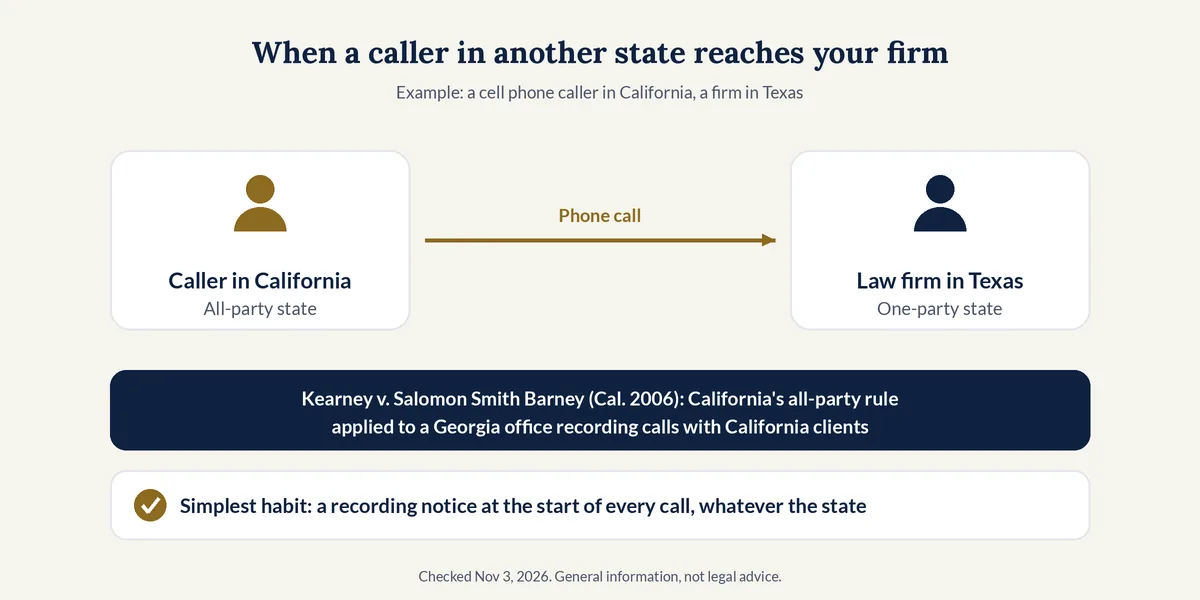
Often the stricter one, so plan for it. In Kearney v. Salomon Smith Barney (2006), the California Supreme Court applied California's all-party rule to a Georgia office that recorded calls with California clients. Other states have reached different results, which is why a notice on every call is the practical answer for a law firm.
In Kearney, the court held that California law governed future recording of calls between the Georgia office and its California clients, though it declined to award damages for past calls. It also said that "if a business informs a client or customer at the outset of a telephone call that the call is being recorded, the recording would not violate the applicable California statute" (Kearney opinion).
Nevada went the other way on its own statute. In Ditech Financial v. Buckles (2017), the Nevada Supreme Court held that NRS 200.620 "does not apply to the recording of interstate calls when the act of recording takes place outside Nevada" (Ditech opinion). So the answer depends on which state's courts are asked.
What that means for a small firm:
- Area codes don't tell you where a caller is. People keep their cell numbers when they move or travel.
- Remote staff count too. A receptionist or attorney answering from another state adds that state's law to the picture.
- One rule beats a map. Giving the same notice on every call is simpler than trying to sort callers by state.
If your firm is in Texas, a one-party state, our Texas guide to recording, AI disclosure and ethics rules covers the Texas statute and ethics opinion in detail.
Does a recording notice count as consent?
In several states, yes. Washington's statute says consent is obtained when a party announces the recording to everyone on the call and the announcement is recorded. Connecticut accepts a verbal notice recorded at the start. California's Supreme Court said a notice at the outset avoids violating its statute. A caller who objects should get another option.
What the statutes and courts say counts as notice:
| State | What counts | Source |
|---|---|---|
| Washington | An announcement "in any reasonably effective manner" that the call is about to be recorded, with the announcement itself recorded | Rev. Code 9.73.030(3) |
| Connecticut | Written consent, consent at the start of the recording, a verbal notice recorded at the beginning, or a warning tone about every fifteen seconds | Gen. Stat. 52-570d |
| California | Telling the caller "at the outset of a telephone call that the call is being recorded" | Kearney v. Salomon Smith Barney (2006) |
| Montana | A warning: "If one person provides the warning, either party may record" | Mont. Code 45-8-213 |
| Massachusetts and Illinois | Both statutes are written against secret or surreptitious recording, so an open announcement matters | Gen. Laws ch. 272, sec. 99; 720 ILCS 5/14-2 |
Whether a caller who stays on the line after a notice has consented in every state is a question for your counsel. Asking "Is that OK?" and waiting for an answer removes most of the doubt, and it gives you a recorded yes.
Which laws require an AI call disclosure?
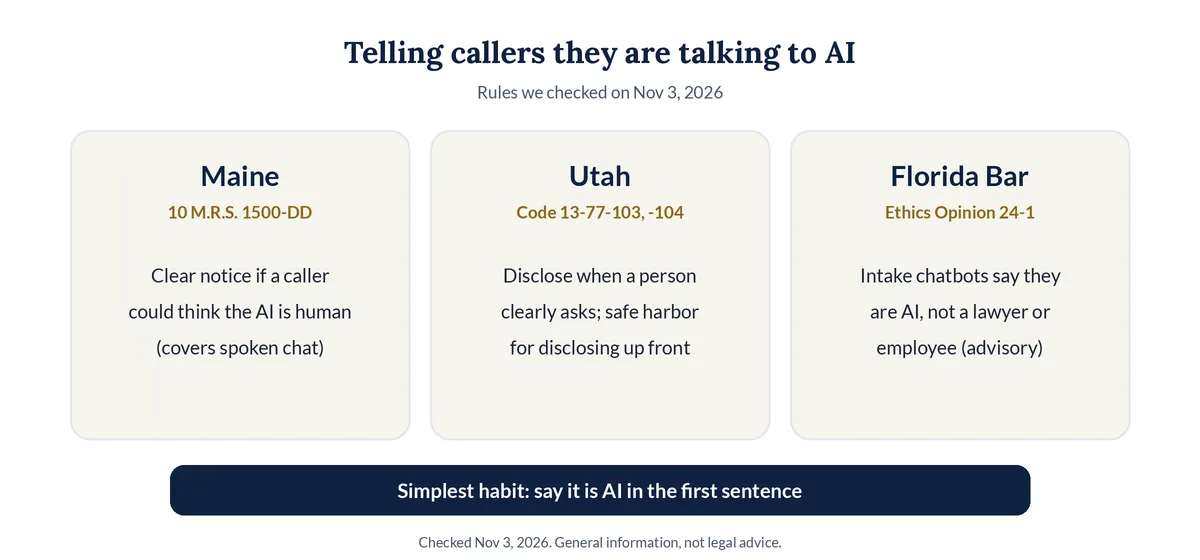
Maine and Utah have AI disclosure statutes, and Florida's bar has an ethics opinion. Maine requires a clear notice when an AI chatbot, including one that talks, could mislead a consumer into thinking it is human. Utah requires disclosure when asked. Florida Bar Opinion 24-1 says intake chatbots must tell prospective clients they are AI.
An AI call disclosure law is a statute that requires a business to tell people when they are communicating with AI instead of a person. The ones we checked:
| Rule | Who it covers | What it requires |
|---|---|---|
| Maine, 10 M.R.S. 1500-DD | Anyone using an AI chatbot, defined to include "aural communications," in trade with a consumer | A "clear and conspicuous" notice that the consumer is not engaging with a human being, if the consumer could be misled |
| Utah Code 13-77-103(1) | A supplier using generative AI in a consumer transaction | Disclose that the person is talking to generative AI when the person clearly asks |
| Utah Code 13-77-104 | Safe harbor | No enforcement action if the AI clearly discloses at the outset and throughout that it is AI |
| Florida Bar Ethics Opinion 24-1 (Jan 19, 2024) | Florida lawyers using generative AI chatbots | Inform prospective clients they are communicating "with an AI program and not with a lawyer or law firm employee" |
Sources: Maine 10 M.R.S. 1500-DD, Utah Code chapter 13-77, and Florida Bar Ethics Opinion 24-1, checked Nov 3, 2026. The Florida opinion is advisory and says so. Other states are considering similar laws, so check yours.
Does the FCC's AI voice ruling apply to calls a law firm receives?
The FCC's February 2024 ruling says AI-generated voices are "artificial" under the Telephone Consumer Protection Act, so calls made with them need the called person's prior express consent. It is about calls a business places. An AI receptionist answering a call the caller placed is a different situation that the ruling does not address.
In Declaratory Ruling FCC 24-17, adopted Feb 2, 2024 and released Feb 8, 2024, the FCC confirmed that the federal restrictions on "artificial or prerecorded voice" calls "encompass current AI technologies that generate human voices" (FCC 24-17; FCC news release). Where it matters for a firm is outbound calls: appointment reminders, callbacks, or follow-ups made with an AI voice. Before turning those on, confirm with your counsel that the consent you collect fits the calls the system will place.
What do lawyer ethics rules add to recording consent?
Ethics rules can ask for more than the statute. ABA Formal Opinion 512 says lawyers must supervise AI tools, read the vendor's terms, and never leave legal advice to AI alone. The New York City Bar has said clients should be told, and asked, before an AI system records their calls, even though New York is a one-party state.
ABA Formal Opinion 512 (July 29, 2024) says "lawyers may not leave it to GAI tools alone to offer legal advice to clients," that lawyers "should read and understand the Terms of Use, privacy policy, and related contractual terms and policies" of any generative AI tool, and that managing lawyers "must establish clear policies regarding the law firm's permissible use of GAI" (ABA Formal Opinion 512). The New York City Bar's Formal Opinion 2025-6 concluded that clients "must be notified, and their consent obtained, whenever their calls are being recorded by an AI-empowered system."
Policies a firm should set before recording intake calls:
- Who can open recordings and transcripts. Limit access to the people who need it.
- How long recordings are kept. Decide this with your attorney, including for callers whose matters you decline.
- What the AI may say. No legal advice, no predictions, and no promises that the firm will take a case.
- Who approves script changes. The attorney responsible for ethics compliance should sign off.
For what intake should and should not ask on these calls, see our guide on how to screen intake callers without losing good cases.
What should a recording notice and AI disclosure say?
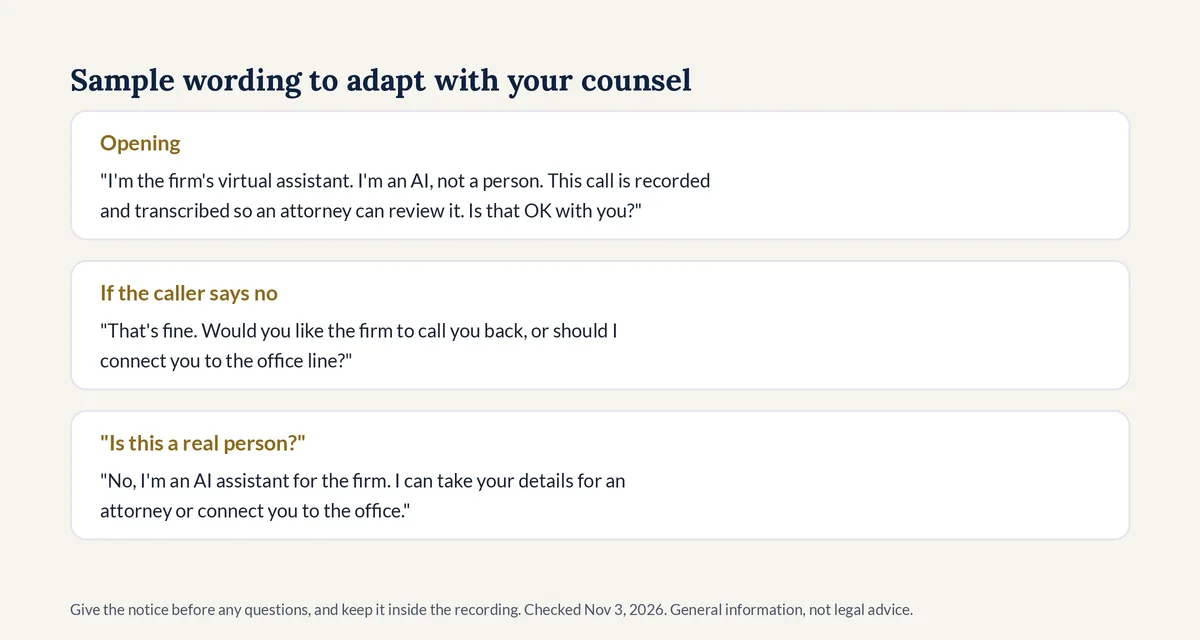
A good notice is short, comes before any questions, and covers three things: that the caller is talking to AI, that the call is recorded, and why. Then ask a yes-or-no question and wait for the answer. Use the same words on every call, keep the notice inside the recording, and have your attorney approve the final wording.
Sample wording to adapt with your counsel (replace the bracketed parts):
| Situation | Sample wording |
|---|---|
| AI receptionist opening | "Thanks for calling [Firm Name]. I'm the firm's virtual assistant. I'm an AI, not a person. This call is recorded and transcribed so an attorney can review it. Is that OK with you?" |
| Staff answering the phone | "Thanks for calling [Firm Name]. Just so you know, this call is recorded so the firm can follow up accurately. Is that all right?" |
| Caller says no | "That's fine. Would you like the firm to call you back, or should I connect you to the office line?" |
| Caller asks if it is a real person | "No, I'm an AI assistant for [Firm Name]. I can take your details for an attorney or connect you to the office." |
| Caller asks a legal question | "I can't give legal advice, but I can set up a consultation with an attorney who can. Would that help?" |
| Reminder call with an AI voice (only to people who agreed to reminders) | "This is an automated reminder from [Firm Name], using an AI voice, for [Name] about your appointment on [date] at [time]." |
Tips that make the wording work:
- Put it first. Give the notice before any intake questions.
- Only promise what your system can do. If the script offers a callback or a transfer, test that both work.
- Avoid a double notice. If your phone company already plays its own recording message, tell your provider so callers don't hear two.
- Match your callers' language. If you serve Spanish-speaking callers, have a native speaker approve a Spanish version.
How do you set up recording consent at a law firm?
Map where your callers are, adopt one notice for every call, and write the AI disclosure and the "no" path before you turn recording on. Then decide who can open recordings, check any calls the system places, and test with real calls. Confirm the final setup with your counsel or state bar before you rely on it.
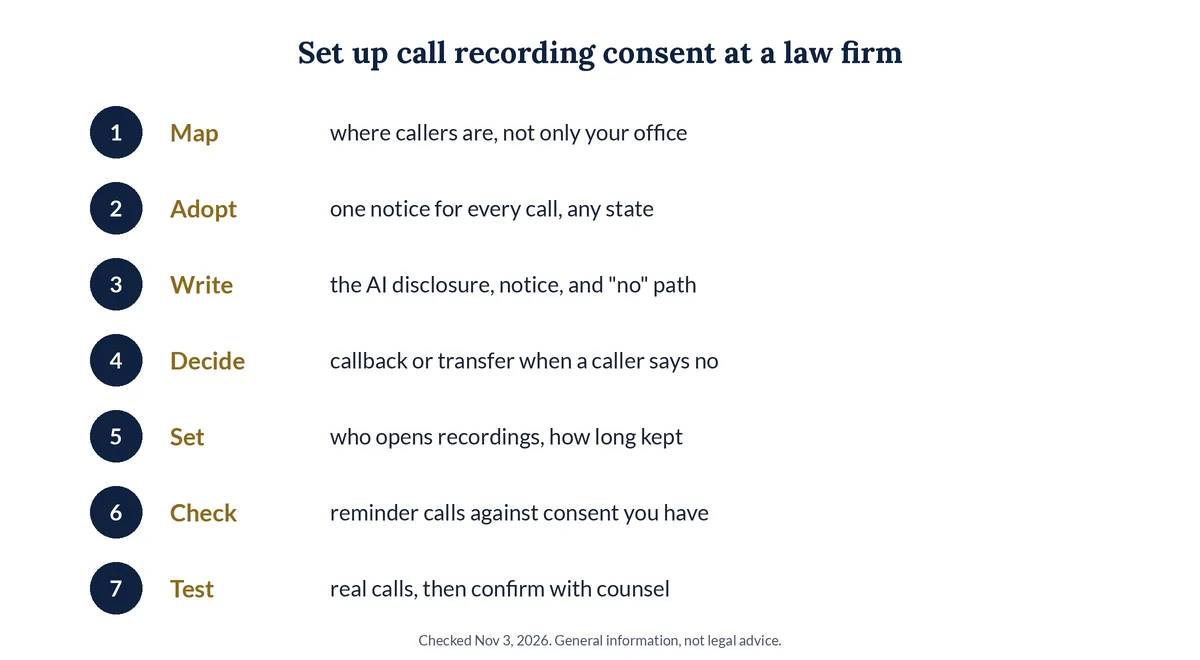
- Map where your callers are, not only where your office is, using the addresses from past intake.
- Adopt one rule for every call: an AI disclosure and a recording notice at the start, whatever the caller's state.
- Write the notice, the AI disclosure, and the wording for callers who decline, and have the responsible attorney approve them.
- Decide what happens when a caller says no, such as a callback or a transfer to the office line.
- Set who can open recordings and transcripts, and how long they are kept.
- Check any calls the system places, such as reminders, against the consent you collected.
- Test with real calls, listen for the notice in each recording, and confirm the rules with your counsel or state bar.
How does Legal Touch AI handle recording notices and AI disclosure?
Legal Touch AI opens every call with an AI disclosure and a recording notice: "I'm the firm's AI assistant, not a person. This call is recorded so the firm can follow up with you. Is that OK?" If a caller says no, it follows the option you chose at setup, such as a short message or your office line.
What our live site says, from our home page, pricing page, and our step-by-step look at a Legal Touch AI call:
- AI disclosure. It says it is your firm's AI assistant in its first sentence.
- Recording notice. Every call starts with a recording notice, because California and several other states require consent from everyone on the call.
- Written with you. On the Done for You plans, setup includes your greeting, AI disclosure, recording notice, and screening questions, written with you.
- Access. Recording and transcript access follow your configured settings.
- Limited outbound calls. It answers incoming calls. The only calls it places are reminders to people who booked with you or asked for a callback, and only if you turn that on.
- Your records. How long recordings are kept, and how you export or delete them, will be set in the service agreement.
Legal Touch AI plans start at $149 a month. See Legal Touch AI plans and pricing for what each plan includes. For how AI receptionists fit a small firm's phones day to day, read our plain guide to what changes when an AI receptionist answers your firm's calls, and for short answers to 25 common questions, see our AI receptionist FAQ for small law firms. To see how other providers describe their recording features, start with our comparison of legal answering services and AI receptionists.
Why we wrote this guide
We set up Legal Touch AI on our own phone lines first, before offering it to small law firms. We wrote this guide because callers reach small firms from every state, and the recording lists we found online disagreed on a handful of states. So we read each statute ourselves and wrote down what we found. You can read more about the people behind Legal Touch AI.
Hear the notice yourself. Book a free 15-minute Legal Touch AI demo. We'll show you a live call, including the AI disclosure and the recording notice, and answer your questions.
Frequently asked questions
Is it legal for a law firm to record calls with clients?
Yes, if the firm follows the consent rule that applies. A firm on the call can record in one-party states, but 11 states require everyone's consent, and ethics opinions may expect more. Telling callers at the start and asking whether that is OK is the simplest way to meet both. Confirm your own state's rules with counsel.
If my firm is in a one-party state, do I still need a recording notice?
Your state's statute may not require one, but your callers may be somewhere else. California's Supreme Court applied its all-party law to calls recorded by a Georgia office, and a cell phone's area code doesn't show where a caller is. A short notice on every call avoids guessing and fits ethics guidance on AI recording.
Does a caller have to say yes for recording consent to count?
Not always by statute. Washington treats a recorded announcement as consent, and Connecticut accepts a verbal notice recorded at the start. Other states are less clear about callers who stay on the line. Asking "Is that OK?" and waiting for an answer gives you a clear record, and a caller who says no should get another option.
Do I have to tell callers they are talking to an AI receptionist?
In some places, yes. Maine requires a clear notice when an AI chatbot could mislead a reasonable consumer into thinking it is human, Utah requires disclosure when a person asks, and Florida Bar Opinion 24-1 expects intake chatbots to say they are AI. Saying it in the first sentence of every call works in every state.
Which states are two-party consent states for phone calls?
By our reading of the statutes, 11 states require all parties' consent for phone calls: California, Connecticut, Florida, Illinois, Maryland, Massachusetts, Montana, Nevada, New Hampshire, Pennsylvania, and Washington. Delaware and Michigan are unsettled. Some lists add or drop states because Connecticut, Nevada, and Oregon treat phone calls and in-person conversations differently.
Legal Touch AI is not a law firm and does not provide legal advice. This article is general information, not legal advice, and is not a complete statement of any state's law. Statutes have exceptions, courts interpret them, and laws change, so confirm the rules that apply to your firm with your own counsel or your state bar. Using Legal Touch AI does not create an attorney-client relationship.
Sources (checked Nov 3, 2026)
- 18 U.S.C. 2511 (GovInfo): https://www.govinfo.gov/content/pkg/USCODE-2023-title18/html/USCODE-2023-title18-partI-chap119-sec2511.htm
- California Penal Code section 632: https://leginfo.legislature.ca.gov/faces/codes_displaySection.xhtml?lawCode=PEN§ionNum=632
- California Penal Code section 632.7: https://leginfo.legislature.ca.gov/faces/codes_displaySection.xhtml?lawCode=PEN§ionNum=632.7
- Connecticut General Statutes section 52-570d (FindLaw copy of the official code): https://codes.findlaw.com/ct/title-52-civil-actions/ct-gen-st-sect-52-570d/
- Connecticut General Statutes section 53a-187 (FindLaw copy of the official code): https://codes.findlaw.com/ct/title-53a-penal-code/ct-gen-st-sect-53a-187/
- Delaware Code title 11, section 2402: https://delcode.delaware.gov/title11/c024/sc01/index.html
- Delaware Code title 11, section 1335: https://delcode.delaware.gov/title11/c005/sc07/index.html
- Florida Statutes section 934.03: https://www.flsenate.gov/Laws/Statutes/2025/934.03
- Illinois 720 ILCS 5/14-2: https://www.ilga.gov/legislation/ilcs/fulltext.asp?DocName=072000050K14-2
- Maryland Courts and Judicial Proceedings section 10-402: https://mgaleg.maryland.gov/mgawebsite/Laws/StatuteText?article=gcj§ion=10-402&enactments=false
- Massachusetts General Laws chapter 272, section 99: https://malegislature.gov/Laws/GeneralLaws/PartIV/TitleI/Chapter272/Section99
- Michigan Compiled Laws section 750.539a: https://www.legislature.mi.gov/Laws/MCL?objectName=mcl-750-539a
- Michigan Compiled Laws section 750.539c: https://www.legislature.mi.gov/Laws/MCL?objectName=mcl-750-539c
- Montana Code section 45-8-213: https://archive.legmt.gov/bills/mca/title_0450/chapter_0080/part_0020/section_0130/0450-0080-0020-0130.html
- Nevada Revised Statutes section 200.620 (FindLaw copy of the official code): https://codes.findlaw.com/nv/title-15-crimes-and-punishments/nv-rev-st-200-620/
- New Hampshire RSA 570-A:2: https://gc.nh.gov/rsa/html/LVIII/570-A/570-A-2.htm
- Oregon Revised Statutes section 165.540 (FindLaw copy of the official code): https://codes.findlaw.com/or/title-16-crimes-and-punishments/or-rev-st-sect-165-540/
- Pennsylvania 18 Pa. Cons. Stat. section 5704 (FindLaw copy of the official code): https://codes.findlaw.com/pa/title-18-pacsa-crimes-and-offenses/pa-csa-sect-18-5704/
- Washington RCW 9.73.030: https://app.leg.wa.gov/RCW/default.aspx?cite=9.73.030
- One-party state statutes listed in the table: read on Nov 3, 2026 on each state's legislature website or on FindLaw's copy of the official code
- Kearney v. Salomon Smith Barney, Inc., California Supreme Court, S124739 (July 13, 2006): https://scocal.stanford.edu/opinion/kearney-v-salomon-smith-barney-33656/
- Lane v. Allstate Insurance Co., Nevada Supreme Court (1998): https://law.justia.com/cases/nevada/supreme-court/1998/25670-1.html
- Ditech Financial LLC v. Buckles, Nevada Supreme Court (Sept 14, 2017): https://law.justia.com/cases/nevada/supreme-court/2017/70475.html
- Sullivan v. Gray, Michigan Court of Appeals (1982): https://law.justia.com/cases/michigan/court-of-appeals-published/1982/57301.html
- Fisher v. Perron, U.S. Court of Appeals for the Sixth Circuit (Mar 23, 2022): https://law.justia.com/cases/federal/appellate-courts/ca6/21-1184/21-1184-2022-03-23.html
- Justia, Recording Phone Calls and Conversations: 50-State Survey (cross-check for Delaware and Vermont): https://www.justia.com/50-state-surveys/recording-phone-calls-and-conversations/
- FCC Declaratory Ruling FCC 24-17, CG Docket No. 23-362 (adopted Feb 2, 2024, released Feb 8, 2024): https://docs.fcc.gov/public/attachments/FCC-24-17A1.pdf
- FCC news release on AI-generated voices (Feb 8, 2024): https://docs.fcc.gov/public/attachments/DOC-400393A1.pdf
- ABA Formal Opinion 512 (July 29, 2024): https://www.americanbar.org/content/dam/aba/administrative/professional_responsibility/ethics-opinions/aba-formal-opinion-512.pdf
- Florida Bar Ethics Opinion 24-1 (Jan 19, 2024): https://www.floridabar.org/etopinions/opinion-24-1/
- Utah Code chapter 13-77: https://le.utah.gov/xcode/Title13/Chapter77/C13-77_2025050820250508.pdf
- Maine Revised Statutes title 10, section 1500-DD: https://legislature.maine.gov/statutes/10/title10sec1500-DD-1.html
- New York City Bar, Formal Opinion 2025-6 (Dec 22, 2025; quote as read for our Oct 30, 2026 ethics guide, site unavailable Nov 3): https://www.nycbar.org/reports/formal-opinion-2025-6-ethical-issues-affecting-use-of-ai-to-record-transcribe-and-summarize-conversations-with-clients/
- Legal Touch AI home: https://legaltouchai.com/
- Legal Touch AI how it works: https://legaltouchai.com/how-it-works/
- Legal Touch AI pricing: https://legaltouchai.com/pricing/