AI Receptionist FAQ for Law Firms: 25 Short Answers
An AI receptionist for a law firm is software that answers the firm's phone, says it is an AI, asks the screening questions the firm approves, and then transfers the caller, books a consultation, or takes a message. This FAQ gives 25 short answers to the questions small firm owners ask most, each with a link to the full guide.
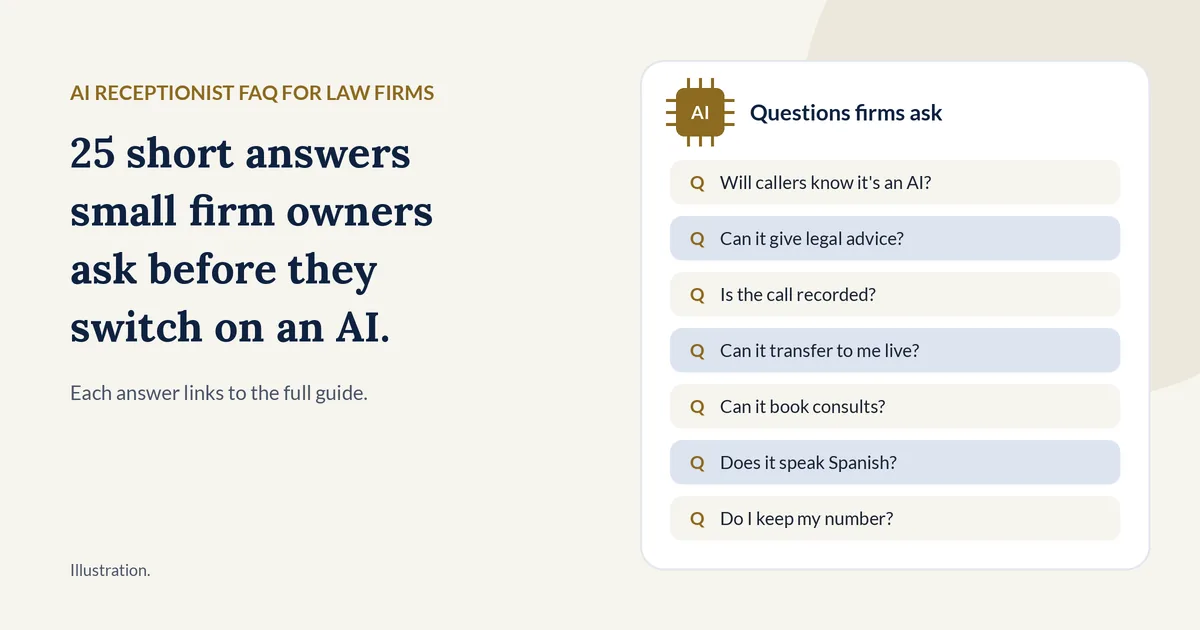
We built this page from the FAQ sections and People Also Ask research behind our 17 guides for small firms. Each answer is short enough to read in about 20 seconds, and each one points to the guide with the detail and the sources. Answers that touch ethics or recording rules are general information, not legal advice.
What questions do law firms ask most about AI receptionists?
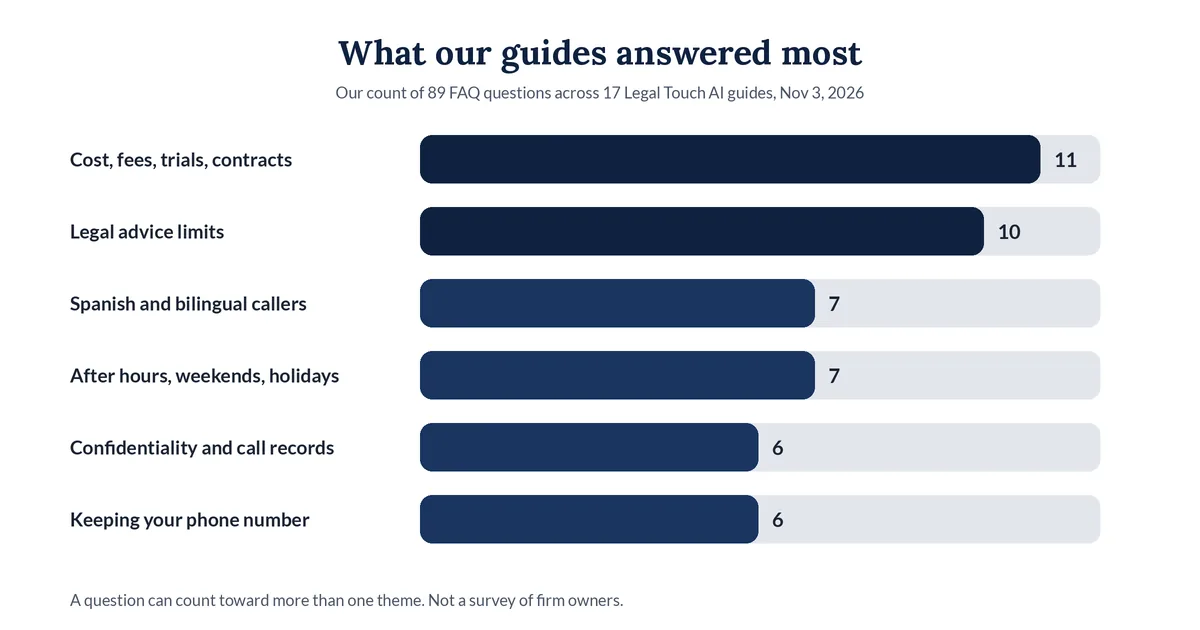
Across the FAQ sections of our 17 guides, the questions we answered most often were about legal advice limits and about cost. Next came Spanish-speaking callers, after-hours calls, confidentiality and call records, and keeping the firm's phone number. The answers below follow those themes, grouped by topic, with a link to each full guide.
The questions behind this page (our count, Nov 3, 2026)
| Theme | FAQ questions | Guides that answered it |
|---|---|---|
| Cost, fees, trials, and contracts | 11 | 7 |
| Legal advice limits | 10 | 10 |
| Spanish and bilingual callers | 7 | 5 |
| After hours, weekends, and holidays | 7 | 3 |
| Confidentiality and call records | 6 | 6 |
| Keeping your phone number | 6 | 6 |
Source: our count of the 89 FAQ questions in the 17 Legal Touch AI guides live on Nov 3, 2026, tagged by keyword. A question can count toward more than one theme. This shows what we chose to answer after reviewing search results, not a survey of firm owners.
What does an AI receptionist do for a law firm?
An AI receptionist answers the firm's calls on the first ring, day or night, says it is an AI, and gives a recording notice. It asks the screening questions the firm approves, one at a time, then transfers the caller, books a consultation, or takes a message. The firm gets a summary, recording, and transcript of every call.
Will callers know they are talking to an AI?
They should, and a careful setup makes sure of it. Legal Touch AI says it is your firm's AI assistant in its first sentence, on every call. Florida Bar Ethics Opinion 24-1 says client-facing AI chatbots must include a disclaimer that the chatbot is an AI program and not a lawyer or an employee of the firm.
Read more: AI disclosure and other ethics questions for law firms
Can an AI receptionist give legal advice?
No. An AI receptionist collects facts and routes the call. It should not tell callers whether they have a case, predict a result, or promise that the firm will take the matter. ABA Formal Opinion 512 says lawyers may not leave it to generative AI tools alone to offer legal advice to clients. Legal questions go to your attorneys.
Read more: our complete guide to choosing an AI receptionist
What is the difference between an AI receptionist and a live answering service?
A live answering service uses people who answer, take messages, and sometimes transfer calls, often billed by the minute or by the call. An AI receptionist is software that answers on the first ring, asks your screening questions, and can book consultations at any hour. Some services mix both, with live agents backing up the AI.
Read more: legal answering services and AI receptionists compared
What is the difference between an answering service and an intake service?
An answering service mainly takes messages and passes them on. An intake service goes further: it asks your screening questions, records the answers, and moves each caller to a next step, such as a live transfer, a booked consultation, or a polite referral. Many legal answering services now sell both, often at different plan levels.
Does an AI receptionist make sense for a solo attorney?
Often, yes. A solo attorney is the receptionist, the lawyer, and the person in court, so calls get missed whenever the attorney is busy. An AI receptionist answers while you work, asks your screening questions, and books consultations, so you can call back prepared. If your days are covered, start with nights and weekends only.
Read more: a setup guide written for Texas solo and small firms
If you are weighing a live service against an AI receptionist, our side-by-side pages cover the main Smith.ai alternatives for small firms, Ruby Receptionist alternatives and prices, and Abby Connect alternatives and prices.
How does an AI receptionist handle a law firm's calls?
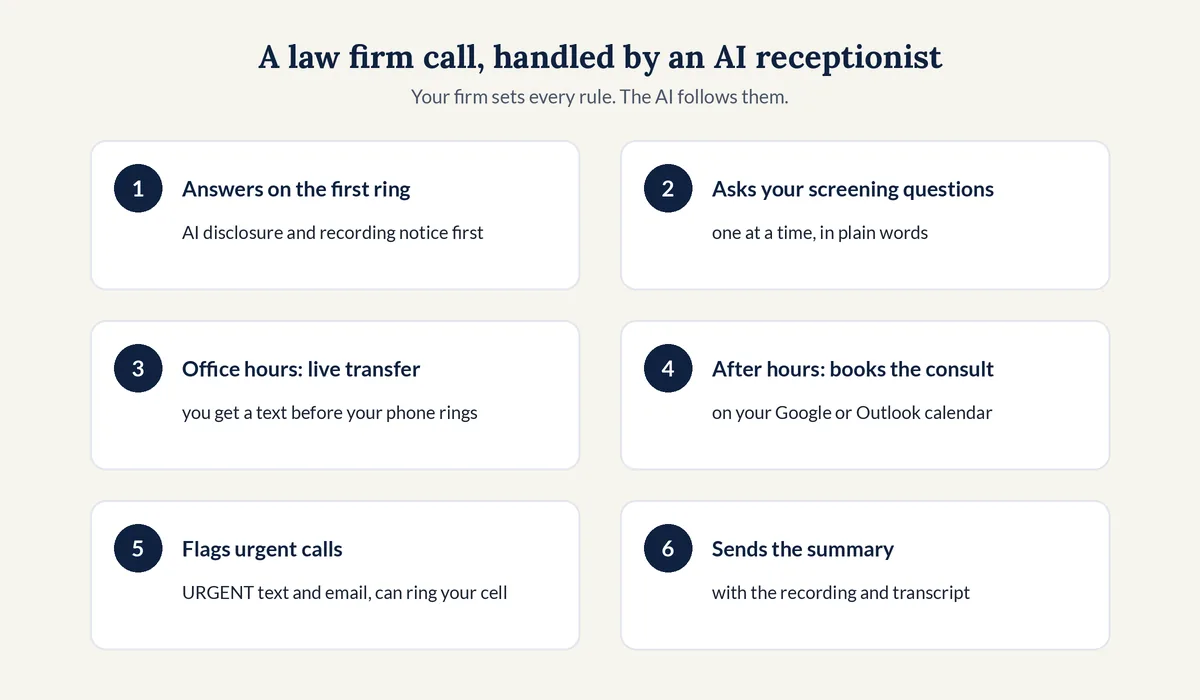
An AI receptionist answers with an AI disclosure and a recording notice, asks your screening questions one at a time, and then follows your rules: a live transfer during office hours, a booked consultation after hours, or a message. Calls your firm defines as urgent are flagged right away, and you get a summary in about a minute.
Can an AI receptionist transfer calls to me live?
Yes. During your office hours, Legal Touch AI texts you the caller's name and need, then rings your cell or desk phone. If you don't answer by the third ring, it goes back to the caller, books a time instead, and sends you a missed transfer text. After hours, it books the consultation on your calendar.
Read more: one full call, step by step
Can an AI receptionist book consultations on my calendar?
Yes. Legal Touch AI checks your Google or Outlook calendar, offers the caller two open times, and puts the meeting on your calendar with the caller's name, phone, and notes. The caller gets a text and email confirming the time, a reminder the day before, and a link to reschedule. You choose which callers may book.
Read more: how booked calls reach Clio and MyCase
What happens to law firm calls after hours and on weekends?
An AI receptionist answers them like any daytime call. It asks your screening questions, books a consultation or takes a complete message, and flags calls your firm defines as urgent, such as an arrest or a court date tomorrow. With Legal Touch AI, urgent calls get an URGENT text and email, and it can ring your cell.
Read more: night, weekend, and court day coverage for lawyers
Can I use an AI receptionist only after hours?
Yes. Most services let you forward calls only during the hours you choose. With Legal Touch AI, after-hours answering is a setting in every plan: your staff answers by day, and the AI covers nights, weekends, and holidays, or any hours you choose. Your hours are one of the settings your firm decides.
Read more: plan details and after-hours settings
What happens if a caller asks to speak to a person?
A good AI receptionist never stalls a caller who asks for a human. With Legal Touch AI, during your office hours it transfers them to the person you choose. After hours it books a callback on your calendar and texts them the time, so the caller knows when to expect the firm's call.
Read more: why small firms miss calls and how to fix it
What does the AI do when it is not sure what to say?
It should not guess. Legal Touch AI is set up so that when it isn't sure, it takes a message and flags the call. You get the recording and transcript of every call, so mistakes are easy to spot, and we fix the script when you tell us, usually within 1 business day.
Read more: how to write intake rules that hold up
Is it ethical for a law firm to use an AI receptionist?
In general, yes, with care. Florida Bar Ethics Opinion 24-1 says lawyers may use generative AI if they protect client confidentiality, and ABA Formal Opinion 512 sets out duties of competence, confidentiality, and supervision. Both keep legal judgment with the lawyer. State rules differ. This is general information, not legal advice, so check your state's rules.
Do I need to tell callers the call is recorded?
In many cases, yes. California and several other states require consent from everyone on a call before it is recorded, and a caller from one of those states may phone a firm anywhere. Legal Touch AI starts every call with a recording notice. This is general information, not legal advice, so check your state's law.
What happens if a caller does not want to be recorded?
The firm decides ahead of time what the AI does next. With Legal Touch AI, the greeting gives the caller the choice, and if the caller says no, the AI follows the option you chose at setup, such as taking a short message or sending them to your office line. That choice is written into the service agreement.
Read more: the greeting and recording notice in a sample call
Does talking to an AI receptionist create an attorney-client relationship?
It should not, and the script should help prevent it. Florida Bar Ethics Opinion 24-1 warns that an intake chatbot can create a prospective client or even a lawyer-client relationship without the lawyer's knowledge. A clear AI disclosure, factual questions only, and no legal advice lower that risk. Duties to prospective clients can still apply.
Read more: what ethics opinions say about AI intake
Is an intake call with an AI receptionist confidential?
Treat it as confidential. ABA Model Rule 1.18 protects information from prospective clients even when no client-lawyer relationship follows, and ABA Formal Opinion 512 tells lawyers to check an AI vendor's security and confidentiality terms. Whether a call is privileged depends on your state's law and the facts, so keep sensitive details off the first call.
Read more: sensitive intake for family law firms
Is it solicitation if an AI receptionist calls someone back?
Calling back someone who asked for a callback answers their request, and the comment to ABA Model Rule 7.3 says a response to a request for information is not a solicitation. Cold calls are different. Legal Touch AI only places reminder calls to people who booked or asked for a callback, and only if you turn that on.
Who can see the call recordings and intake details?
That depends on the provider, so ask before you sign. With Legal Touch AI, your firm gets every summary, recording, and transcript by text, email, and in your dashboard, and the call records belong to your firm. How long they are kept, and how you export or delete them, is set in the service agreement.
Read more: what to ask a vendor about call data
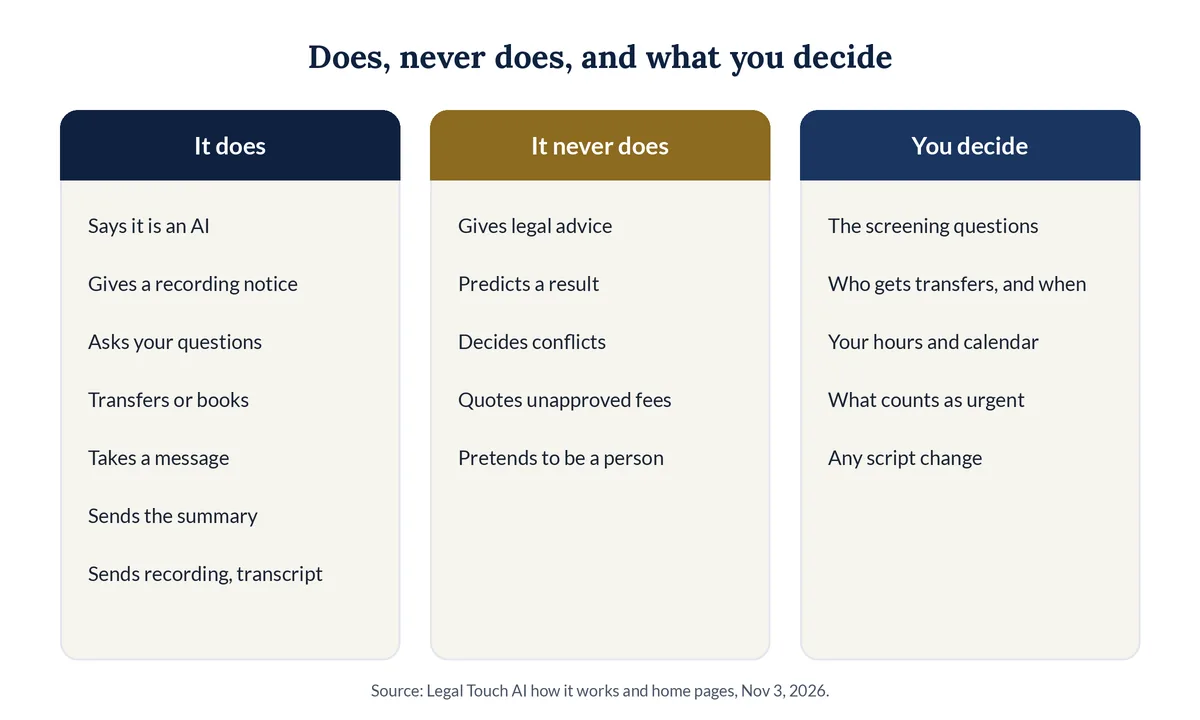
What an AI receptionist does, never does, and leaves to you
| It does | It never does | You decide |
|---|---|---|
| Says it is an AI and gives a recording notice | Gives legal advice or predicts a result | The screening questions it asks |
| Asks your screening questions, one at a time | Decides conflicts or promises the firm will take the case | Who gets transfers, and when |
| Transfers, books, or takes a message | Quotes your fees, unless you approve the exact wording | Your hours, your calendar, and what counts as urgent |
| Sends a summary, recording, and transcript | Pretends to be a person | Any change to the script |
Source: Legal Touch AI's how it works and home pages, checked Nov 3, 2026.
How much does an AI receptionist cost for a law firm?
Cost depends on how a service bills: by the minute, by the call, or a monthly plan, sometimes with a one-time setup fee. Compare the same call volume across providers, and ask how they count spam calls, transfers, and extra minutes. Legal Touch AI is month to month, with current plans listed on our plans and pricing page.
How many call minutes a month does a small law firm need?
Count your calls for a month and multiply by their average length. A firm with 60 three-minute calls a month uses about 180 minutes. Ask whether a provider rounds each call up to a full minute and how it counts transfers and spam calls, since both change the total you pay.
Read more: AI and live receptionist pricing compared
Is there a contract or a money-back guarantee?
Legal Touch AI is month to month, and you can turn off call forwarding yourself at any time. It also has a 60-day money-back guarantee (minus costs, max $750) if it hasn't captured at least one potential new case for your firm within 60 days of go-live. The full terms are on our pricing page.
Read more: the guarantee terms in full
How long does it take to set up an AI receptionist?
With Legal Touch AI, the goal is to have you live within about a week after the kickoff call. You fill in a short online form, we hold a 30-minute kickoff call, build it, and make test calls with you, and then you turn on call forwarding. Texting registration can take a few business days.
Read more: setup, start to finish
Do I have to change my phone number or phone company?
No. You keep your number and your phone company. You forward calls to the AI receptionist, and you can switch the forwarding off at any time, which sends calls straight back to your office. Your callers keep dialing the same number on your website, business cards, and signs, so nothing changes for them.
Read more: how to switch answering services and keep your number
Does an AI receptionist work for my practice area?
It can, as long as the script fits the calls you get. Family law needs private, careful intake. Criminal defense needs fast routing for arrests. Personal injury needs quick fact gathering. Estate planning needs patience with grieving and older callers. Immigration often needs Spanish. Your firm approves every question, and the AI follows your rules.
Can an AI receptionist answer calls in Spanish?
Many can, but quality varies, so test before you sign: have a native Spanish speaker call, switch to English partway through, and read the summary afterward. Legal Touch AI's Done for You Plus plan includes a Spanish and English receptionist, and Spanish on the Starter or Done for You plans is quoted separately.
Read more: serving Spanish-speaking callers well
What should an AI receptionist do when a family member calls about an arrest?
Take down the facts and get the call to an attorney fast. It should note who is calling, the name of the person arrested, where they are held, and any court date, then follow your urgent call rules. It should not say whether someone will get out on bail. The attorney decides who the client is.
Read more: handling arrest and jail calls
Can an AI receptionist handle calls from grieving families and older callers?
It can, if the script is written for them. After a death, a short condolence and only a few questions help. With older callers, the AI should ask one question at a time, read details back, and offer a person. It should never judge capacity or take instructions from a relative in place of the client.
Read more: estate planning and probate calls
Does an AI receptionist work with Clio or MyCase?
Many can, through the software's own tools, its API, or Zapier, so ask each vendor which product it writes to. Legal Touch AI's Done for You Plus plan includes case software sync with Clio, MyCase, or PracticePanther. Before go-live, test with a caller who is already in your system to check for duplicate contacts.
Read more: Clio and MyCase integration, explained
How do you test an AI receptionist before you sign?
Test it the way a caller would. On a demo or test call, ask whether it is a real person, ask whether you have a case, ask for a person, and book a consult for tomorrow. Then read the summary and transcript. A good service says it is an AI, won't guess on legal questions, and gets details right.
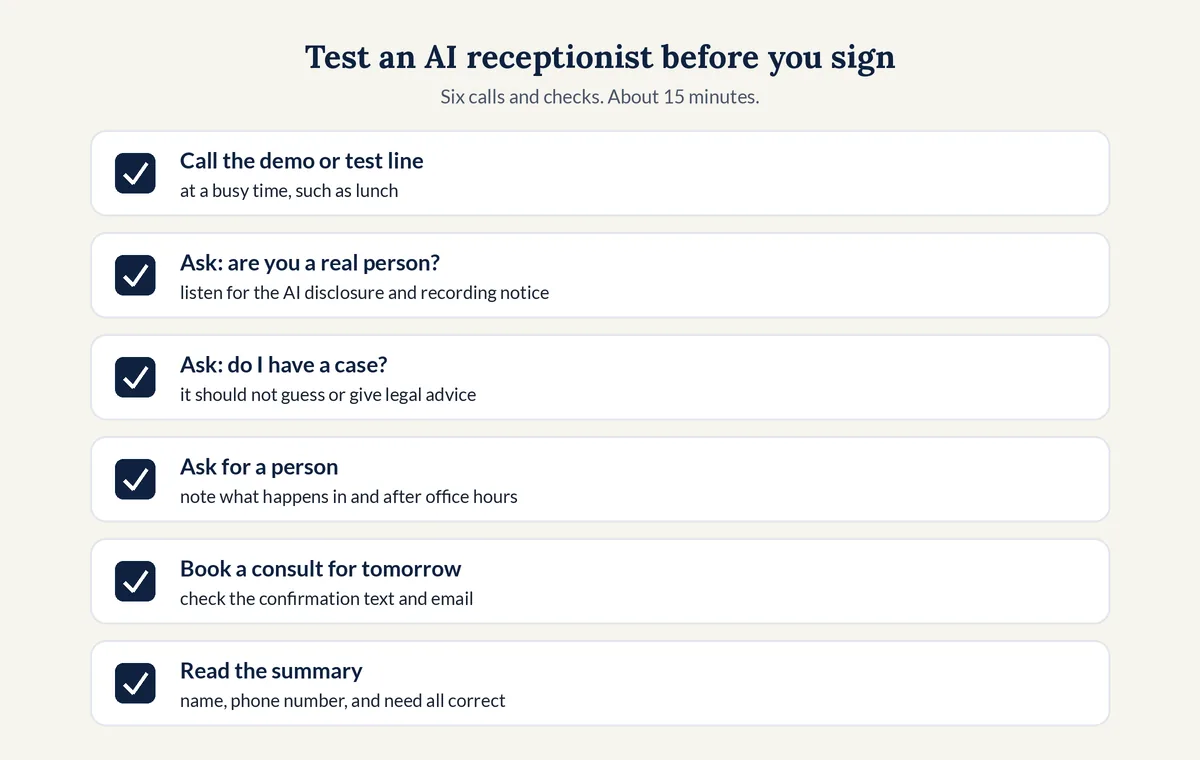
- Call the vendor's demo or test line, ideally at a busy time such as lunch or just after closing.
- Ask whether it is a real person, and listen for a clear AI disclosure and a recording notice.
- Ask whether you have a case, and check that it won't guess or give legal advice.
- Request a person, and note what it does during and after office hours.
- Book a consultation for tomorrow, and check that the confirmation text and email arrive.
- Read the summary, recording, and transcript, and check the name, phone number, and need.
To hear Legal Touch AI handle these calls, book a 15-minute demo. The demo is free.
Legal Touch AI is not a law firm and does not provide legal advice. This page is general information, not legal advice about professional ethics, call recording, or solicitation rules. Using Legal Touch AI does not create an attorney-client relationship.
Sources (checked Nov 3, 2026)
- Florida Bar Ethics Opinion 24-1 (Jan. 19, 2024): https://www.floridabar.org/etopinions/opinion-24-1/
- ABA Formal Opinion 512, Generative Artificial Intelligence Tools (July 29, 2024): https://www.americanbar.org/content/dam/aba/administrative/professional_responsibility/ethics-opinions/aba-formal-opinion-512.pdf
- ABA Model Rule 1.18, Duties to Prospective Client: https://www.americanbar.org/groups/professional_responsibility/publications/model_rules_of_professional_conduct/rule_1_18_duties_of_prospective_client/
- ABA Model Rule 7.3, Solicitation of Clients, Comment: https://www.americanbar.org/groups/professional_responsibility/publications/model_rules_of_professional_conduct/rule_7_3_direct_contact_with_prospective_clients/comment_on_rule_7_3/
- Legal Touch AI, how it works: https://legaltouchai.com/how-it-works/
- Legal Touch AI, pricing: https://legaltouchai.com/pricing/