Why Law Firms Miss Calls (and What It Costs): Fixes for Small Firms
A law firm missed call is any call to the firm that no one answers live, including calls that ring out, go to voicemail, hit a busy signal, or end when the caller hangs up on hold or in a phone menu. This guide explains why small firms miss calls, what those calls can cost, and eight steps to stop missing client calls, with sources checked on Oct 31, 2026.
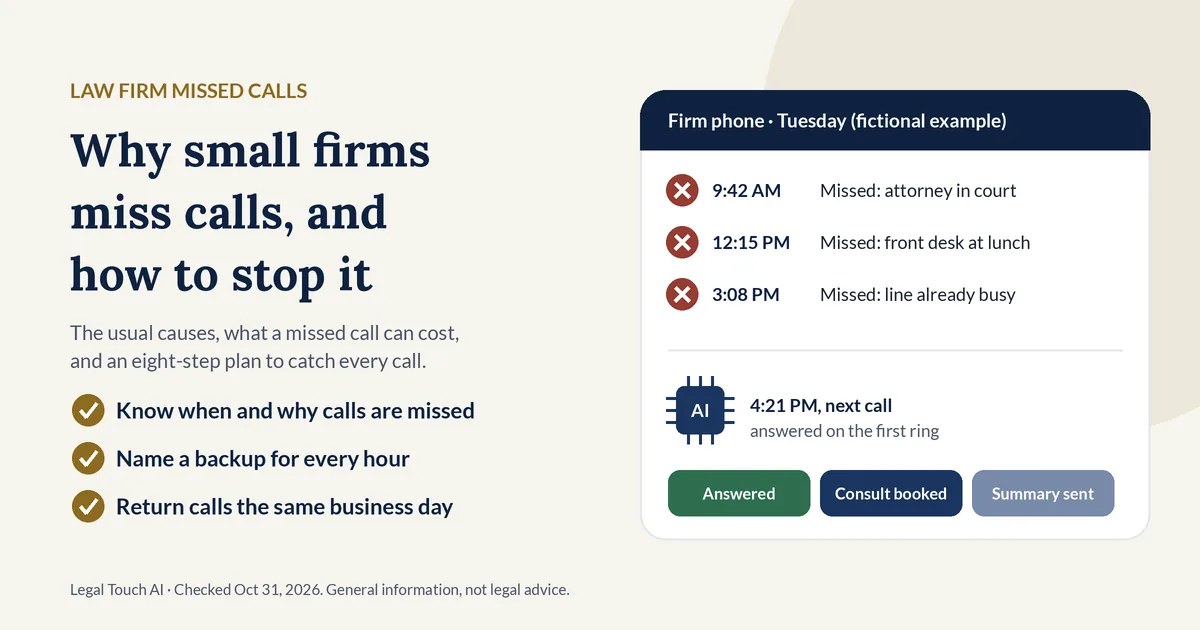
Why it matters: in a secret-shopper study published in Clio's 2019 Legal Trends Report, a research firm called law firms as a potential client would. A person answered 56% of the calls and 39% went to voicemail, and more than half of the firms didn't respond to their voicemails within 72 hours. In the same report, 79% of surveyed consumers said they expected a response within 24 hours (Clio press release, Oct 21, 2019).
What counts as a missed call at a law firm?
A missed call at a law firm is any call that doesn't reach a person or system able to help right away. That includes calls that ring out, go to voicemail, get a busy signal, drop during a transfer, or end when the caller gives up on hold. After-hours calls count too.
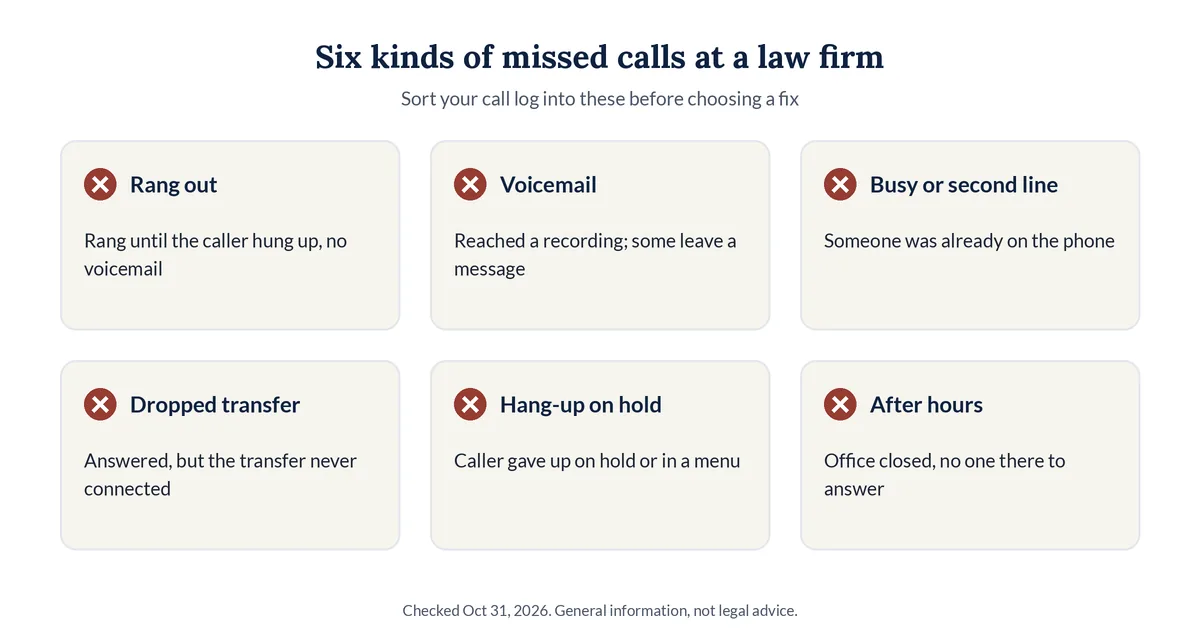
Six kinds of missed calls can show up in a small firm's phone log:
- Rang out. The phone rang until the caller hung up, with no voicemail.
- Voicemail. The caller reached a recording. Some leave a message and some don't.
- Busy or second line. Someone was already on the phone, and the next caller got a busy signal or voicemail.
- Dropped transfer. Someone answered, tried to transfer, and the call never connected.
- Hang-up on hold or in a menu. The caller gave up before anyone picked up.
- After hours. The office was closed, so every call went unanswered by design.
Each one has a different fix, which is why it helps to sort them before buying anything. For a full overview of how AI phone answering fits into a firm, see our complete guide to AI receptionists for law firms.
Why do law firms miss so many calls?
Law firms miss calls mostly because the people who answer are busy doing legal work. Attorneys are in court, depositions, or client meetings. Small staffs take lunch, step away, or are already on another line. And for most of the week the office is closed. Few firms miss calls on purpose. The phones simply have no backup.
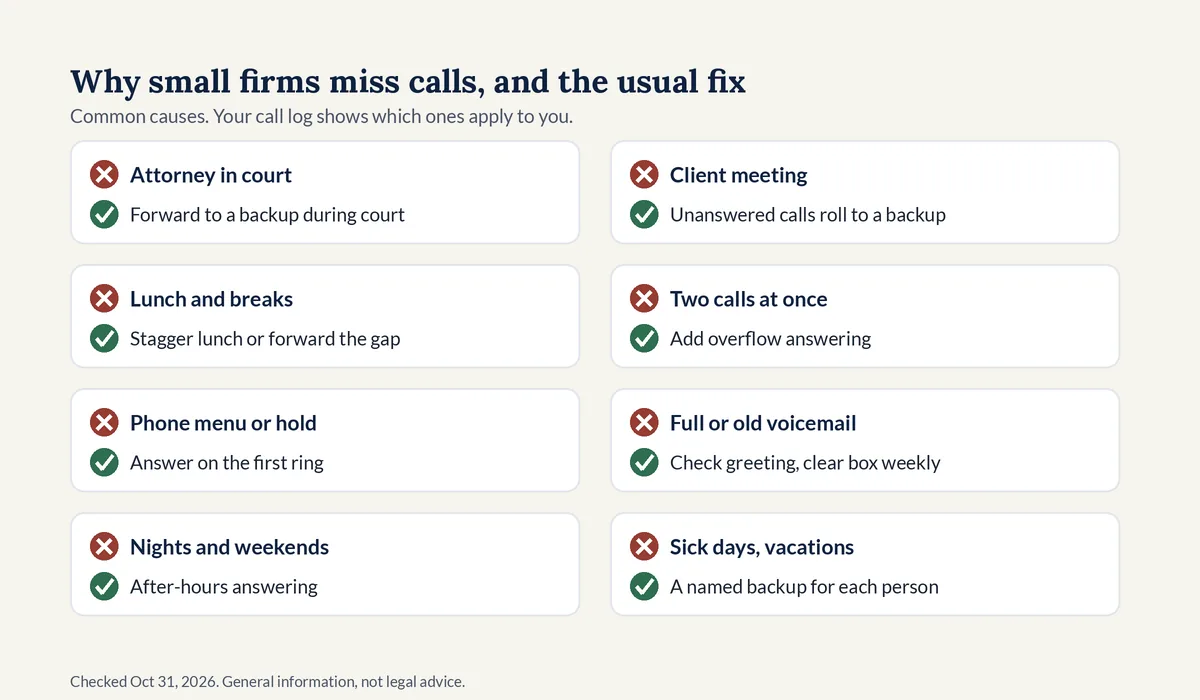
Common causes of missed calls at small firms, and the fix that usually works:
| Cause | What happens to the caller | Usual fix |
|---|---|---|
| Attorney in court or a deposition | Phone is off, call rings out or goes to voicemail | Forward to a backup or service during court time |
| Client meeting or focused work | Attorney lets the call ring | Route unanswered calls after a few rings to a backup |
| Lunch and breaks | Front desk is empty for an hour | Stagger lunch or forward during the gap |
| Two calls at once | Second caller hears a busy signal or voicemail | Add overflow answering for busy lines |
| Phone menu or long hold | Caller gives up before reaching anyone | Shorten or remove the menu; answer on the first ring |
| Full or outdated voicemail box | Caller can't leave a message or hears old hours | Check the greeting and clear the box weekly |
| Nights, weekends, holidays | No one is there | After-hours answering or a clear callback promise |
| Sick days and vacations | Coverage quietly disappears | Name a backup for every person who answers |
By hours, closed time is the biggest gap: a 9 to 5 front desk is empty for 128 or more of the 168 hours in a week (see the coverage table below). Our guide to after-hours answering for nights, weekends and court days covers that part in depth, including how many hours a typical office is closed in a year.
How many calls do law firms miss?
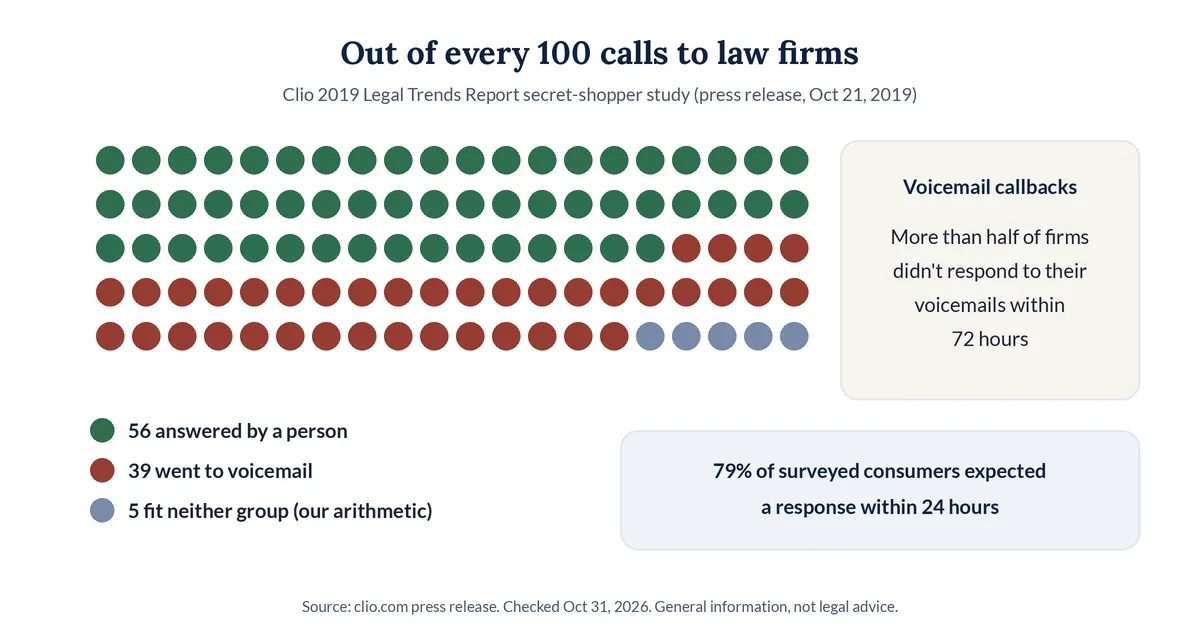
The best-known public measure comes from Clio's 2019 Legal Trends Report: in a secret-shopper study of law firms, a person answered 56% of phone calls and 39% went to voicemail. More than half of the firms didn't respond to their voicemails within 72 hours. Your own rate may be higher or lower, so check your call log.
Here is what those published rates mean for every 100 calls, using Clio's numbers. The last row is our arithmetic, not a Clio figure:
| Out of every 100 calls in Clio's 2019 study | Calls | Source |
|---|---|---|
| Answered by a person | 56 | Clio press release |
| Went to voicemail | 39 | Clio press release |
| Neither answered by a person nor sent to voicemail | 5 | Our arithmetic (100 minus 56 minus 39); the release doesn't describe these calls |
Two cautions. The study is from 2019, and it measured calls from potential clients, not current clients. It is still the most widely cited public measure. For your firm, the number that matters is the one in your own call log, which the steps below show how to pull.
What does a missed call cost a law firm?
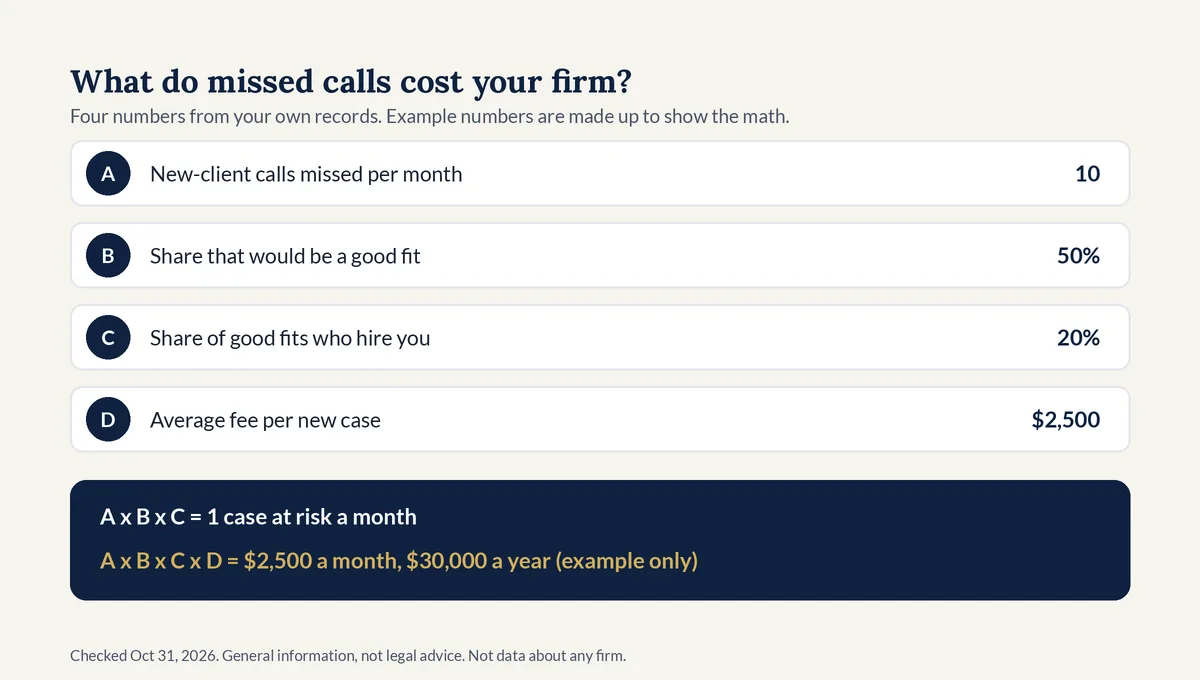
A missed call costs a law firm the fee from any case it would have signed, plus the time spent chasing callers who already moved on. No public study gives one dollar figure that fits every firm. You can estimate your own with four numbers: missed new-client calls, share that fit, share that hire, and average fee.
Use this worksheet with numbers from your own records. The example column uses made-up round numbers only to show the math. They are not data about any firm.
| Step | Your number | Example (made up, to show the math) |
|---|---|---|
| A. New-client calls missed in a month (from your call log) | ____ | 10 |
| B. Share of those callers who would have been a good fit | ____ | 50% |
| C. Share of good-fit callers who usually hire you after a consultation | ____ | 20% |
| D. Average fee per new case | ____ | $2,500 |
| Cases at risk per month (A x B x C) | ____ | 1 |
| Fees at risk per month (A x B x C x D) | ____ | $2,500 |
| Fees at risk per year (x 12) | ____ | $30,000 |
The worksheet leaves out costs that are harder to count: current clients who feel ignored, referral sources who stop sending people, and staff time spent returning calls to people who already hired someone else. If your A number is a guess, start by counting it for one month.
Do callers leave voicemails, or call the next firm?
Some callers leave a message and wait, and some hang up and call another firm. Voicemail only works if the firm calls back fast. In Clio's 2019 study, more than half of firms didn't respond to their voicemails within 72 hours, while 79% of surveyed consumers expected a response within 24 hours.
That gap is where voicemail loses clients. A potential client with a stressful problem may have more than one firm's number from the same search. If your line goes to voicemail and theirs answers, the caller may never hear your callback.
Voicemail is not useless. It is a fallback, not a front desk. If you keep it, make it work harder:
- Say when you'll call back. Give a real window, such as "by 4 PM today" or "the next business morning," and keep it.
- Offer a faster path. Point callers to an online booking link or a text reply option if you have one.
- Keep the greeting current. Remove old hours, holiday notes, and staff who have left.
- Check it on a schedule. Set a time each day when someone clears the box and returns every call.
Clio also reported that nearly all firms in the study provided unsatisfactory voicemail responses, measured against criteria built from its consumer survey, so the callback itself matters as much as the speed.
How quickly should a law firm return a missed call?
Aim to return a missed call the same business day, and within 24 hours at the latest. In Clio's 2019 survey, 79% of consumers expected a response within 24 hours. For current clients, the comment to ABA Model Rule 1.4 says a lawyer should promptly respond to or acknowledge client communications.
The ABA comment also says that when a prompt response isn't feasible, the lawyer, or a member of the lawyer's staff, should acknowledge the request and say when a response may be expected (ABA Model Rule 1.4, comment [4]). That makes a quick acknowledgment useful even on days you can't call back right away. States adopt their own versions of the Model Rules, so check your state's rule and its comments.
A practical callback standard for a small firm:
- New potential clients: same business day, and within an hour when you can.
- Current clients: acknowledge the same day, with a time for a full reply.
- Courts, clerks, and opposing counsel: flag for the attorney at the next break.
- Everyone: one named owner for every missed call, so nothing sits in a shared inbox.
How much phone coverage does a small firm really have?
Less than most owners think. A week has 168 hours. A front desk staffed 9 to 5 on weekdays, with an unstaffed lunch hour, covers 35 of them, about 20.8% of the week. Even 8 to 6 coverage reaches only 50 hours, about 29.8%. Every other hour needs a backup plan.
Our arithmetic for a 168-hour week, before holidays, sick days, and vacations:
| Who answers | Hours staffed per week | Hours with no one at the desk | Share of the week staffed |
|---|---|---|---|
| Front desk 9 to 5 weekdays, lunch hour unstaffed | 35 | 133 | 20.8% |
| Front desk 9 to 5 weekdays, lunch covered | 40 | 128 | 23.8% |
| Front desk 8 to 6 weekdays, lunch covered | 50 | 118 | 29.8% |
| Answering service or AI receptionist, all hours | 168 | 0 | All of it |
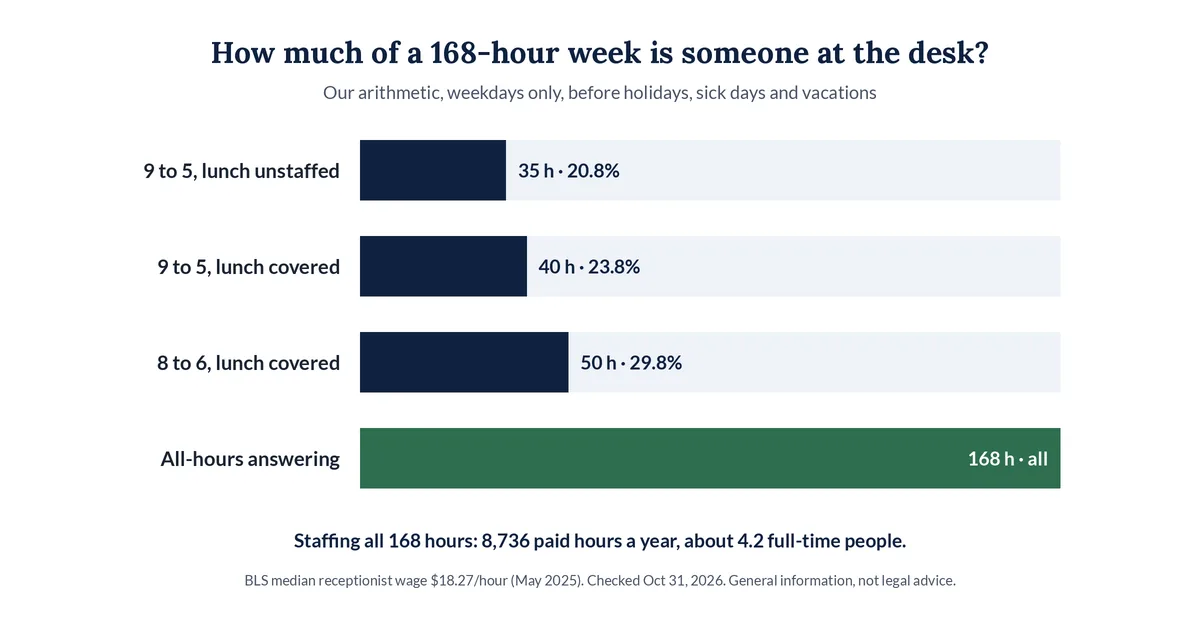
Covering every hour with staff is expensive. The U.S. Bureau of Labor Statistics reports a median wage for receptionists of $18.27 an hour, or $38,010 a year, as of May 2025 (BLS Occupational Outlook Handbook, Receptionists). Staffing all 168 hours for 52 weeks takes 8,736 paid hours a year, about 4.2 full-time people at 40 hours each. At the median hourly wage that is roughly $159,600 a year in wages alone, before payroll taxes, benefits, and time off. For a small firm, that math usually points to staff by day and a service as the backup.
How do you stop missing client calls?
To stop missing client calls, find out when and why you miss them, name a backup for every hour, send unanswered calls to that backup instead of voicemail, set a callback promise you can keep, and review your call log every month. The backup can be staff, an answering service, or an AI receptionist.
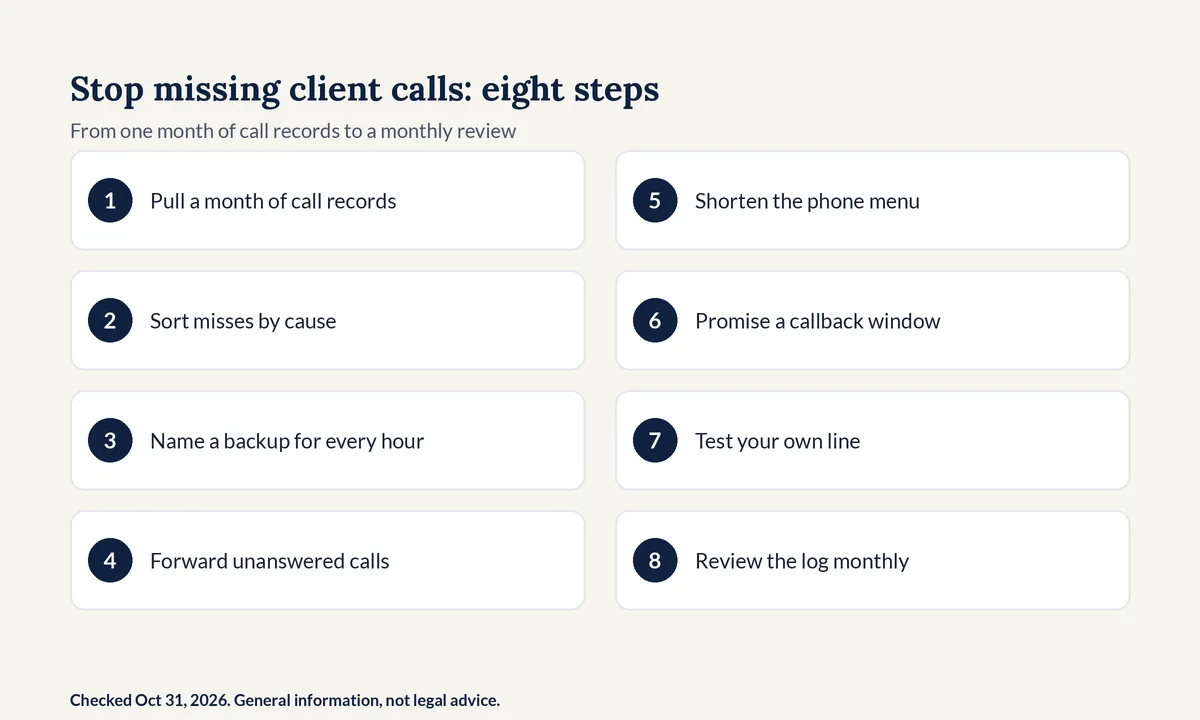
- Pull one month of call records from your phone system or carrier and count the missed calls.
- Sort each missed call by cause: court, meeting, lunch, second line, menu, or closed hours.
- Name a backup for every hour of the week, including court days, lunch, and nights.
- Forward unanswered and busy calls to that backup after a few rings, instead of to voicemail.
- Shorten or remove your phone menu so callers reach a person or system on the first ring.
- Promise a callback window in your greeting, and assign one owner to each missed call.
- Test your own line from another phone at 9 AM, noon, 5:30 PM, and on a Saturday.
- Review the call log every month and adjust coverage where misses still happen.
Steps 3 and 4 do most of the work. A backup can be a staff member, a live answering service, or an AI receptionist, as long as it answers every time the first person can't.
Should you use voicemail, an answering service, or an AI receptionist?
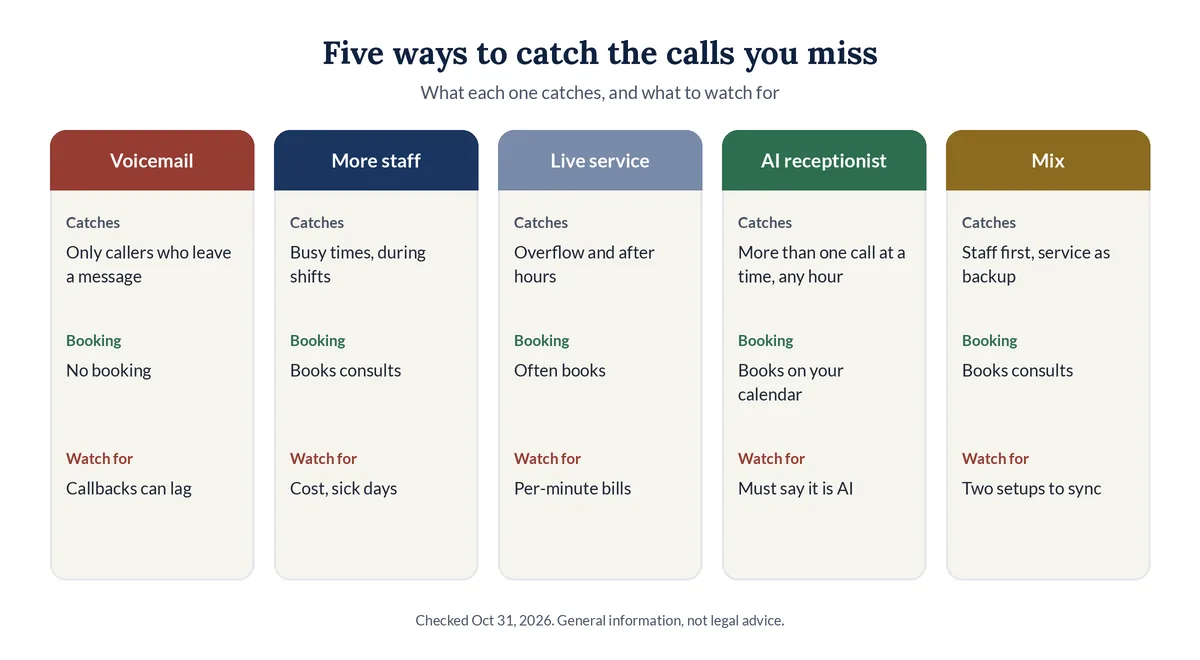
Use voicemail only as a last fallback. Use staff or a live answering service if your callers need a human voice and you accept per-minute or per-call costs. Use an AI receptionist if you want every call answered on the first ring, including busy lines and lunch, at a predictable monthly price. Many firms combine them.
| Option | Catches calls when staff are busy? | Catches after-hours calls? | Books consultations? | Watch for |
|---|---|---|---|---|
| Voicemail | Records a message if the caller leaves one | Records a message if the caller leaves one | No | Callers may hang up; callbacks can lag |
| More in-house staff | Yes, during their shifts | Only with night shifts | Yes | Cost, sick days, turnover |
| Live answering service | Yes, if set as overflow | Yes, on most plans | Often | Possible hold times, per-minute or per-call bills |
| AI receptionist | Yes, can answer more than one call at a time | Yes | Yes, on your calendar | Must say it is AI; complex calls need a handoff plan |
| Mix of staff and a service | Yes | Yes | Yes | Two setups to keep in sync |
Whatever you choose, you are responsible for how it handles your callers, including AI disclosure and call recording notices. Our guide on the disclosure, recording and confidentiality questions for AI receptionists covers those. To see how named providers compare, read our side-by-side comparison of legal answering services and AI receptionists, and for what each model costs at different call volumes, see our breakdown of legal answering service costs.
Legal Touch AI plans start at $149 a month. See Legal Touch AI plans and pricing for details.
How do you track missed calls at a law firm?
Track missed calls with your phone system's call log or your carrier's online report. Each month, count total calls, calls answered live, calls sent to voicemail, hang-ups, and how long callbacks took. Then match new-client calls to booked consultations. Five numbers, reviewed monthly, show where calls are slipping.
Five numbers worth tracking every month:
- Answer rate: calls answered live, divided by total calls.
- Voicemail rate: calls that reached voicemail, divided by total calls.
- Hang-ups: callers who hung up on hold, in a menu, or before a message.
- Callback time: hours from a missed call to your return call.
- Booked consultations: new-client calls that ended with a time on the calendar.
The last number matters most. Answering a call is only the start. What the person or system asks next decides whether a good case turns into a booked consultation. Our guide to screening intake callers without losing good cases covers the questions that work.
How does Legal Touch AI handle calls a firm would otherwise miss?
Legal Touch AI answers on the first ring with no phone menu or hold music, says it is the firm's AI assistant, and gives a recording notice. During office hours it texts you before transferring a good caller. If you don't answer by the third ring, it books the caller a time instead and texts you.
What our live site commits to, from our step-by-step page on how a call works:
- No menu, no hold. Every call opens with: "I'm the firm's AI assistant, not a person. This call is recorded so the firm can follow up with you. Is that OK?"
- Missed transfers are caught. You get a text before the transfer. If you don't pick up by the third ring, it goes back to the caller, books a time, and sends you a "missed transfer" text.
- Hang-ups get a text back. If someone hangs up early, they get a text within about a minute. It only texts people who called your firm.
- After hours, it books the consult. It offers two open times from your Google or Outlook calendar, and the caller gets a text and email confirmation, a reminder the day before, and a reschedule link.
- Summaries in about a minute. You get a short text with name, phone, need, and outcome, plus an email with every answer, the recording, and the transcript.
- Limits. It never gives legal advice or predicts a result, never decides conflicts, never promises your firm will take a case, and never pretends to be a person.
Why we wrote this guide
We set up Legal Touch AI on our own phone lines first, before offering it to small law firms. Our own callers are often stressed, and many call after work or on weekends. We needed every call answered, every caller treated kindly, and every good lead sent to the right person on our team. You can read more about the Legal Touch AI team.
Hear it yourself. Book a 15-minute Legal Touch AI demo, then call the demo line while your own phone is busy and see what the caller hears.
Related guides
Frequently asked questions
Is it unethical for a lawyer not to return phone calls?
For current clients, prompt communication is part of a lawyer's ethical duties. The comment to ABA Model Rule 1.4 says a lawyer should promptly respond to or acknowledge client communications, and staff may acknowledge a request and say when to expect a reply. Check your state's version. This is general information, not legal advice.
Should a law firm text back missed calls?
A short text back can help, because it tells the caller the firm noticed and gives a next step, such as a booking link. Text only people who called you, keep case details out of the message, and follow your firm's own consent and communication practices and your state's rules. Then follow up with a call.
What should a law firm voicemail greeting say?
A good greeting names the firm, says when the caller will hear back, and offers a faster option if you have one, such as online booking. It should tell callers to call 911 in an emergency and avoid anything that sounds like legal advice. Keep the hours current and update it for holidays and court days.
Can an AI receptionist answer when my staff is already on another call?
Yes. An AI receptionist can answer more than one call at a time, so a second or third caller reaches the same greeting and questions instead of a busy signal or voicemail. If your phone system supports it, you can forward only the calls staff don't answer within a few rings, so staff still take calls when they can.
How can I test whether my firm is missing calls?
Call your own main number from a phone the firm doesn't know, at different times: first thing in the morning, at lunch, just after closing, and on a Saturday. Note who answers, how long it takes, and what you hear. Then compare what you found with a month of your phone system's call log.
Legal Touch AI is not a law firm and does not provide legal advice. This article is general information, not legal advice. Ethics rules vary by state and change, and your state's laws, rules of professional conduct, and ethics opinions govern. Using Legal Touch AI does not create an attorney-client relationship.
Sources (checked Oct 31, 2026)
- Clio, Legal Trends Report press release (Oct 21, 2019): https://www.clio.com/about/press/clios-legal-trends-report-reveals-law-firms-struggle-to-respond-to-client-inquiries/
- ABA Model Rule 1.4, Comment: https://www.americanbar.org/groups/professional_responsibility/publications/model_rules_of_professional_conduct/rule_1_4_communications/comment_on_rule_1_4/
- U.S. Bureau of Labor Statistics, Occupational Outlook Handbook, Receptionists (May 2025 wage data): https://www.bls.gov/ooh/office-and-administrative-support/receptionists.htm
- Legal Touch AI how it works: https://legaltouchai.com/how-it-works/
- Legal Touch AI pricing: https://legaltouchai.com/pricing/
- Legal Touch AI about: https://legaltouchai.com/about/