After-Hours Answering Service for Lawyers: Nights, Weekends and Court Days
An after-hours answering service for lawyers is a service that answers a law firm's phone calls when no one at the firm can pick up, such as nights, weekends, holidays, and days the attorneys are in court, and then takes a message, books a consultation, or alerts an on-call attorney under the firm's rules. This guide shows how many hours a typical office is actually closed, how named services handle after-hours calls, and how to set up coverage, with sources checked on Oct 31, 2026.
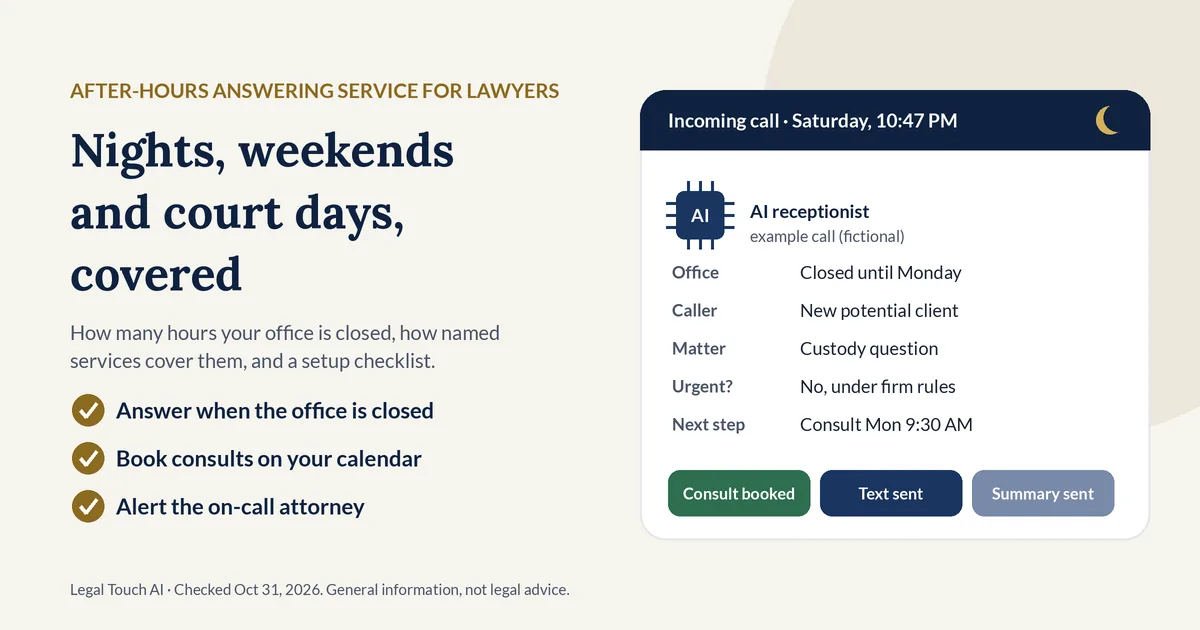
Why it matters: in a secret-shopper study in Clio's 2019 Legal Trends Report, 39% of calls to law firms went to voicemail, and more than half of the firms didn't respond to those voicemails within 72 hours. In the same report, 79% of surveyed consumers said they expected a response within 24 hours (Clio press release, Oct 21, 2019). A caller who reaches voicemail on Friday night may wait until Monday, or may call the next firm on the list.
What does an after-hours answering service do for a law firm?
An after-hours answering service picks up your firm's calls when the office is closed or no one can answer, follows your instructions, and makes sure each caller leaves with a clear next step. Typical next steps are a booked consultation, a message for the morning, a referral, or an alert to an on-call attorney.
Most services do four jobs after hours:
- Answer. Every call is picked up in your firm's name instead of going to voicemail.
- Sort. The service asks whether the caller is a new potential client, a current client, or someone else, and how urgent the matter is under your rules.
- Act. It books a consultation, takes a detailed message, gives a referral you approved, or alerts the attorney you named.
- Report. You get a summary of every call, often with a recording and transcript, before the office opens.
An answering service can be staffed by people, run by an AI receptionist, or both. For a full overview of how AI phone answering works in a firm, including what it costs, see our guide to AI receptionists for law firms.
How many hours is a law firm's office actually closed?
In 2027, a firm open 9 to 5 on weekdays and closed on the 11 federal holidays is open 2,000 hours and closed 6,760 hours, about 77% of the year. Even an office open 8 to 8 on weekdays is closed about 66% of the time. Nights, weekends, and holidays are most of the calendar.
Our arithmetic for 2027, using the federal holiday dates published by the U.S. Office of Personnel Management. All 11 holidays are observed on weekdays in 2027, which leaves 250 working weekdays (OPM federal holidays):
| Office schedule (weekdays, closed on federal holidays) | Hours open in 2027 | Hours closed in 2027 | Share of the year closed |
|---|---|---|---|
| 9 to 5 (8 hours a day) | 2,000 | 6,760 | 77.2% |
| 8 to 6 (10 hours a day) | 2,500 | 6,260 | 71.5% |
| 8 to 8 (12 hours a day) | 3,000 | 5,760 | 65.8% |
| Answered 24/7 | 8,760 | 0 | 0% |
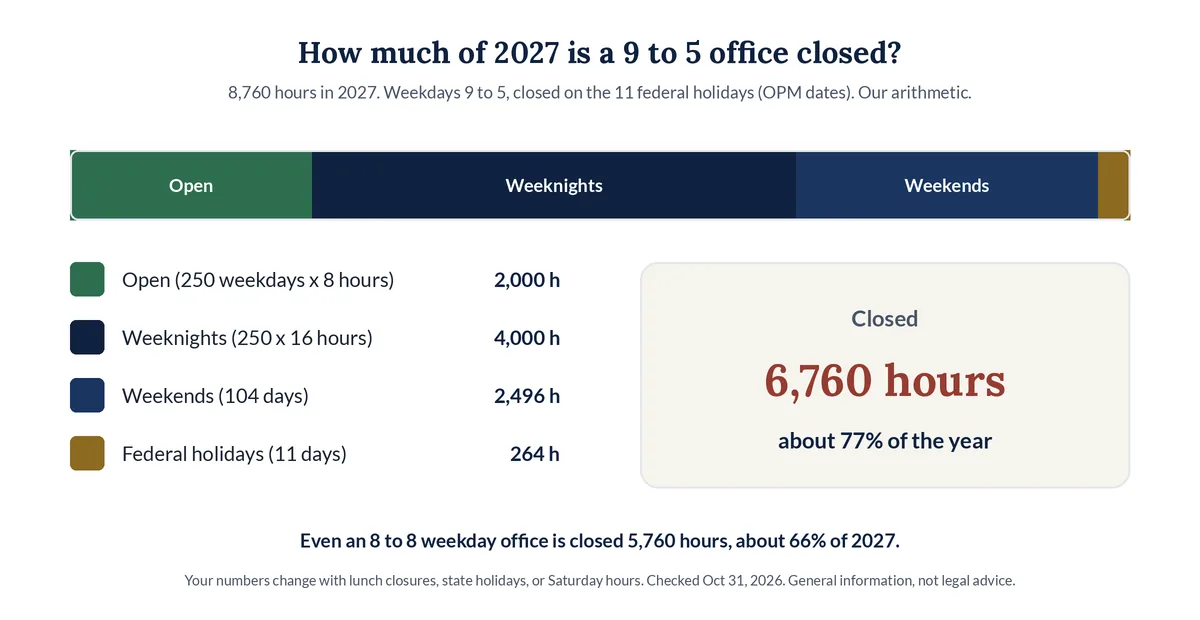
For the 9 to 5 office, the 6,760 closed hours break down into 4,000 weeknight hours, 2,496 weekend hours (104 weekend days), and 264 holiday hours. Your own numbers will differ if you close for lunch, close on state holidays, or open on Saturdays. The point holds either way: a front desk alone can't cover most of the hours in a year.
What happens to calls on court days?
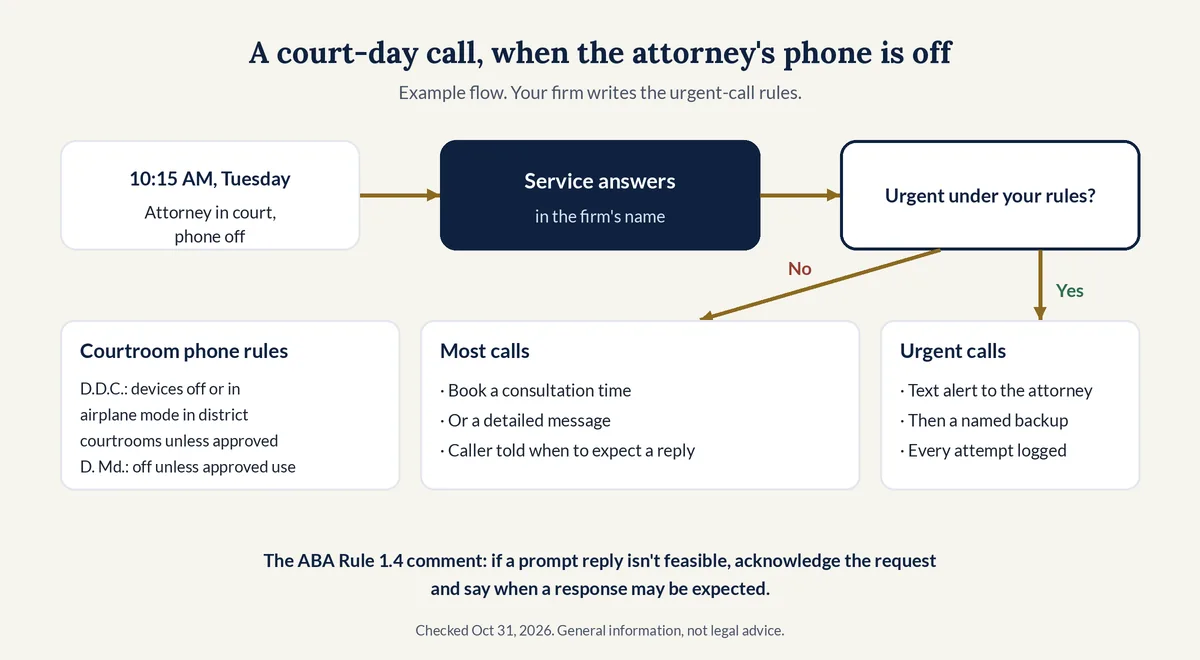
On court days, calls often go unanswered during business hours, because attorneys can't take calls in the courtroom and small firms may have no one else at the desk. A good setup treats court days like after hours: the service answers, books or takes messages, and saves live alerts for calls you define as urgent.
Courtroom phone rules are strict in many places. In the U.S. District Court for the District of Columbia, devices with cellular or WiFi capability must be turned off or put in airplane mode before entering a district or bankruptcy courtroom, unless the presiding judge approves limited use (D.D.C. electronic device policy). In the District of Maryland, counsel of record may use devices at counsel table for approved purposes, and otherwise devices must be turned off in the courtroom unless the judge permits it (D. Md. electronic devices policy). Check your own court's local rules.
Three ways small firms cover court days:
- Turn on full answering for the day. Forward all calls to the service from the morning until you're back, as if the office were closed.
- Forward only unanswered calls. Many phone systems can forward a call after a set number of rings or when the line is busy. Ask your phone company what it supports.
- Tell callers when to expect a reply. The comment to ABA Model Rule 1.4 says that when a prompt response to a client isn't feasible, the lawyer or a member of the lawyer's staff should acknowledge the request and advise the client when a response may be expected (Rule 1.4 comment [4]). An answering service can give that message for you, in words you approve.
Missed calls during the workday are their own problem, with their own fixes. Our guide on why law firms miss calls and what it costs covers the daytime side.
Do lawyers need a 24/7 answering service?
Not every firm needs every hour covered, but most firms need more than voicemail. If people call your firm about arrests, injuries, protective orders, or deadlines, nights and weekends matter. If your callers are mostly businesses that call during the workday, evenings and court days may be enough.
A simple way to decide is to sort the calls your firm actually gets by type, then write one rule for each. Here is an example rule set. Your attorneys decide the real one:
| Call type | During office hours | Nights, weekends, holidays | Court days |
|---|---|---|---|
| New potential client, good fit | Transfer to the intake person | Book the next open consultation | Book a time, or transfer to a backup person |
| New caller, case type you don't take | Polite referral you approved | Same referral | Same referral |
| Current client, routine question | Message to the assigned staff member | Detailed message, reply next business day | Message with a callback window |
| Current client, urgent under your rules (for example, a hearing tomorrow) | Transfer now | Alert the on-call attorney by text and call | Text alert to the attorney and a backup |
| Court, clerk, or opposing counsel | Transfer or message | Detailed message, flagged | Message, flagged for the break |
| Sales calls and spam | Short message or decline | Same | Same |
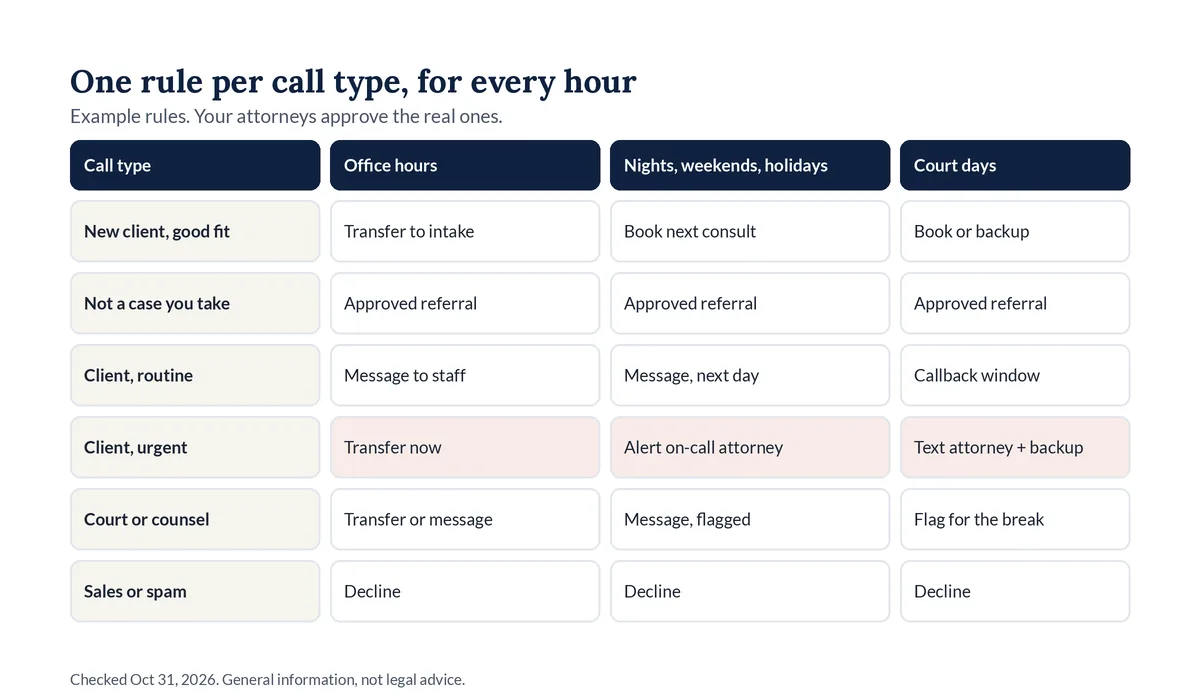
The rule set shows where coverage matters most. If the "nights, weekends, holidays" column has calls you can't afford to lose, you need after-hours answering. If it is mostly messages, a lighter setup may do.
How do after-hours answering services for lawyers compare?
After-hours services for lawyers fall into three groups: live receptionists who answer around the clock, AI receptionists that answer every call instantly, and hybrids that use people by day and AI at night. The biggest differences are who answers, whether nights cost more, and what happens on an urgent call.
How named services describe their after-hours coverage on their own pages (we read each page on Oct 31, 2026):
| Service | Who answers after hours | After-hours options on its page | Extra charge for nights or weekends? | Source, checked Oct 31, 2026 |
|---|---|---|---|---|
| Answering Legal | Live receptionists, legal only | 24/7 answering, or "just 5-9 coverage" (its words) | Not stated on the page we read | After-hours phone service page |
| LexHelper | Live receptionists; its FAQ says after-hours calls are handled by its teams in Australia and the UK | 24/7, weekdays 6pm to midnight, weekdays 24/7, weekends, busy or no answer, specific hours | No. "No extra charge for evenings, weekends or federal holidays" | After-hours call handling page |
| Ruby | Live receptionists | 24 hours a day, 365 days a year; you choose the hours it answers | No additional charge for 24/7 service itself, but the extra minutes count toward your plan | Ruby FAQs |
| Abby Connect | People, AI, or both on one plan | Business hours, extended hours, or 24/7 | No after-hours or weekend upcharge; an AI minute counts as half a plan minute | After-hours and overflow page |
| Smith.ai Hybrid, "After Hours Only" preset | Live agents by day, AI after hours | AI answers nights and weekends and can hand a call to a live agent | Billed per call; this preset starts from about $3.70 per call | Smith.ai Hybrid pricing |
| Veza | Live receptionists | Overflow, after-hours, weekends, or 24/7 | Not stated on the page we read | Veza home page |
| Back Office Betties | Live receptionists, weekdays only | Monday to Friday, 5 AM to 5 PM Pacific; after-hours calls go to voicemail and are emailed to you | Not an after-hours service | Back Office Betties FAQ |
| Legal Touch AI | AI receptionist | 24/7, or after hours only, as a setting | No separate night rate; after-hours calls use plan minutes | Details in the Legal Touch AI section below |
Two things to check with any provider: how it reaches a person on an urgent call at 2 AM, and whether night calls are answered by the same team and script as day calls. For a wider look at the market, see our comparison of legal answering services and AI receptionists.
Should after-hours calls go to a live person or an AI receptionist?
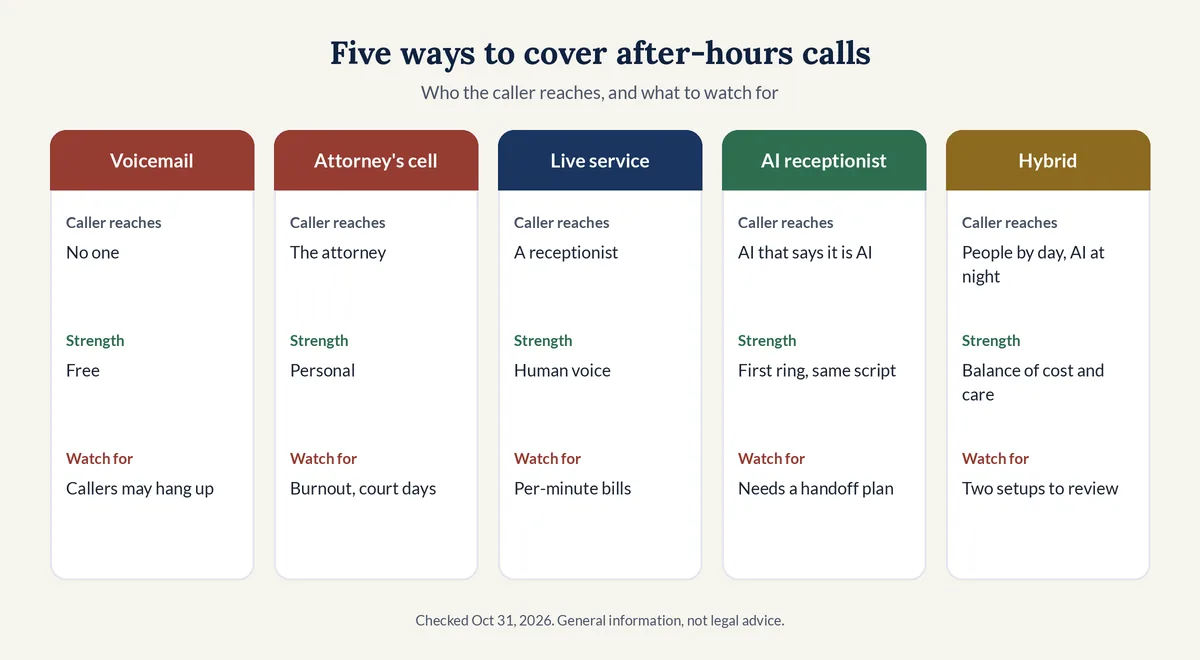
Choose a live person if your after-hours callers are often in crisis and want a human voice, and you accept per-minute or per-call costs. Choose an AI receptionist if you want every call answered on the first ring with the same questions every time, at a predictable price. Many firms mix both.
| Option | Who the caller reaches | Strengths | Watch for |
|---|---|---|---|
| Voicemail | No one | Free | Callers may hang up instead of leaving a message, and some call another firm |
| Attorney's cell phone | The attorney | Personal | Burnout, missed calls in court, no record of the call |
| Live answering service | A trained receptionist | Human voice, judgment on unusual calls | Possible hold times at busy hours, per-minute or per-call bills |
| AI receptionist | An AI voice that says it is AI | Answers on the first ring, same script every call, books consults | Must disclose it is AI; complex calls need a handoff plan |
| Hybrid (people by day, AI at night) | Depends on the hour | Balances cost and care | Two systems to set up and review |
Whichever you pick, you are still responsible for how it works. Under the comment to ABA Model Rule 5.3, a lawyer who uses services outside the firm must make reasonable efforts to ensure they are provided in a way that is compatible with the lawyer's professional obligations (Rule 5.3 comment [3]). For AI disclosure and recording consent, see our guide on whether it is legal for a law firm to use an AI receptionist.
How much does an after-hours answering service cost?
After-hours answering is usually billed the same way as daytime answering: per minute, per call, or a flat monthly plan. Several services say nights and weekends cost nothing extra, but every after-hours call still uses your plan's minutes or calls. Your total depends mostly on how many calls arrive after hours.
What the pages we checked on Oct 31, 2026 say about after-hours billing:
- Same rate at night. LexHelper says there is no extra charge for evenings, weekends, or federal holidays, and Abby Connect says it has no after-hours or weekend upcharge.
- Minutes still count. Ruby says there is no additional charge for 24/7 service itself, but after-hours calls use your receptionist minutes.
- Per call. Smith.ai's Hybrid "After Hours Only" preset, with live agents by day and AI at night, starts from about $3.70 per call.
Legal Touch AI plans start at $149 a month, and after-hours-only answering is a setting on every plan, not a separate plan. See Legal Touch AI plans and pricing for details. For prices across providers at different call volumes, see our legal answering service cost breakdown.
What should an after-hours service do with an urgent call?
An after-hours service should spot urgent calls using rules your firm wrote in advance, collect the key facts, alert the attorney you named right away, and tell the caller exactly what happens next. It should not give legal advice or promise an outcome. If anyone is in danger, the caller should be told to call 911.
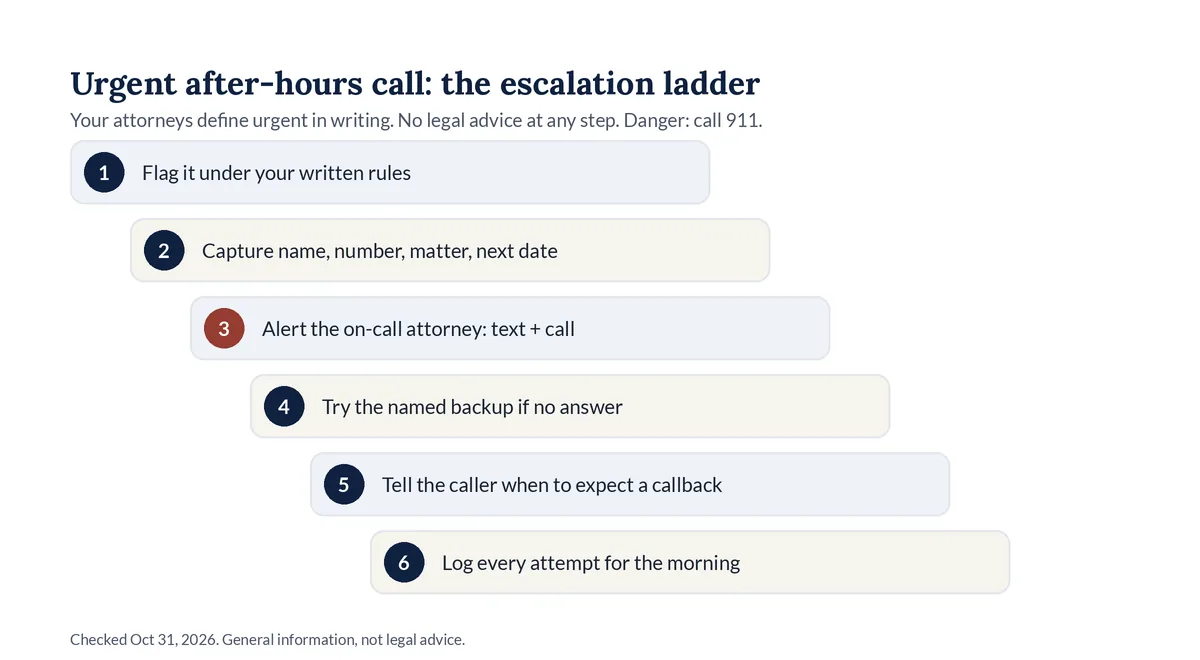
Define "urgent" in writing. Common examples are a client who has been arrested, a hearing or deadline in the next day or two, or a protective order matter, but your attorneys decide the list. Then set an escalation ladder:
- Flag the call as urgent under your written rules.
- Capture the caller's name, number, matter, and the next date or deadline.
- Alert the on-call attorney by text and a phone call.
- Try a backup attorney or staff member if the first person doesn't answer.
- Tell the caller when to expect a callback, in words you approved.
- Log every attempt so the firm can review it in the morning.
For screening questions that work at any hour, see our guide to screening intake callers without losing good cases. Practice-area details, like accident calls on a weekend, are in our AI receptionist guide for personal injury firms.
How do you set up after-hours answering for a law firm?
To set up after-hours answering, list your real call types, choose the hours to cover, write rules for urgent and routine calls, name the on-call attorney and a backup, approve the script, connect your calendar, forward your phones, and test with sample calls. Review the first two weeks of calls closely.
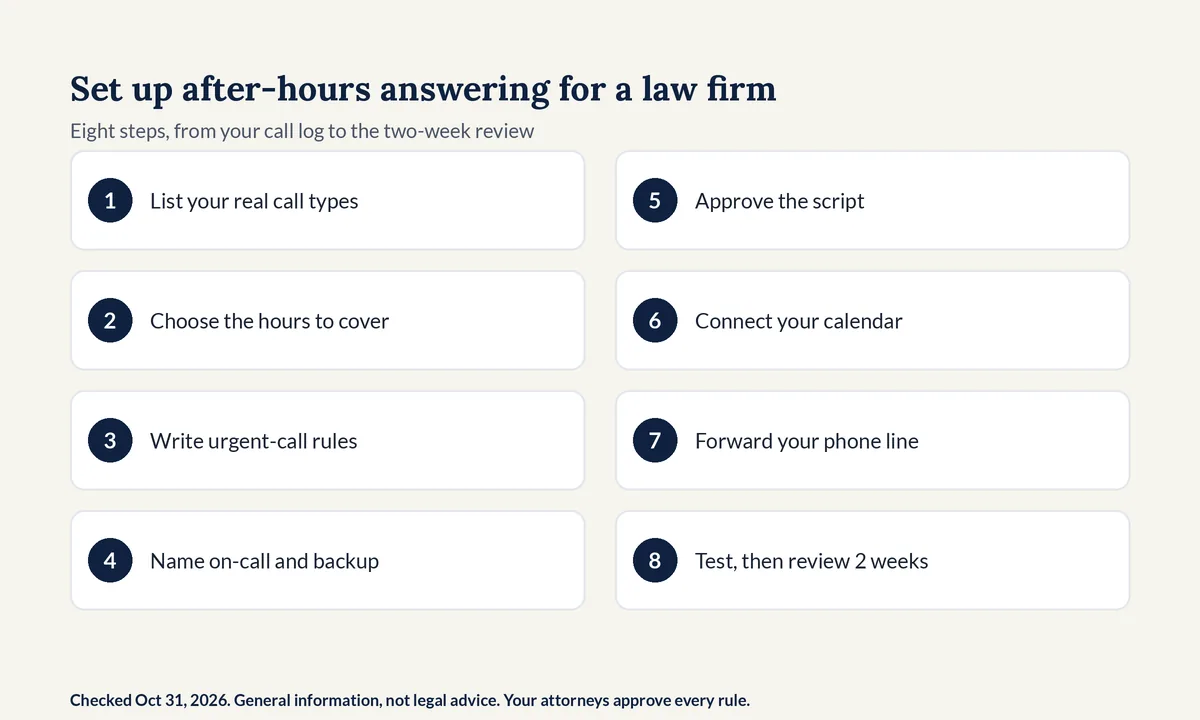
- List the types of calls your firm gets, using a week of your own call log.
- Choose the hours to cover: nights, weekends, holidays, court days, or all of them.
- Write urgent-call rules, with examples your attorneys approve.
- Name an on-call attorney and a backup for each night and weekend.
- Approve the script, including the greeting, screening questions, and what callers hear about callbacks.
- Connect your calendar so after-hours callers can book a consultation.
- Forward your phone line during the chosen hours, or only for unanswered calls.
- Test with sample calls at night and on a weekend, then review every call for two weeks.
How does Legal Touch AI handle after-hours calls?
Legal Touch AI answers on the first ring, 24/7, says it is your firm's AI assistant, gives a recording notice, and asks your screening questions one at a time. After hours, it books the consultation on your Google or Outlook calendar, texts the caller a confirmation, and sends you a summary in about a minute.
What our live site commits to, from our step-by-step page on how a call works:
- Disclosure first. Every call opens with: "I'm the firm's AI assistant, not a person. This call is recorded so the firm can follow up with you. Is that OK?"
- Booking. It offers two open times from your Google or Outlook calendar. The caller gets a text and email confirming the time, a reminder the day before, and a link to reschedule.
- Urgent calls. You decide what counts as urgent, such as an arrest or a court date tomorrow. Those calls get an "URGENT" text and email, and it can ring your cell.
- Hang-ups. People who hang up early get a text within about a minute. It only texts people who called your firm.
- Summaries. You get a short text with the caller's name, phone, need, and outcome, plus an email with every answer, the recording, and the transcript.
- Limits. It never gives legal advice or predicts a result, never decides conflicts, never promises your firm will take a case, and never pretends to be a person.
If your staff answers by day, you can set it to cover only nights, weekends, and holidays, or any hours you choose.
Why we wrote this guide
The Legal Touch AI team has run Legal Touch since 2021. We set up Legal Touch AI on our own phone lines first, before offering it to small law firms. Our own callers are often stressed, and many call after work or on weekends, so we built it to answer every call kindly and get urgent ones to the right person fast. You can read more about the Legal Touch AI team.
Try it after hours. Book a 15-minute Legal Touch AI demo, then call the demo line at night, ask to speak to a person, and book a consultation for the next morning.
Related guides
Frequently asked questions
Can an after-hours answering service give legal advice?
No. An answering service, live or AI, should never give legal advice, tell callers whether they have a case, or predict a result. Its job is to collect facts, book a consultation or take a message, and alert an attorney under your rules. Legal questions wait for the attorney, even late at night.
What is the difference between an after-hours answering service and voicemail?
Voicemail records a message only if the caller chooses to leave one. An after-hours answering service talks with the caller, asks your screening questions, books a consultation or takes a complete message, and alerts an attorney on urgent calls. In Clio's 2019 study, 39% of calls to law firms went to voicemail.
Can a law firm use an answering service only on nights and weekends?
Yes. Most services let you forward calls only during the hours you choose, such as weeknights, weekends, holidays, or court days, while your staff answers during the day. With Legal Touch AI, after-hours-only answering is a setting on every plan, so you choose the hours it covers.
What happens to law firm calls on holidays?
That depends on your setup. Without coverage, holiday calls go to voicemail until the office reopens. With an answering service, calls are answered as on any night or weekend: consultations get booked, messages get sent, and urgent calls reach the on-call attorney. In 2027, all 11 federal holidays are observed on weekdays.
Will callers know they reached an AI receptionist after hours?
They should. A well-set-up AI receptionist says it is AI in its first sentence and gives a recording notice before asking questions. Some states have rules on AI disclosure and call recording, so ask your provider how it handles both, and have your attorney approve the greeting before you go live.
Legal Touch AI is not a law firm and does not provide legal advice. This article is general information, not legal advice. Court policies and ethics rules vary and change, and your state's laws, rules of professional conduct, and ethics opinions govern. Using Legal Touch AI does not create an attorney-client relationship.
Sources (checked Oct 31, 2026)
- Clio, Legal Trends Report press release (Oct 21, 2019): https://www.clio.com/about/press/clios-legal-trends-report-reveals-law-firms-struggle-to-respond-to-client-inquiries/
- U.S. Office of Personnel Management, Federal Holidays (2027 schedule): https://www.opm.gov/policy-data-oversight/pay-leave/federal-holidays/
- U.S. District Court for the District of Columbia, Electronic Device Policy: https://www.dcd.uscourts.gov/electronic-device-policy
- U.S. District Court for the District of Maryland, Electronic Devices in the Courthouse: https://www.mdd.uscourts.gov/electronic-devices-courthouse
- ABA Model Rule 1.4, Comment: https://www.americanbar.org/groups/professional_responsibility/publications/model_rules_of_professional_conduct/rule_1_4_communications/comment_on_rule_1_4/
- ABA Model Rule 5.3, Comment: https://www.americanbar.org/groups/professional_responsibility/publications/model_rules_of_professional_conduct/rule_5_3_responsibilities_regarding_nonlawyer_assistant/comment_on_rule_5_3/
- Answering Legal, After hours phone service: https://www.answeringlegal.com/after-hours-phone-service
- LexHelper, After-hours call handling: https://lexhelper.com/legal-answering-services/after-hours-call-handling/
- Ruby, FAQs: https://www.ruby.com/faqs/
- Abby Connect, After-hours and overflow answering: https://www.abby.com/use-cases/afterhours-overflow/
- Smith.ai, Hybrid AI and human receptionist pricing: https://smith.ai/pricing/hybrid-ai-human-receptionists
- Veza Reception, home page: https://vezareception.com/
- Back Office Betties, FAQ: https://backofficebetties.com/faq/
- Legal Touch AI how it works: https://legaltouchai.com/how-it-works/
- Legal Touch AI pricing: https://legaltouchai.com/pricing/
- Legal Touch AI about: https://legaltouchai.com/about/