AI Receptionist for Personal Injury Firms: Answer Every Accident Call
An AI receptionist for personal injury firms is software that answers a personal injury (PI) firm's phone calls with a computer-generated voice, asks the firm's accident intake questions, and sends each caller to a next step: a live transfer, a booked consultation, a referral, or a message. This guide covers what PI intake should ask, how to handle deadlines and callers who already have a lawyer, and where the solicitation rules draw the line, with the rules and statutes we read on Oct 30, 2026.
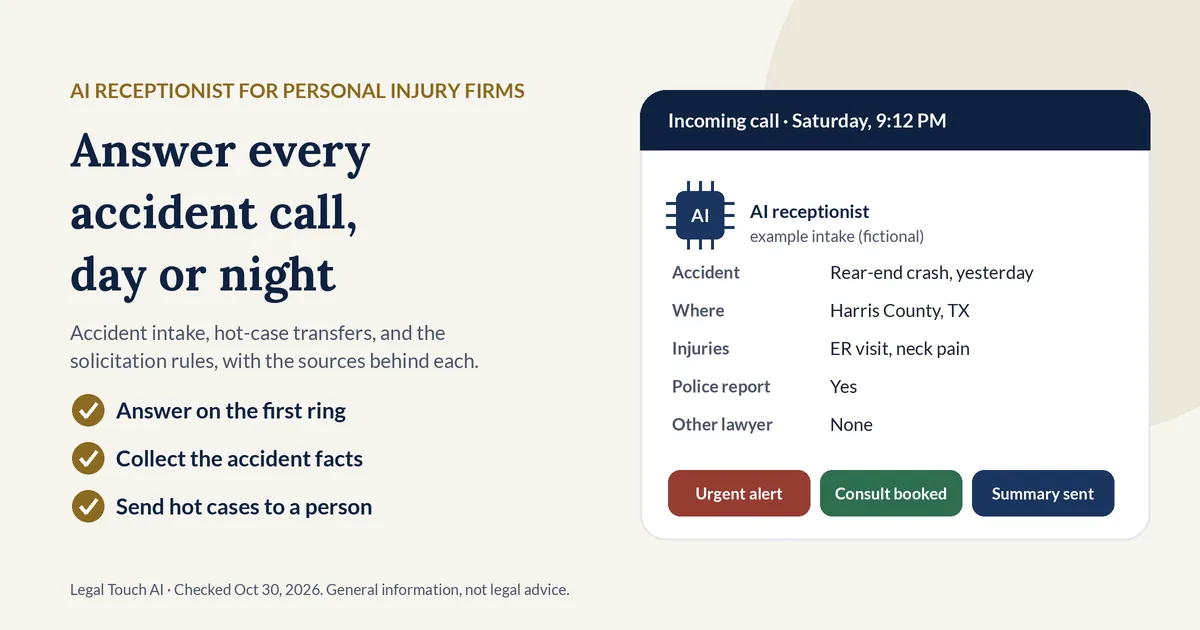
Why it matters: in a secret-shopper study in Clio's 2019 Legal Trends Report, 39% of calls to law firms went to voicemail, and more than half of the firms didn't respond to those voicemails within 72 hours. In the same report, 79% of surveyed consumers said they expected a response within 24 hours (Clio press release, Oct 21, 2019). That study tested family, criminal, bankruptcy, employment, and business inquiries, not personal injury. Still, an injured caller who reaches voicemail faces the same choice: wait, or call the next firm.
What does an AI receptionist do for a personal injury firm?
An AI receptionist answers a personal injury firm's calls on the first ring, day or night, says it is AI, and asks the firm's intake questions one at a time. It then transfers strong cases to an attorney, books consultations on the firm's calendar, refers callers the firm doesn't serve, and sends a summary of every call.
For a PI firm, the work splits into four jobs:
- Answer. Every call is picked up, including nights, weekends, and holidays, when no one is at the front desk.
- Screen. The AI asks the firm's own questions about the accident, the injuries, and whether another lawyer is involved.
- Route. Hot cases go to a person live. Others get a booked consultation, a referral, or a message.
- Report. The firm gets a summary, recording, and transcript, so an attorney can review every call.
What it should never do matters just as much: give legal advice, say what a case is worth, tell a caller whether they have a case, or promise the firm will take it. For the full picture across practice areas, see our pillar guide to what an AI receptionist does for law firms and what it costs.
Why do personal injury firms miss accident calls?
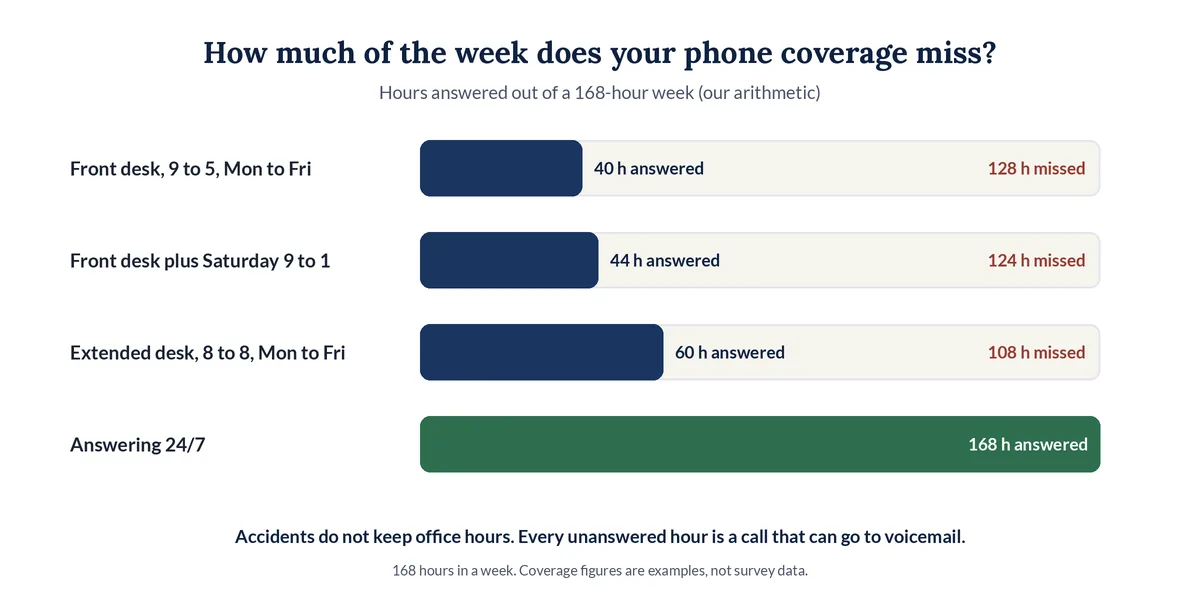
Personal injury firms miss accident calls mostly because of timing. A typical front desk covers about 40 hours a week, but a week has 168 hours, so 128 hours fall outside a standard schedule. Accidents do not keep office hours, and injured people call when they are able to, which can be any hour of any day.
How much of the week each schedule leaves uncovered (our arithmetic, based on a 168-hour week):
| Phone coverage | Hours answered a week | Hours not answered |
|---|---|---|
| Front desk, 9 to 5, Monday to Friday | 40 | 128 |
| Front desk plus Saturday 9 to 1 | 44 | 124 |
| Extended desk, 8 to 8, Monday to Friday | 60 | 108 |
| Answering 24/7 | 168 | 0 |
Calls also go unanswered during office hours: the receptionist is on another line, the attorney is in court or at a deposition, or the office is at lunch. An AI receptionist picks up every one of those calls too.
What questions should a personal injury intake call ask?
A personal injury intake call should ask for the caller's contact details, the date and place of the accident, what happened, the injuries and any treatment, whether police made a report, what insurance is involved, and whether the caller already has a lawyer. Each question should change the next step or help the attorney review.
Our PI intake question map, with what the AI should stay away from on each one:
| Question | Why the attorney needs it | What the AI should not do |
|---|---|---|
| Full name, best phone number, and email | Callback, booking, and conflict check | Ask for Social Security or card numbers |
| Are you safe right now? Is anyone in danger? | Emergencies come first | Continue intake during an emergency (tell the caller to call 911) |
| Are you the injured person, or calling for someone else? | Shows who the potential client is | Assume a relative can decide for the injured person |
| When did the accident happen? | Lets the attorney review deadlines | Say how long the caller has to file |
| Where did it happen: state, county, and city? | Shows whether the firm handles matters there | Guess which state's law applies |
| What happened, in a sentence or two? | Car, truck, fall, work injury, or other, for practice fit | Comment on who was at fault |
| What injuries, and any ER visit, doctor, or ongoing care? | Urgency and fit | Give medical advice or say whether to keep treating |
| Was a police or incident report made? | A record the attorney may request | Explain how to get or change the report |
| Which insurance companies are involved, and is there a claim number? | Who the attorney may contact | Say whether to talk to an adjuster |
| Who else was involved, people or companies? | Names for the conflict check | Decide whether there is a conflict |
| Have you hired or talked to another lawyer about this? | Flags a represented caller | Criticize the other lawyer |
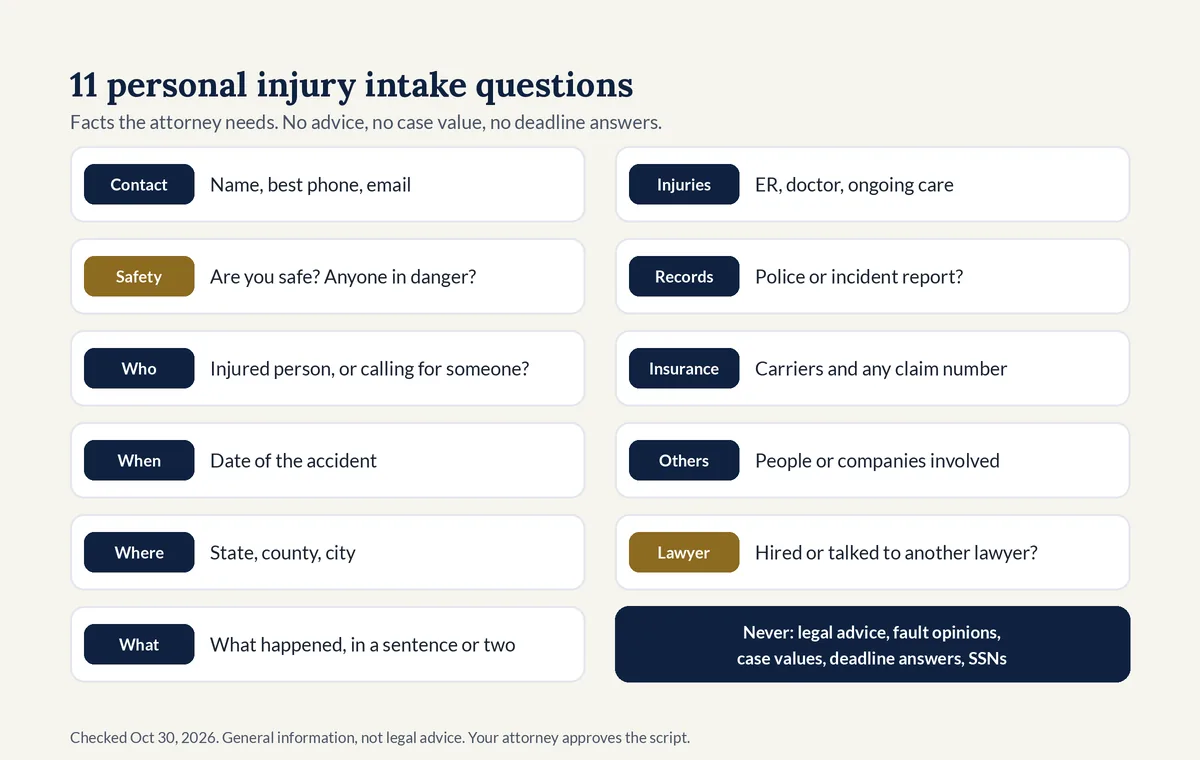
Keep the script short. Under ABA Model Rule 1.18, a person who consults a lawyer about possibly hiring them is a prospective client, and comment [4] advises limiting the first consultation to the information reasonably needed to decide whether to take the matter (Rule 1.18 comment). Florida Bar Ethics Opinion 24-1 applies an older Florida opinion on intake to AI: nonlawyer intake must identify its status, limit questions to facts, and refer legal questions to the lawyer (Florida Bar Ethics Opinion 24-1). For the core questions every practice area shares, see our guide on how to screen intake callers without losing good cases.
How should PI intake handle the statute of limitations?
PI intake should record the date of the accident, where it happened, and whether a government vehicle or property was involved, then flag the call for an attorney. The AI should never tell a caller how long they have to file or whether a deadline has passed. That is a legal judgment for the attorney.
Deadlines vary by state and by claim, and some notice periods are much shorter than the general one. Three examples from official statute text:
| Rule | What it says | What intake should capture |
|---|---|---|
| Texas Civ. Prac. and Rem. Code 16.003(a) | A suit for personal injury generally must be brought not later than two years after the cause of action accrues | The accident date |
| Texas Civ. Prac. and Rem. Code 101.101(a) | A governmental unit is entitled to notice of a claim not later than six months after the incident | Whether a city, county, or state vehicle or property was involved |
| Fla. Stat. 95.11(5)(a) | An action founded on negligence must be commenced within two years | The accident date |
Checked Oct 30, 2026 (Texas CPRC chapter 16; Texas CPRC chapter 101; Fla. Stat. 95.11). Exceptions apply, such as for minors and some types of claims. Your attorney decides the flag rules, for example sending any accident older than a set number of months to an attorney the same day.
There is a second reason to keep deadline talk out of the script. Texas makes it an offense for a person who is not a licensed lawyer, seeking an economic benefit, to advise someone "as to the person's rights and the advisability of making claims for personal injuries" (Texas Penal Code 38.123(a)(2)). A safe script line is: "I can't give legal advice, but I've noted the date, and an attorney will review it."
What should happen when a PI caller already has a lawyer?
The AI should ask early whether the caller has hired or talked with another lawyer about the accident, note the answer, and flag it. It should not end the call or criticize the other lawyer. An attorney decides the next step, because people may seek a second opinion and the firm must handle that within its rules.
What the sources we read say about represented callers:
- Second opinions. Comment [4] to ABA Model Rule 4.2 says the rule does not "preclude communication with a represented person who is seeking advice from a lawyer who is not otherwise representing a client in the matter" (Rule 4.2 comment).
- AI intake screening. Florida Bar Ethics Opinion 24-1, written about website chatbots, says a lawyer "should consider including screening questions that limit the chatbot's communications if a person is already represented by another lawyer."
- No marketing follow-up. Florida Bar Rule 4-7.18(b)(1)(B) and Texas Penal Code 38.12(d)(2)(B) restrict solicitations, including written ones, to people known to be represented in the matter, so a represented caller should never land on a marketing list.
Legal Touch AI's example screening questions include whether another attorney is already involved, per how a Legal Touch AI call works. Your attorney sets what happens after a yes.
Is an AI receptionist solicitation under the ethics rules?
Answering calls people place to your firm is generally not solicitation. ABA Model Rule 7.3 defines solicitation as a communication initiated by or on behalf of a lawyer, and its comment says a response to a request for information is not one. The risk is outbound: calling or texting accident victims who never contacted the firm.
Solicitation rules that matter for PI phone intake, from each rule's official text:
| Rule | What it says | What it means for an AI receptionist |
|---|---|---|
| ABA Model Rule 7.3(a) and comment [1] | Solicitation is initiated by or on behalf of a lawyer; a response to a request for information is not solicitation | Answering inbound calls is generally outside the rule |
| ABA Model Rule 7.3(b) and comment [2] | No live person-to-person solicitation for pecuniary gain, including "live telephone" contact | No outbound cold calls to accident victims |
| Texas Disciplinary Rule 7.03(a)(1) and (b) | Covers telephone contact initiated by a person acting on behalf of a lawyer "in a live or electronically interactive manner" | An interactive AI voice call placed for a firm may be covered |
| Texas Penal Code 38.12(d)(2)(A) | Bars an attorney or other listed professional from written, phone, or electronic solicitation about an accident, to a person who has not sought their services, before the 31st day | Outbound accident outreach in the first 30 days can be a crime |
| Texas Penal Code 38.18 | Bars using crash report information from a government entity for direct solicitation | Never load crash report lists into any calling or texting system |
| Florida Bar Rule 4-7.18(a) | No in-person or telephone solicitation when a significant motive is pecuniary gain | The Florida Bar handbook lists cold calls as prohibited |
| Florida Bar Rule 4-7.18(b)(1)(A) | No written solicitation about an accident until more than 30 days after it | The handbook applies this to email, text messages, and targeted social media |
| ABA Formal Opinion 501 (April 13, 2022) | A lawyer's responsibility for solicitation can extend, under certain circumstances, to people employed by or retained by the lawyer | A vendor calling on your behalf can be your responsibility |
Checked Oct 30, 2026 (Rule 7.3; Rule 7.3 comment; Texas Rule 7.03; Texas Penal Code chapter 38; Florida Bar Advertising Handbook, 2025 edition; ABA on Formal Opinion 501).
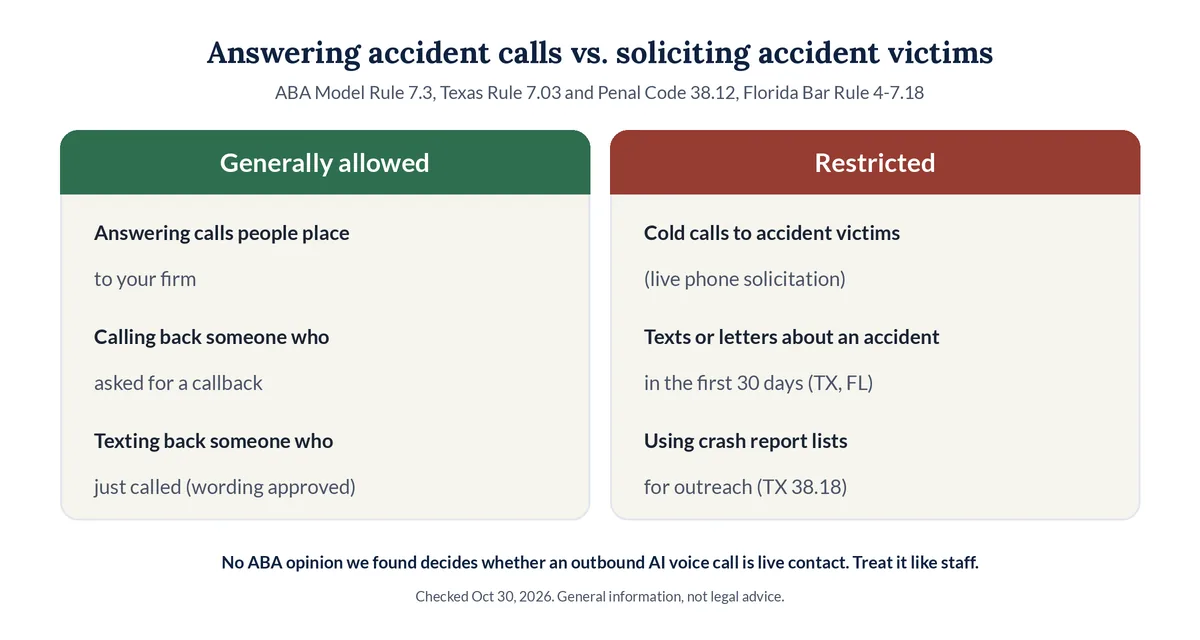
We found no ABA opinion that decides whether an AI voice call counts as "live person-to-person contact." Until your bar says otherwise, treat an outbound AI call to someone who has not contacted you like a call from your own staff. A text back to a person who just called your firm responds to that call, but have counsel approve its wording and keep it free of sales language. For AI disclosure and recording consent, see our guide to the disclosure, recording and confidentiality rules for AI receptionists.
When should an AI receptionist transfer a PI call live?
An AI receptionist should transfer a PI call live when it meets the firm's written hot-case rules, such as a recent accident with hospital treatment, a serious injury, a commercial truck, or a death in the family. A good setup texts the attorney first, then connects. After hours, it books a time and sends an urgent alert.
How a well-set-up AI receptionist could route common PI calls (example rules; your firm sets its own):
| Caller | During office hours | After hours |
|---|---|---|
| Rear-end crash yesterday, ER visit, no lawyer | Text the attorney, then transfer live | Book the next open consultation and send an urgent alert |
| Relative calling about a fatal crash | Transfer to the attorney you name | Urgent alert, and ring the on-call attorney's cell |
| Fall at a store 20 months ago | Flag the date and transfer or book the same day | Book, and flag the date for attorney review |
| Already has a lawyer, wants a second opinion | Note it and follow the attorney's rule | Take the details and flag for attorney review |
| Case type the firm doesn't take | Polite referral to a number you approve | Same polite referral |
| Asks "Do I have a case?" | No opinion; offer a transfer or consultation | No opinion; book a consultation |
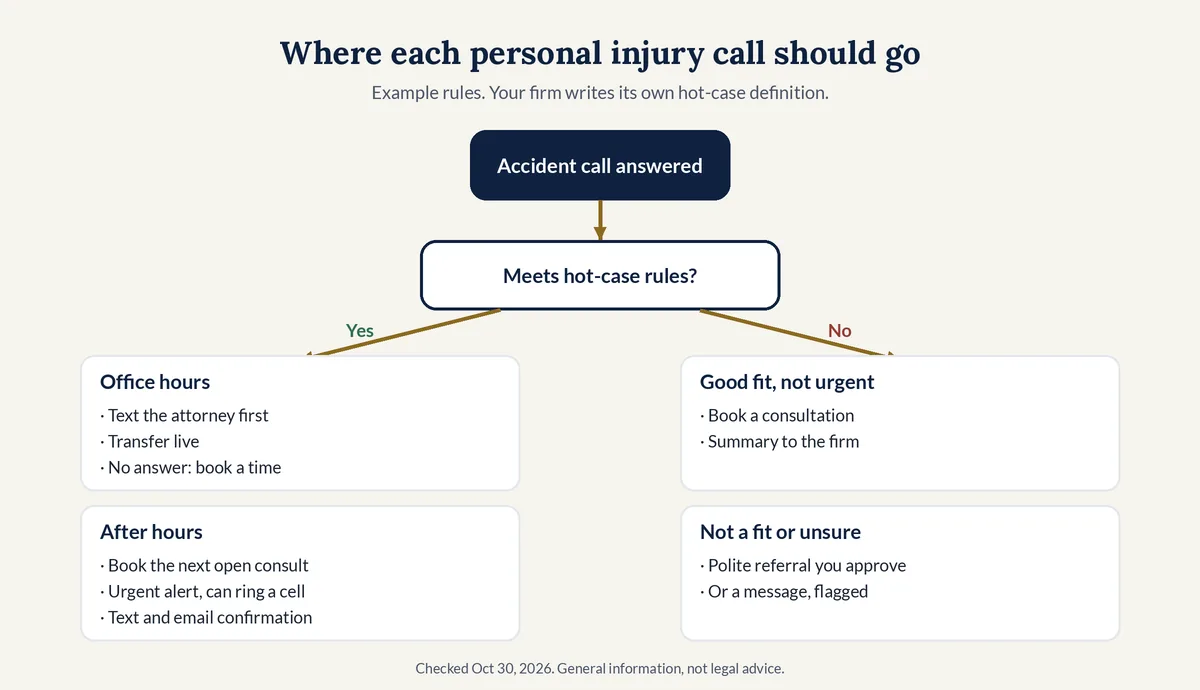
The worst outcome for a strong case is a caller who hangs up with only "someone will call you." If the attorney can't pick up, the system should book a time while the caller is still on the line.
How do you set up an AI receptionist for a personal injury firm?
To set up an AI receptionist for a personal injury firm, define hot cases in writing, build a short accident script, block legal advice and deadline talk, set transfer and after-hours rules, keep the system inbound only, and test it with real scenarios. Have the attorney responsible for intake approve every line before launch.
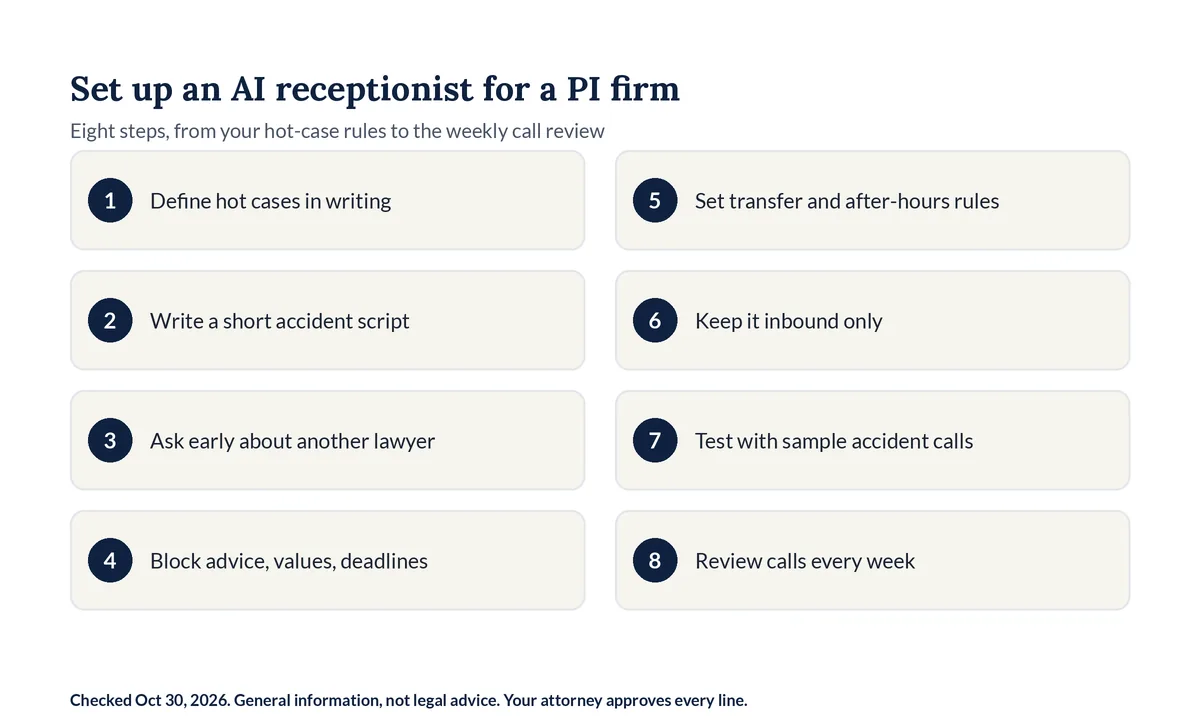
- Define hot cases in writing: injury level, accident type, how recent it is, and the counties you serve.
- Write a short script that collects the accident date, place, injuries, treatment, police report, insurance, and others involved.
- Ask early whether the caller has hired or talked to another lawyer, and flag every yes for attorney review.
- Block legal advice, case values, deadline answers, fault opinions, and promises that the firm will take the case.
- Set live transfer rules for office hours, and booking and urgent alert rules for nights and weekends.
- Keep the system inbound only, and have counsel approve any reminder, callback, or text wording.
- Test the script with sample calls: a fresh crash with an ER visit, a caller asking "Do I have a case?", a represented caller, and a case type you don't take.
- Review recordings and summaries every week, and fix the script when a good case slips through.
How does Legal Touch AI handle personal injury calls?
Legal Touch AI answers on the first ring, 24/7, says it is your firm's AI assistant, gives a recording notice, and asks your screening questions one at a time. During office hours it texts you, then transfers good callers live. After hours it books the consultation on your Google or Outlook calendar and texts the caller a confirmation.
What the live site commits to, from our how it works page and home page:
- Disclosure first. Every call opens with: "I'm the firm's AI assistant, not a person. This call is recorded so the firm can follow up with you. Is that OK?"
- Your questions. You choose the screening questions, so your script can include the accident questions above.
- Urgent calls. You decide what counts as urgent. Those calls get an "URGENT" text and email, and it can ring your cell.
- Missed transfers. If you don't answer by the third ring, it goes back to the caller and books a time instead, and you get a "missed transfer" text.
- Not a fit. Callers with a case type you don't take are told politely and can get a referral number you give us.
- Hang-ups. People who hang up early get a text within about a minute. It only texts people who called your firm.
- Limits. It never gives legal advice or predicts a result, never decides conflicts, never promises your firm will take a case, and never asks for Social Security numbers, card numbers, or passwords. When it isn't sure, it takes a message and flags the call.
- Inbound only. It does not make sales calls. The only calls it places are reminders to people who booked with you or asked for a callback, and only if you turn that on.
Spanish is set up and quoted separately, so ask about it on the demo call. Plans start at $149 a month, month to month, with a 60-day money-back guarantee (minus costs, max $750); see Legal Touch AI plans and pricing, and our legal answering service cost breakdown for prices across providers.
If you want a person on every accident call, live intake services may suit you better. Our comparison of legal answering services and AI receptionists and our honest Smith.ai alternative comparison cover the main options.
Why we wrote this guide
The Legal Touch AI team has run Legal Touch since 2021. We set up Legal Touch AI on our own phone lines first, before offering it to small law firms. Our own callers are often stressed, and many call after work or on weekends, so we built it to answer every call kindly and get good leads to the right person fast. You can read more about the Legal Touch AI team.
Try it like an accident caller. Book a 15-minute Legal Touch AI demo, then ask if you have a case, ask to speak to a person, and book a consultation for tomorrow.
Related guides
Frequently asked questions
Can an AI receptionist tell a caller if they have a personal injury case?
No. Deciding whether someone has a case is a legal judgment for an attorney. A well-set-up AI receptionist collects the facts, says an attorney will review them, and offers a live transfer or a consultation. It should never estimate what a case is worth, comment on fault, or promise the firm will take it.
Can an AI receptionist answer personal injury calls in Spanish?
Some can, so ask each provider for a Spanish test call before you sign. With Legal Touch AI, Spanish is set up and quoted separately from the standard plan, so ask about it on the demo call. In any language, the AI disclosure and the recording notice should come first, before any intake questions.
Is it solicitation if the AI calls an accident victim back?
Calling back someone who asked for a callback responds to their request, and the comment to ABA Model Rule 7.3 says that is not solicitation. Calling accident victims who never contacted the firm is different, and the ABA, Texas, and Florida rules restrict it. Limit outbound calls to people who called or booked.
Should an AI receptionist ask about insurance and police reports?
Yes, as facts. Intake can ask which insurance companies are involved, whether there is a claim number, and whether police made a report. It should not tell the caller whether to speak with an adjuster, give a recorded statement, or sign anything. Those questions go to the attorney, who can answer them properly.
What happens to an accident call at 2 AM on a Sunday?
An AI receptionist answers on the first ring, asks the intake questions, and lets the caller book a consultation for the next open time. With Legal Touch AI, the caller gets a text and email confirming the time, and calls your firm defines as urgent can also ring an attorney's cell right away.
Legal Touch AI is not a law firm and does not provide legal advice. This article is general information, not legal advice, and is not a complete survey of every state's laws. Statutes and ethics rules change, and your state's laws, rules of professional conduct, and ethics opinions govern. Using Legal Touch AI does not create an attorney-client relationship.
Sources (checked Oct 30, 2026)
- Clio, Legal Trends Report press release (Oct 21, 2019): https://www.clio.com/about/press/clios-legal-trends-report-reveals-law-firms-struggle-to-respond-to-client-inquiries/
- ABA Model Rule 7.3, Solicitation of Clients: https://www.americanbar.org/groups/professional_responsibility/publications/model_rules_of_professional_conduct/rule_7_3_direct_contact_with_prospective_clients/
- ABA Model Rule 7.3, Comment: https://www.americanbar.org/groups/professional_responsibility/publications/model_rules_of_professional_conduct/rule_7_3_direct_contact_with_prospective_clients/comment_on_rule_7_3/
- ABA news release on Formal Opinion 501 (April 13, 2022): https://www.americanbar.org/news/abanews/aba-news-archives/2022/04/aba-issues-guidance-on-live-person-lawyer-solicitation/
- ABA Model Rule 4.2, Comment: https://www.americanbar.org/groups/professional_responsibility/publications/model_rules_of_professional_conduct/rule_4_2_communication_with_person_represented_by_counsel/comment_on_rule_4_2/
- ABA Model Rule 1.18, Comment: https://www.americanbar.org/groups/professional_responsibility/publications/model_rules_of_professional_conduct/rule_1_18_duties_of_prospective_client/comment_on_rule_1_18_duties_of_prospective_client/
- Florida Bar Ethics Opinion 24-1 (Jan 19, 2024): https://www.floridabar.org/etopinions/opinion-24-1/
- The Florida Bar, Advertising Handbook, 2025 Edition (includes Rule 4-7.18 text): https://www-media.floridabar.org/uploads/2025/12/Handbook-2025-Approved-by-SCA-12-10-25.pdf
- Texas Disciplinary Rules of Professional Conduct, Rule 7.03 (Texas Center for Legal Ethics): https://www.legalethicstexas.com/resources/rules/texas-disciplinary-rules-of-professional-conduct/solicitation-and-other-prohibited-communications/
- Texas Penal Code chapter 38 (sections 38.12, 38.123, 38.18): https://statutes.capitol.texas.gov/Docs/PE/htm/PE.38.htm
- Texas Civil Practice and Remedies Code chapter 16 (section 16.003): https://statutes.capitol.texas.gov/Docs/CP/htm/CP.16.htm
- Texas Civil Practice and Remedies Code chapter 101 (section 101.101): https://statutes.capitol.texas.gov/Docs/CP/htm/CP.101.htm
- Florida Statutes section 95.11: http://www.leg.state.fl.us/statutes/index.cfm?App_mode=Display_Statute&URL=0000-0099/0095/Sections/0095.11.html
- Legal Touch AI how it works: https://legaltouchai.com/how-it-works/
- Legal Touch AI pricing: https://legaltouchai.com/pricing/
- Legal Touch AI about: https://legaltouchai.com/about/