Is It Legal for a Law Firm to Use an AI Receptionist? Disclosure, Recording and Confidentiality
An AI receptionist is software that answers a business's phone calls with a computer-generated voice, asks set questions, and transfers, books, or takes a message for each caller. For a law firm, using one is generally legal in the U.S. when it follows three sets of rules: call recording consent laws, AI disclosure rules, and the lawyer ethics rules on confidentiality and supervision. This guide covers each one, with the statutes and ethics opinions we read on Oct 30, 2026.
Why firms ask: in a secret-shopper study in Clio's 2019 Legal Trends Report, 39% of calls to law firms went to voicemail, and 79% of surveyed consumers said they expected a response within 24 hours (Clio press release, Oct 21, 2019). An AI receptionist can answer those calls. The real question is how to do it within the rules.
Is it legal to use AI to answer calls?
Yes, in general. No federal law we reviewed bars a business, including a law firm, from having AI answer the calls people place to it. What the law regulates is how: recording the call, telling callers they are talking to AI where a state requires it, and, for lawyers, protecting what callers share and supervising the tool.
Three sets of rules apply to a law firm's AI receptionist:
- Recording consent. Federal and state wiretap laws decide whether one person's consent is enough to record a call, or whether everyone must agree.
- AI disclosure. A few states regulate when AI must say it is AI, and bar ethics guidance expects intake tools to say so.
- Professional conduct. Your state's version of ABA Model Rules 1.1, 1.6, 1.18, 5.3, and 7.1 covers competence, confidentiality, prospective clients, supervision, and truthful communication.
Calls the system places, such as reminders, are covered below. For how an AI receptionist fits into a firm's phones day to day, see our guide to what an AI receptionist does for a law firm.
Does an AI receptionist have to tell callers it is AI?
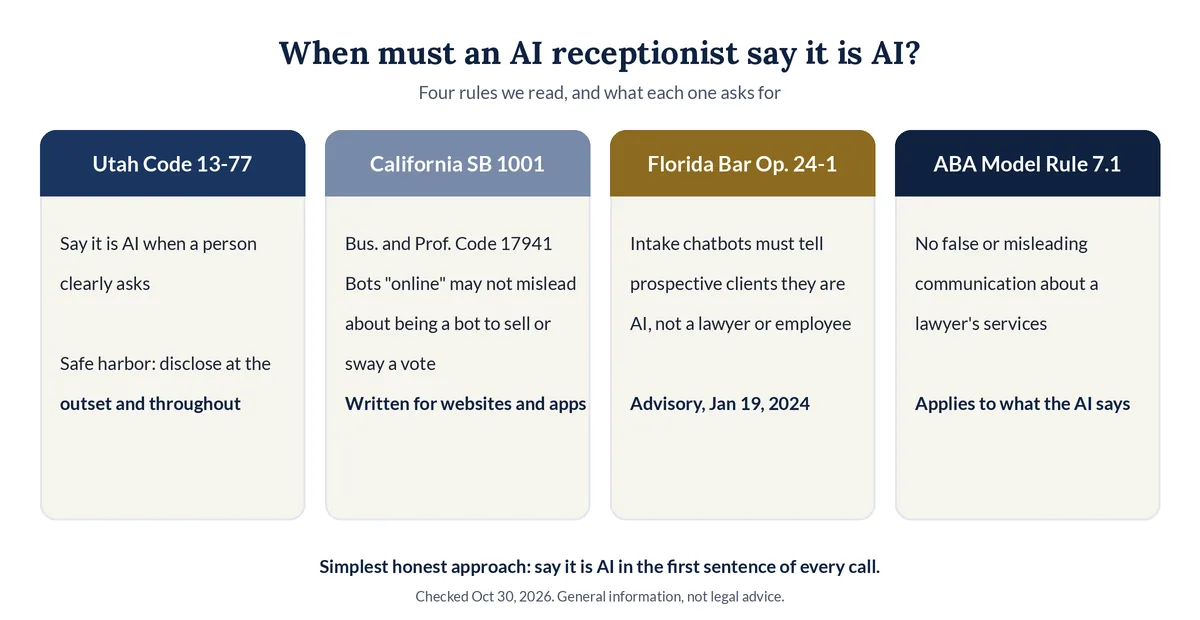
In some situations, yes. Utah requires a business using generative AI in a consumer transaction to say so when a person clearly asks. Florida Bar Ethics Opinion 24-1 says a lawyer must tell prospective clients they are communicating with an AI program, not a lawyer or law firm employee. Saying it up front is the simplest honest approach.
AI disclosure rules we checked, by source:
| Rule | Who it covers | What it says |
|---|---|---|
| Utah Code 13-77-103(1) | A supplier using generative AI in a consumer transaction | Disclose that the person is talking to generative AI, not a human, when the person clearly and unambiguously asks |
| Utah Code 13-77-103(2) and (3) | People in occupations regulated by Utah's Department of Commerce, in "high-risk" interactions such as legal advice or services | Disclose prominently, out loud at the start of a voice interaction |
| Utah Code 13-77-104 | Safe harbor | No enforcement action if the AI clearly discloses, at the outset and throughout, that it is AI |
| California Bus. and Prof. Code 17941 (SB 1001) | Bots that communicate with people in California "online" to sell goods or services or influence a vote | No using a bot to mislead about its artificial identity; a clear, conspicuous disclosure avoids liability |
| Florida Bar Ethics Opinion 24-1 (Jan 19, 2024, advisory) | Florida lawyers using generative AI chatbots | Inform prospective clients they are communicating with an AI program, not a lawyer or law firm employee |
| ABA Model Rule 7.1 | Every lawyer communication about the lawyer's services | No false or misleading communication |
Checked Oct 30, 2026. California's statute defines "online" as websites and apps, so it is written for online bots rather than phone calls (Bus. and Prof. Code 17940). Whether Utah's stricter subsection reaches lawyers depends on its definition of a regulated occupation (Utah Code 13-77).
The Florida opinion is the most specific guidance we found for intake. It applies an older Florida opinion on nonlawyer intake staff, who must clearly identify their nonlawyer status, limit questions to gathering facts, and refer legal questions to the lawyer. It warns against "an overly welcoming generative AI chatbot that may provide legal advice, fail to immediately identify itself as a chatbot, or fail to include clear and reasonably understandable disclaimers" (Florida Bar Ethics Opinion 24-1).
Does the FCC's AI voice ruling apply to an AI receptionist?
The FCC's February 2024 ruling covers calls made using an AI-generated voice, which generally need the called person's prior express consent under federal robocall law. An AI receptionist answering a call the caller placed is a different situation that the ruling does not address. Outbound calls the system places, such as reminders or callbacks, are where the ruling matters.
In its Declaratory Ruling released Feb 8, 2024, the FCC confirmed that the Telephone Consumer Protection Act's restrictions on "artificial or prerecorded voice" calls cover current AI technologies that generate human voices. Callers using them "must obtain the prior express consent of the called party," and the messages must identify the entity responsible for the call (FCC Declaratory Ruling FCC 24-17; FCC news release).
So ask any provider two questions: which calls does the system place, and on what consent? Then have your firm's counsel confirm the consent you collect fits the calls you turn on.
Do you need consent to record an AI receptionist call?
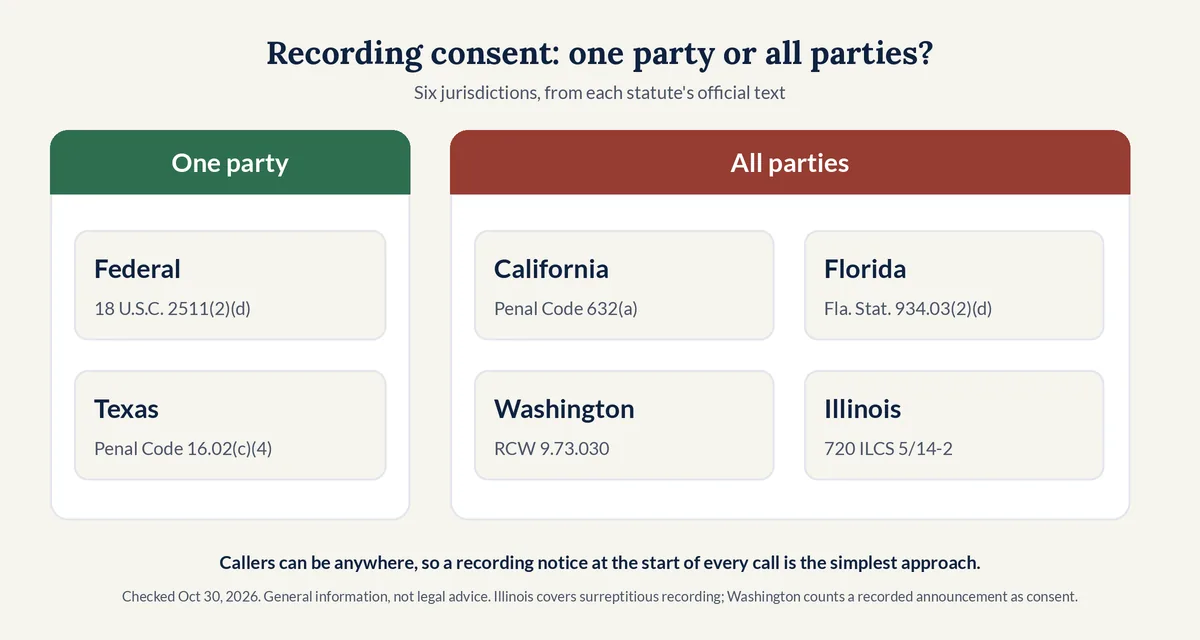
You need at least one party's consent everywhere, and everyone's consent in some states. Federal law and Texas allow recording when one party consents. California, Florida, Washington, and Illinois require consent from all parties, with some differences in wording. Because callers can be anywhere, a recording notice at the start of every call is the simplest approach.
Recording consent rules for six jurisdictions, from each statute's official text:
| Jurisdiction | Consent rule | What the statute says | Source |
|---|---|---|---|
| Federal | One party | Lawful when a party to the call, or someone with one party's prior consent, records it, unless for a criminal or tortious purpose | 18 U.S.C. 2511(2)(d) |
| Texas | One party | A defense applies when the person recording is a party to the call or one party gave prior consent | Penal Code 16.02(c)(4) |
| California | All parties | Bars recording a "confidential communication" without the consent of all parties | Penal Code 632(a) |
| Florida | All parties | Recording is lawful when all parties have given prior consent | Fla. Stat. 934.03(2)(d) |
| Washington | All parties | Consent is obtained when a party announces the recording to everyone in a reasonably effective manner, and the announcement is recorded | RCW 9.73.030(3) |
| Illinois | All parties | Bars recording a private conversation "in a surreptitious manner" without the consent of all other parties | 720 ILCS 5/14-2(a)(2) |
Checked Oct 30, 2026. Which state's law governs a call between two states is a legal question for your counsel.
Ethics guidance can ask for more than the statute. The New York City Bar's Formal Opinion 2025-6 (Dec 22, 2025) concluded that clients "must be notified, and their consent obtained, whenever their calls are being recorded by an AI-empowered system," even though New York allows one-party recording (NYC Bar Opinion 2025-6). Its Formal Opinion 2026-2 applies the same principles to prospective clients and suggests that, absent a good reason, the default should be not to record, because a recording kept inside a firm that declines the case can raise Rule 1.18 conflict risks (NYC Bar Opinion 2026-2). Firms that record should decide who can open recordings and how long they are kept.
Is a call with an AI receptionist confidential?
Your firm should treat it as confidential. Under ABA Model Rule 1.18, what a prospective client shares is generally protected even if the firm never takes the case, and Rule 1.6(c) requires reasonable efforts to prevent unauthorized access. That makes the vendor's storage, access controls, retention, and data use part of the firm's own duties.
Confidentiality under the ethics rules is broader than the attorney-client privilege. Texas Opinion 705 notes the duty covers "both privileged information and all other information relating to a client" (Texas Opinion 705). Whether privilege attaches to a particular intake call is a separate question under your state's law.
Two opinions set the bar for vetting a vendor. ABA Formal Opinion 512 (July 29, 2024) says lawyers should read the terms of use and privacy policy of any generative AI tool, and it lists vendor checks drawn from earlier outsourcing and cloud opinions (ABA Formal Opinion 512). The State Bar of California's 2026 practical guidance adds that "reasonable efforts require more than reliance on generalized marketing assurances" (California guidance).
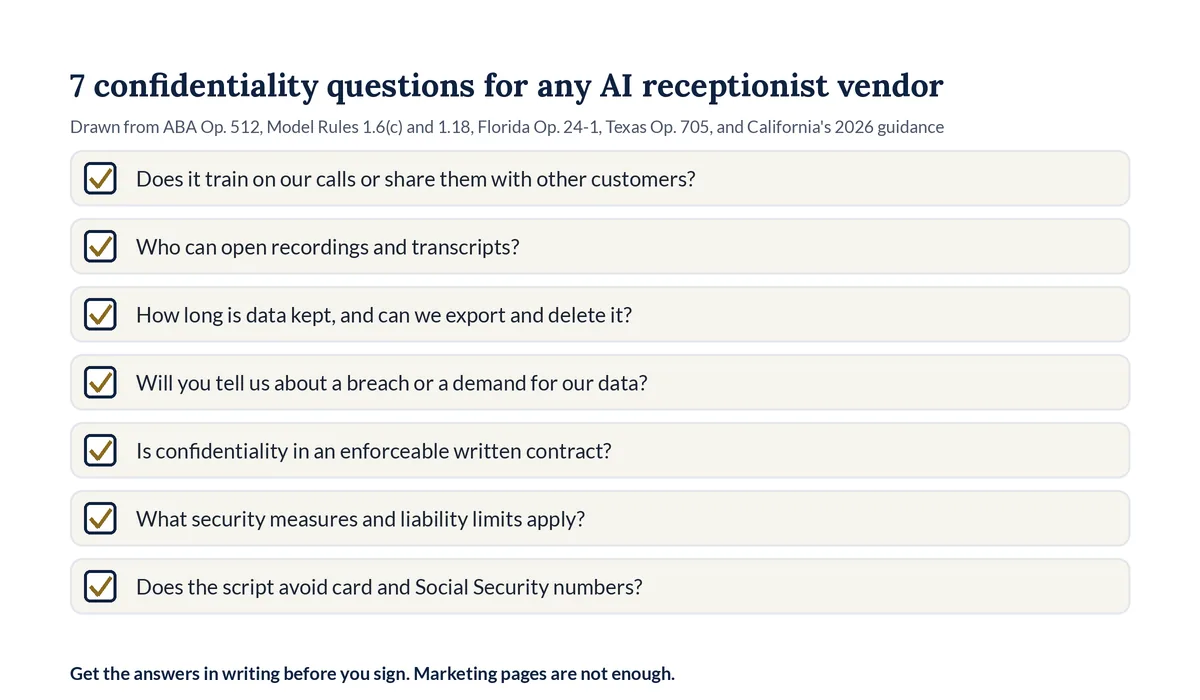
Questions to ask any AI receptionist vendor, and where each comes from:
| Question for the vendor | Why it matters | Source |
|---|---|---|
| Does the system train on our calls or share them with other customers? | Self-learning tools can expose one client's information to others | ABA Op. 512; Florida Op. 24-1 |
| Who can open recordings and transcripts, on your side and ours? | Reasonable efforts to prevent unauthorized access | Model Rule 1.6(c) |
| How long are recordings kept, and can we export and delete them? | Whether the vendor keeps data after service ends | ABA Op. 512; Florida Op. 24-1 |
| Will you notify us of a breach or a demand for our data? | The firm must be able to protect its clients | ABA Op. 512 |
| Is confidentiality in an enforceable written contract? | Promises on a sales page are not enough | ABA Op. 512; California guidance |
| What security measures and liability limits apply? | Stored data can be a target for attackers | ABA Op. 512; Texas Op. 705 |
| Does the script avoid sensitive data like card numbers? | Collect only what the next step needs | Model Rule 1.18 comment [4] |
What do ethics rules say about lawyers using an AI receptionist?
Ethics rules allow it when the lawyer stays in charge. ABA Model Rule 5.3 requires reasonable efforts to ensure outside help acts consistently with the lawyer's duties, Rule 1.1 comment [8] expects lawyers to understand technology's benefits and risks, and ABA Formal Opinion 512 applies both to generative AI. The AI should never give legal advice.
What the main sources say, applied to phone intake:
- Supervision. Rule 5.3(a) and (b) require reasonable efforts to ensure a nonlawyer's conduct "is compatible with the professional obligations of the lawyer." Opinion 512 applies this to outside AI providers and asks managing lawyers to set clear AI policies and train staff (Rule 5.3).
- Competence. Comment [8] to Rule 1.1 says lawyers should keep up with "the benefits and risks associated with relevant technology" (Rule 1.1 comment).
- No legal advice. Opinion 512 says lawyers may not leave it to generative AI tools alone "to offer legal advice to clients."
- Truthful statements. Rule 7.1 bars false or misleading communications about a lawyer's services, which covers what the AI says about fees, results, or who the caller is talking to (Rule 7.1).
- Fair screening. California's 2026 guidance names "autonomously facilitating client intake" as an agentic AI use and notes that AI used in "the screening of clients" may present a risk of unlawful or unethical bias.
State guidance we read, and the point most relevant to phone intake:
| Guidance | Issued | Point for phone intake |
|---|---|---|
| ABA Formal Opinion 512 | July 29, 2024 | Informed client consent before entering information relating to a representation into a self-learning AI tool; vet outside providers |
| Florida Bar Ethics Opinion 24-1 | Jan 19, 2024 | Intake chatbots must say they are AI, not a lawyer or employee; consider screening questions for people already represented |
| Texas Opinion 705 | February 2025 | Understand the tool, review its terms and security, and consider informing clients; consent may be needed |
| State Bar of California practical guidance | 2026 (replaces Nov 2023 version) | Supervision must match the AI's autonomy; watch for bias in client screening |
| NYC Bar Formal Opinions 2025-6 and 2026-2 | Dec 22, 2025, and 2026 | Get consent before AI recording; for prospective clients, the default is not to record without a good reason |
Checked Oct 30, 2026. Advisory opinions are not binding everywhere, and your state's rules control. For what intake should and should not ask, see our guide on how to screen intake callers without losing good cases.
How do you set up an AI receptionist that follows the rules?
To set up an AI receptionist that follows the rules, disclose AI and the recording at the start, keep questions factual, block legal advice, vet the vendor in writing, and review calls every week. Have the attorney responsible for ethics compliance approve the script, and confirm your own state's statutes and opinions first.
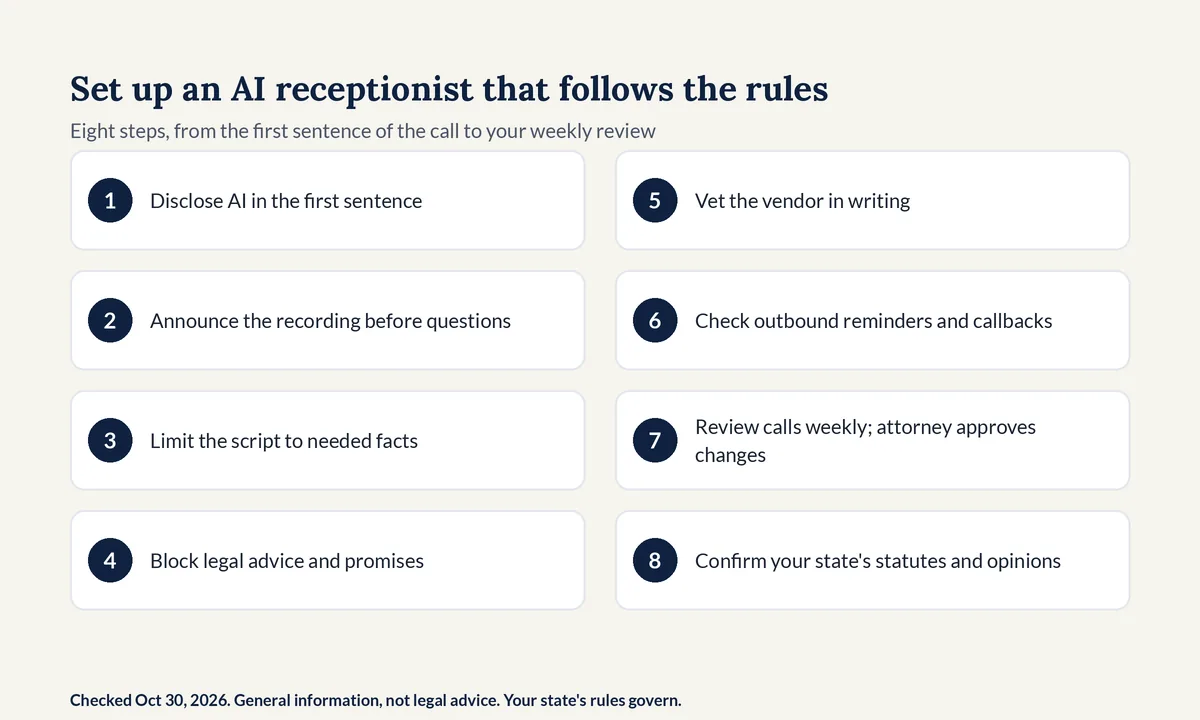
- Disclose that the caller is talking to AI in the first sentence, and confirm it any time a caller asks.
- Announce the recording before any questions, and decide with your attorney what happens if a caller says no.
- Limit the script to the facts needed to choose a next step, and never ask for Social Security or card numbers.
- Block legal advice, case predictions, unapproved fee quotes, and promises that the firm will take a case.
- Vet the vendor's data use, access controls, retention, breach notice, and contract terms in writing.
- Check outbound features, such as reminders and callbacks, against the consent rules for calls the system places.
- Review recordings and summaries every week, and have the responsible attorney approve every script change.
- Confirm your state's recording statute, AI disclosure rules, and ethics opinions with the attorney responsible for ethics compliance.
How does Legal Touch AI handle disclosure, recording and confidentiality?
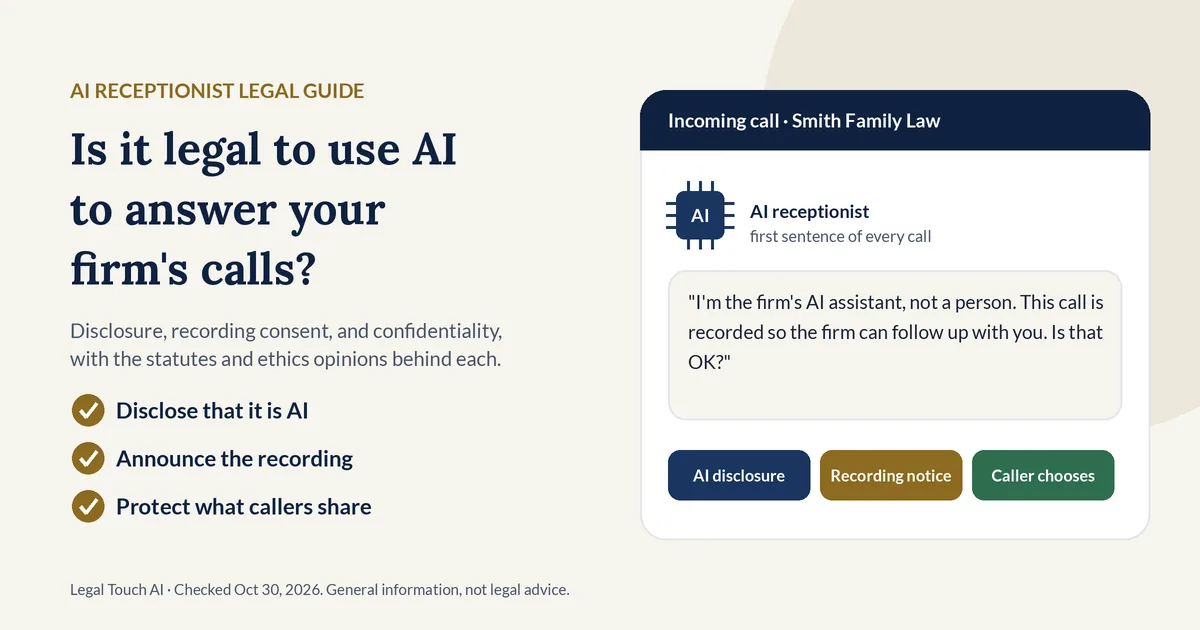
Legal Touch AI says it is your firm's AI assistant in its first sentence and gives a recording notice on every call: "I'm the firm's AI assistant, not a person. This call is recorded so the firm can follow up with you. Is that OK?" If a caller says no, it follows the option you chose at setup.
What else the live site commits to, per how a Legal Touch AI call works:
- No pretending. It never pretends to be a person, never gives legal advice or predicts a result, never decides conflicts, and never promises the firm will take a case.
- No sensitive numbers. It never asks for Social Security numbers, card numbers, or passwords, and never quotes fees unless you approve the exact wording.
- Your records. Recordings and transcripts belong to your firm and are kept for the period your firm chooses, or as the law requires. Export and deletion terms are set in the service agreement.
- Your approval. You approve the greeting, disclosure, recording notice, and questions on test calls before any real caller reaches it.
- Limited outbound calls. It answers incoming calls. The only calls it places are reminders to people who booked with you or asked for a callback, and only if you turn that on.
Under our draft terms of service, your firm approves its script, supervises the service, and follows the confidentiality and advertising rules that apply to its practice. Plans and what's included are on Legal Touch AI plans and pricing, and our legal answering service cost breakdown compares prices across providers.
Other providers handle these points in their own ways, so put the vendor questions above to each one. Our comparison of legal answering services and AI receptionists and our honest Smith.ai alternative comparison are good places to start.
Why we wrote this guide
The Legal Touch AI team has run Legal Touch since 2021. We set up Legal Touch AI on our own phone lines first, before offering it to small law firms. We wrote this guide because the phone is often where a prospective client first shares private facts, and the rules for that moment are spread across statutes and ethics opinions. You can read more about the Legal Touch AI team.
Hear the disclosure for yourself. Book a 15-minute Legal Touch AI demo and listen to the greeting, the recording notice, and how it answers when a caller asks for legal advice.
Related guides
Frequently asked questions
Is Texas a one-party consent state for recording calls?
Yes. Texas Penal Code section 16.02(c)(4) gives a defense when the person recording is a party to the call or one party has given prior consent, unless the purpose is an unlawful act. Texas firms can still get calls from people in all-party states such as California, so a recording notice on every call is a sensible habit.
Can an AI receptionist give legal advice?
No. ABA Formal Opinion 512 says lawyers may not leave it to generative AI tools alone to offer legal advice to clients. An AI receptionist should collect facts, route the call, and offer a consultation when a caller asks a legal question. It should not predict outcomes or promise that the firm will take the case.
What happens if a caller does not want to be recorded?
The firm decides in advance, with its attorney, what the AI does next. Common options are taking a short message or sending the caller to the office line. With Legal Touch AI, the AI follows the option you chose at setup, and that choice is written into the service agreement before activation.
Does talking to an AI receptionist create an attorney-client relationship?
It should not, and the script should help prevent it. Florida Bar Ethics Opinion 24-1 warns that an intake chatbot can create a prospective client or even a lawyer-client relationship without the lawyer knowing. Clear AI disclosure, factual questions only, and no legal advice reduce that risk. Duties to prospective clients can still apply.
Do law firms need client consent to use an AI receptionist?
Ethics opinions differ, so check your state. ABA Formal Opinion 512 says informed consent is required before entering information relating to a representation into a self-learning generative AI tool. Texas Opinion 705 says lawyers should consider informing clients and may need consent. Ask your vendor whether it trains on your call data.
Legal Touch AI is not a law firm and does not provide legal advice. This article is general information, not legal advice, and is not a complete survey of every state's laws. Statutes and ethics opinions change, and your state's laws, rules of professional conduct, and ethics opinions govern. Using Legal Touch AI does not create an attorney-client relationship.
Sources (checked Oct 30, 2026)
- Clio, Legal Trends Report press release (Oct 21, 2019): https://www.clio.com/about/press/clios-legal-trends-report-reveals-law-firms-struggle-to-respond-to-client-inquiries/
- FCC Declaratory Ruling FCC 24-17, CG Docket No. 23-362 (adopted Feb 2, 2024, released Feb 8, 2024): https://docs.fcc.gov/public/attachments/FCC-24-17A1.pdf
- FCC news release on AI-generated voices (Feb 8, 2024): https://docs.fcc.gov/public/attachments/DOC-400393A1.pdf
- 18 U.S.C. 2511 (GovInfo): https://www.govinfo.gov/content/pkg/USCODE-2023-title18/html/USCODE-2023-title18-partI-chap119-sec2511.htm
- Texas Penal Code chapter 16 (section 16.02): https://statutes.capitol.texas.gov/Docs/PE/htm/PE.16.htm
- California Penal Code section 632: https://leginfo.legislature.ca.gov/faces/codes_displaySection.xhtml?lawCode=PEN§ionNum=632
- Florida Statutes section 934.03: http://www.leg.state.fl.us/statutes/index.cfm?App_mode=Display_Statute&URL=0900-0999/0934/Sections/0934.03.html
- Washington RCW 9.73.030: https://app.leg.wa.gov/RCW/default.aspx?cite=9.73.030
- Illinois 720 ILCS 5/14-2: https://www.ilga.gov/legislation/ilcs/fulltext.asp?DocName=072000050K14-2
- Utah Code 13-77-103: https://le.utah.gov/xcode/Title13/Chapter77/C13-77-S103_2025050720250507.html
- Utah Code chapter 13-77 (full chapter, including 13-77-101 and 13-77-104): https://le.utah.gov/xcode/Title13/Chapter77/C13-77_2025050820250508.pdf
- California Business and Professions Code section 17940: https://leginfo.legislature.ca.gov/faces/codes_displaySection.xhtml?lawCode=BPC§ionNum=17940
- California Business and Professions Code section 17941: https://leginfo.legislature.ca.gov/faces/codes_displaySection.xhtml?lawCode=BPC§ionNum=17941
- ABA Formal Opinion 512 (July 29, 2024): https://www.americanbar.org/content/dam/aba/administrative/professional_responsibility/ethics-opinions/aba-formal-opinion-512.pdf
- ABA Model Rule 1.1, Comment: https://www.americanbar.org/groups/professional_responsibility/publications/model_rules_of_professional_conduct/rule_1_1_competence/comment_on_rule_1_1/
- ABA Model Rule 1.6: https://www.americanbar.org/groups/professional_responsibility/publications/model_rules_of_professional_conduct/rule_1_6_confidentiality_of_information/
- ABA Model Rule 1.18: https://www.americanbar.org/groups/professional_responsibility/publications/model_rules_of_professional_conduct/rule_1_18_duties_of_prospective_client/
- ABA Model Rule 1.18, Comment: https://www.americanbar.org/groups/professional_responsibility/publications/model_rules_of_professional_conduct/rule_1_18_duties_of_prospective_client/comment_on_rule_1_18_duties_of_prospective_client/
- ABA Model Rule 5.3: https://www.americanbar.org/groups/professional_responsibility/publications/model_rules_of_professional_conduct/rule_5_3_responsibilities_regarding_nonlawyer_assistant/
- ABA Model Rule 7.1: https://www.americanbar.org/groups/professional_responsibility/publications/model_rules_of_professional_conduct/rule_7_1_communication_concerning_a_lawyer_s_services/
- Florida Bar Ethics Opinion 24-1 (Jan 19, 2024): https://www.floridabar.org/etopinions/opinion-24-1/
- Professional Ethics Committee for the State Bar of Texas, Opinion 705 (February 2025): https://tcle-web.s3.amazonaws.com/public/documents/Opinion_705.pdf
- State Bar of California, Practical Guidance for the Use of Generative AI in the Practice of Law (2026): https://www.calbar.ca.gov/Portals/0/documents/ethics/Generative-AI-Practical-Guidance.pdf
- New York City Bar, Formal Opinion 2025-6 (Dec 22, 2025): https://www.nycbar.org/reports/formal-opinion-2025-6-ethical-issues-affecting-use-of-ai-to-record-transcribe-and-summarize-conversations-with-clients/
- New York City Bar, Formal Opinion 2026-2: https://www.nycbar.org/wp-content/uploads/2026/08/20221672-AiRecordingEthicsOpinion.pdf
- Legal Touch AI how it works: https://legaltouchai.com/how-it-works/
- Legal Touch AI pricing: https://legaltouchai.com/pricing/
- Legal Touch AI privacy policy (draft): https://legaltouchai.com/privacy/
- Legal Touch AI terms of service (draft): https://legaltouchai.com/terms/