Bilingual AI Receptionist for Immigration Law Firms: Serving Spanish-Speaking Callers
A bilingual AI receptionist is a phone system that answers a law firm's calls in English or Spanish, says it is an AI assistant, asks the firm's intake questions, and books consultations. This guide covers what immigration firms need from one: Spanish intake questions, safe answers to legal questions, urgent-call rules, booking, and setup, with sources checked Nov 1, 2026.

Why it matters: in the U.S. Census Bureau's 2024 American Community Survey, 44.9 million people age 5 and older speak Spanish at home, and 41.1% of them say they speak English less than "very well" (Census table S1601, United States). Separately, in a secret-shopper study in Clio's 2019 Legal Trends Report, 39% of calls to law firms went to voicemail (Clio press release, Oct 21, 2019). A caller who can't be understood, or who reaches voicemail, may call the next firm.
What is a bilingual AI receptionist for an immigration law firm?
A bilingual AI receptionist for an immigration law firm is software that answers the firm's phone in English or Spanish, tells callers it is an AI, asks the firm's approved intake questions, flags urgent calls, and books consultations on the attorney's calendar. It never gives legal advice. Attorneys decide every case.
On a typical call it does four jobs:
- Greets the caller with an AI disclosure and a recording notice in the caller's language.
- Asks your intake questions one at a time, in plain words.
- Routes the call by your rules: a live transfer, a booked consultation, or a message.
- Sends you a summary with the caller's answers, the recording, and the transcript.
For a full walkthrough of a call from greeting to summary, see our full rundown of how AI receptionists work for small law firms.
How many of your callers may prefer Spanish?
Nationwide, about 6 of every 100 people age 5 and older speak Spanish at home and speak English less than "very well," per the Census Bureau's 2024 American Community Survey. In California and Texas it is about 11 of every 100, and in Florida about 10.5. An immigration practice may see a very different share than the general population.
We pulled Census table S1601 (2024 ACS 1-year estimates) for the United States and seven states with large Spanish-speaking populations. The last column is our arithmetic.
Spanish speakers who speak English less than "very well" (our compiled table)
| Area | Population age 5+ | Speak Spanish at home | Of those, speak English less than "very well" | Per 100 residents age 5+ (our arithmetic) |
|---|---|---|---|---|
| United States | 321,745,943 | 44,867,699 (13.9%) | 18,432,221 (41.1%) | 5.7 |
| California | 37,348,109 | 10,754,818 (28.8%) | 4,234,066 (39.4%) | 11.3 |
| Texas | 29,339,082 | 8,272,577 (28.2%) | 3,212,475 (38.8%) | 10.9 |
| Florida | 22,225,589 | 5,191,207 (23.4%) | 2,332,104 (44.9%) | 10.5 |
| New Jersey | 8,975,100 | 1,606,399 (17.9%) | 768,926 (47.9%) | 8.6 |
| New York | 18,828,181 | 2,826,836 (15.0%) | 1,301,030 (46.0%) | 6.9 |
| Arizona | 7,188,421 | 1,373,997 (19.1%) | 468,506 (34.1%) | 6.5 |
| Illinois | 12,055,041 | 1,702,816 (14.1%) | 679,251 (39.9%) | 5.6 |
Source: U.S. Census Bureau, ACS 2024 1-year, table S1601, pulled Nov 1, 2026. "Speaks English less than very well" is how people describe themselves to the Census, not a test score.
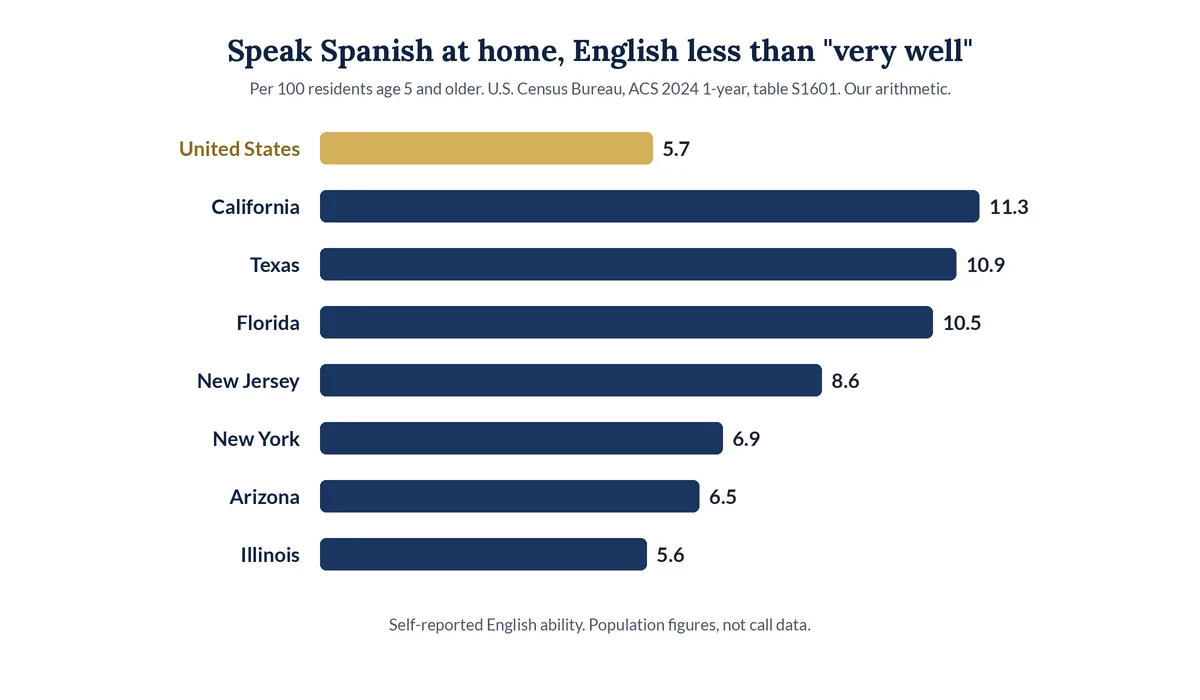
These are population figures, not call data. Your own share depends on your practice, your marketing, and your neighborhood. Count your Spanish-language calls for one month before you decide how to staff them. Texas firms can see six metro areas in our Texas guide, with Census data for six metro areas.
What do ethics rules say about Spanish-speaking clients?
ABA Formal Opinion 500 (Oct 6, 2021) says a lawyer's duties of communication and competence are "undiminished" when lawyer and client don't share a language. When reasonably necessary, the lawyer should use an impartial interpreter or translator who understands the legal concepts and will keep the lawyer's confidences.
The opinion rests on ABA Model Rules 1.1 (competence), 1.4 (communication) and 5.3 (supervising nonlawyer help). Three points from it matter for phone intake:
- Interpreters need real skill. The opinion says to be careful relying on staff who are not professional interpreters.
- Friends and relatives need extra care. A caller's relative may have a personal stake in the matter.
- Technology can help. It says lawyers should also use language-translation technologies when necessary.
The opinion is about lawyers and their clients, and state rules control. Our view: a first call in Spanish is where that relationship starts, so the intake questions should be as clear in Spanish as in English. The AI receptionist books the consultation. The consultation itself still needs a bilingual attorney or a qualified interpreter. For the disclosure and recording side, see our guide to disclosure, recording and confidentiality rules for AI receptionists.
What should a Spanish intake call ask?
A Spanish intake call should ask the same short questions as your English call: the caller's name, best phone number, preferred language, whether they are a current client, what kind of help they need, any date on a notice they received, and their city or state. Leave detailed history for the attorney at the consultation.
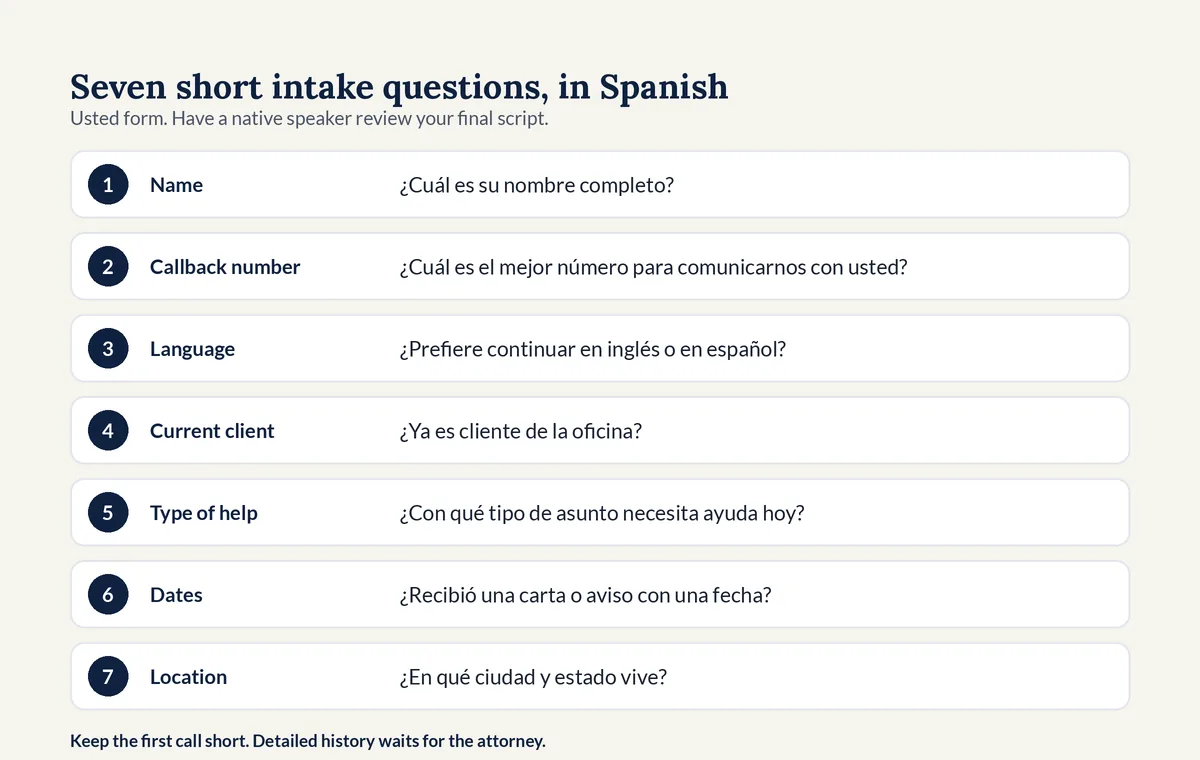
Sample intake questions in English and Spanish (have a native speaker review them)
| What you need | English question | Spanish question (usted form) |
|---|---|---|
| Name | What is your full name? | ¿Cuál es su nombre completo? |
| Callback number | What is the best phone number to reach you? | ¿Cuál es el mejor número para comunicarnos con usted? |
| Language | Would you like to continue in English or Spanish? | ¿Prefiere continuar en inglés o en español? |
| Current client | Are you a current client of the firm? | ¿Ya es cliente de la oficina? |
| Type of help | What kind of help are you looking for today? | ¿Con qué tipo de asunto necesita ayuda hoy? |
| Dates | Did you receive a letter or notice with a date on it? What is the date? | ¿Recibió una carta o aviso con una fecha? ¿Cuál es la fecha? |
| Location | What city and state do you live in? | ¿En qué ciudad y estado vive? |
Three choices make Spanish intake work better:
- Use the formal "usted." It is the safe default with callers you don't know.
- Keep the first call short. Detailed questions about a person's history are better asked by the attorney, in person or by video, with an interpreter if needed.
- Never ask for sensitive numbers by phone. Social Security numbers, card numbers, and passwords stay out of an AI intake call.
Our guide on how to screen intake callers without losing good cases covers screening questions for every practice area.
How should an AI receptionist answer legal questions in Spanish?
An AI receptionist should not answer legal questions in any language. When a caller asks whether they qualify, how long a case takes, or what form to file, it should say it is an AI assistant, not a lawyer, that it can't give legal advice, and offer to book a consultation with an attorney.
This matters more with Spanish-speaking callers. USCIS explains that in many Spanish-speaking countries, "notarios" are attorneys with special legal credentials, but in the United States a notario público "is not authorized to provide you with any legal services related to immigration" (USCIS, Common Scams). EOIR's notice says only licensed attorneys, accredited representatives and other qualified representatives can give legal advice (EOIR, Notario National Notice).
So the AI should be plain about what it is. A sample line, for your native-speaker reviewer:
- English: "I'm the firm's AI assistant, not a lawyer, so I can't give legal advice. I can book you a consultation with one of the firm's attorneys."
- Spanish: "Soy el asistente de inteligencia artificial de la oficina, no un abogado, así que no puedo darle consejos legales. Con gusto le hago una cita con uno de los abogados de la oficina."
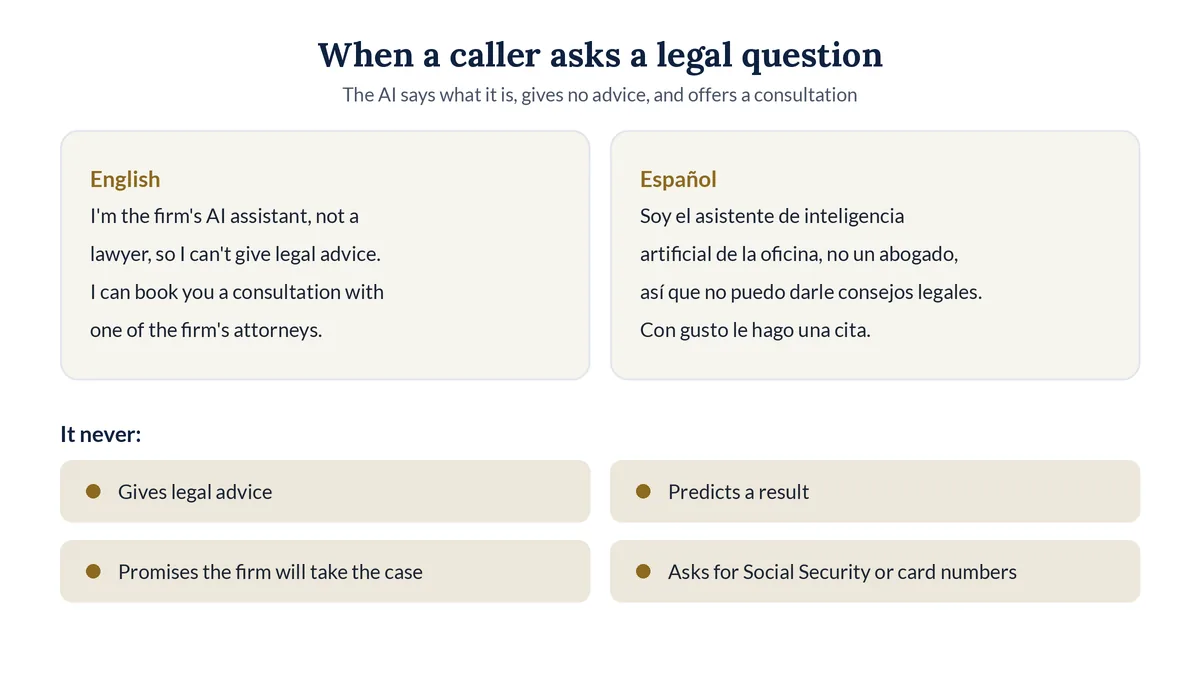
It also should never predict a result, promise the firm will take a case, or quote fees unless you approve the exact wording.
Which immigration calls should be flagged as urgent?
Your firm decides what is urgent, and the AI follows those rules. Common choices are a hearing or appointment date in the next few days, a deadline printed on a notice, or a current client who says something changed. Urgent calls should reach a person right away, by live transfer, text, or both.
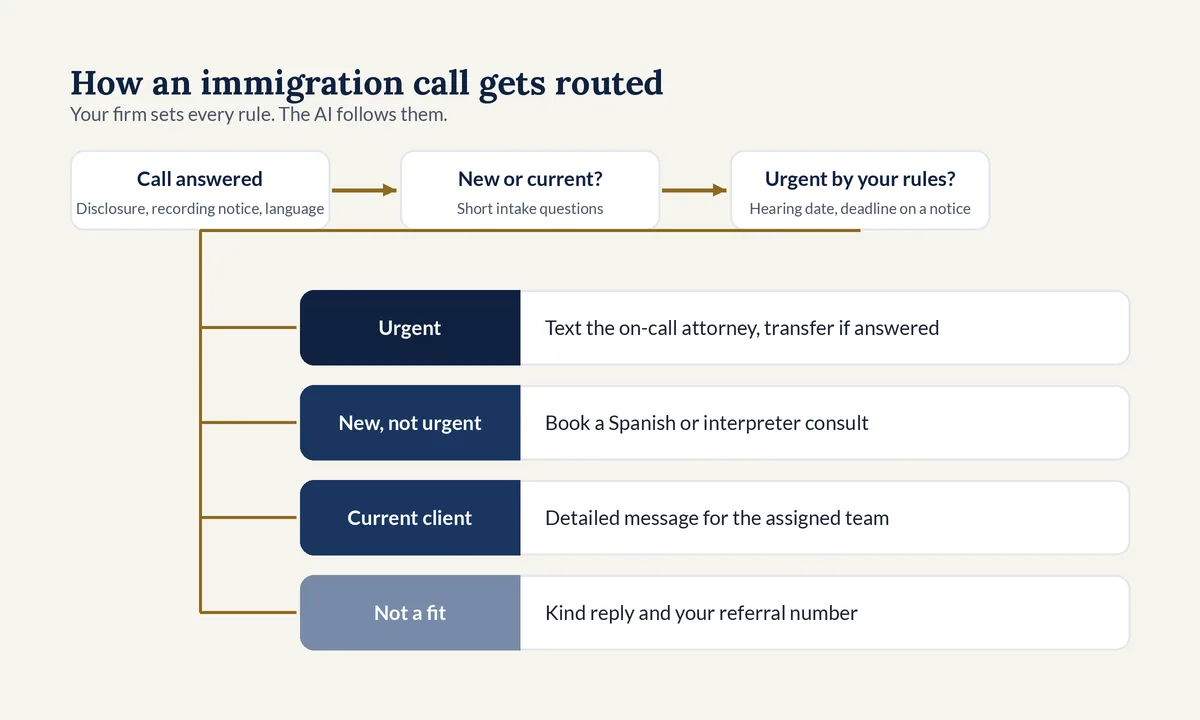
A simple routing plan:
- Urgent by your rules: text the on-call attorney and transfer the caller if someone picks up.
- New caller, not urgent: book a consultation with a Spanish-speaking attorney or a slot with an interpreter.
- Current client: take a detailed message for the assigned attorney or paralegal.
- Not a fit: say so kindly and give a referral number you approved.
Urgent calls don't wait for office hours. Our guide to after-hours answering options for nights and weekends covers coverage plans and what to do with emergencies.
How do you book consultations for Spanish-speaking callers?
To book consultations for Spanish-speaking callers, tag each booking with the caller's language, send it to a Spanish-speaking attorney or to a slot with an interpreter, and confirm the time in the caller's language. Then send a reminder the day before that lists what to bring, such as any letters or notices.
A few details prevent no-shows and wasted consultations:
- Put the language in the calendar title, such as "Consult, Spanish," so staff know who to assign.
- Block interpreter time if no attorney on that day speaks Spanish.
- Ask callers to bring every letter or notice they received, and their own copies of anything filed for them.
- Offer video or phone consultations for callers who work long hours or live far from the office.
How do you set up a bilingual AI receptionist?
To set up a bilingual AI receptionist, decide which calls it answers, write your intake questions in English and have a native speaker review the Spanish, set the disclosure and recording notice in both languages, define urgent calls, connect your calendar, forward your number, and test in both languages before launch.
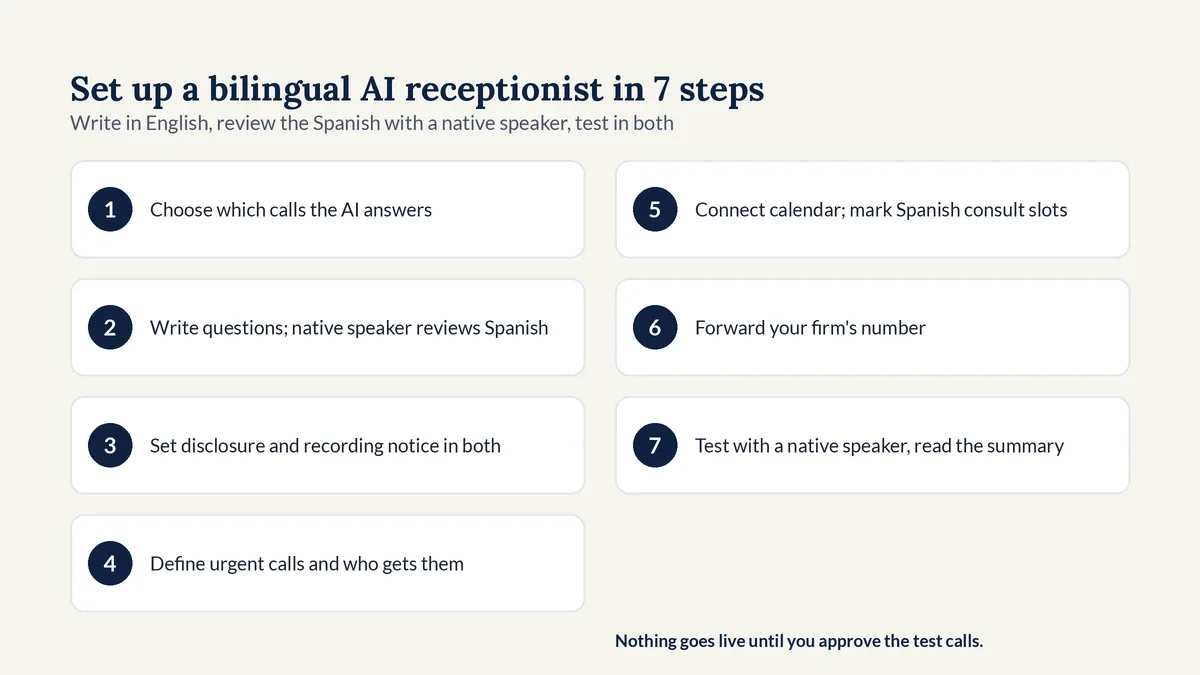
- Choose which calls the AI answers: all calls, overflow, or nights and weekends only.
- Write your intake questions in English, then have a native Spanish speaker review the Spanish version.
- Set the opening in both languages: an AI disclosure and a recording notice.
- Define urgent calls and who gets a text or a transfer for each one.
- Connect your calendar and mark which attorneys take Spanish consultations.
- Forward your firm's number to the AI so callers keep dialing the number they know.
- Test with a native Spanish speaker who switches languages partway through, then read the summary.
How does Legal Touch AI handle Spanish-speaking callers?
Legal Touch AI is an AI receptionist for small U.S. law firms. Spanish is set up on request, so ask about it on the demo call and we'll confirm in writing what your plan includes. Every call starts with an AI disclosure and a recording notice, then your screening questions, one at a time.
What it does on every call:
- Tells callers it is an AI in its first sentence and gives a recording notice.
- Sends good callers to you live during office hours, with a text to you first.
- Books consultations on your Google or Outlook calendar after hours or when you don't pick up.
- Flags urgent calls by your rules with an "URGENT" text and email.
- Sends a summary, the recording, and the transcript after every call.
It never gives legal advice, predicts a result, decides conflicts, or promises that your firm will take a case. You keep your number and approve every script change. For plans, see Legal Touch AI plans and pricing.
Why we wrote this guide
The Legal Touch AI team has run Legal Touch since 2021. We set up Legal Touch AI on our own phone lines first, screening callers and booking callbacks, before offering it to small law firms. We wrote this guide because most bilingual receptionist pages we read stop at "we speak Spanish." Immigration firms also need clear Spanish intake questions, a safe answer to legal questions, and a plan for the consultation itself.
Hear it answer a call. Book a 15-minute Legal Touch AI demo and ask about Spanish answering for your intake questions.
Frequently asked questions
Can an AI receptionist speak Spanish?
Many can, but quality varies, so test before you sign. Ask the vendor for a live demo in Spanish, then have a native speaker call, use everyday words, and switch to English partway through. Read the summary afterward and check that the name, phone number, and reason for the call came through correctly.
Should the AI greet callers in English or Spanish first?
One common setup opens in English with a short Spanish line, or asks the caller which language they prefer. If most of your callers speak Spanish, open in Spanish. Either way, the AI disclosure and the recording notice should come first, in the language the caller will understand, before any intake questions.
Can an AI receptionist tell a caller their immigration court date?
It shouldn't read case information to callers. If your firm approves it, the AI can point callers to EOIR's Automated Case Information system, which works in English and Spanish and asks for an A-Number. EOIR says that tool is for convenience only. Otherwise, the AI takes a message for the attorney.
Does a bilingual AI receptionist replace an interpreter?
No. It handles first contact: the greeting, short intake questions, and booking. ABA Formal Opinion 500 says that when reasonably necessary, lawyers should use an impartial interpreter who understands the legal concepts and keeps confidences. Plan a bilingual attorney or a qualified interpreter for the consultation itself.
What should the AI say if a caller asks whether they qualify?
It should say it is the firm's AI assistant, not a lawyer, and can't give legal advice, then offer to book a consultation with an attorney. It should never guess, predict a result, or promise the firm will take the case. That keeps callers safe and leaves every legal judgment to your attorneys.
Legal Touch AI is not a law firm and does not provide legal advice. This article is general information, not legal advice about immigration or professional ethics rules. Using Legal Touch AI does not create an attorney-client relationship.
Sources (checked Nov 1, 2026)
- U.S. Census Bureau, ACS 2024 1-year, table S1601, United States: https://data.census.gov/table/ACSST1Y2024.S1601?g=010XX00US
- U.S. Census Bureau, ACS 2024 1-year, table S1601, seven states (CA, TX, FL, NJ, NY, AZ, IL): https://data.census.gov/table/ACSST1Y2024.S1601?g=040XX00US06,040XX00US48,040XX00US12,040XX00US34,040XX00US36,040XX00US04,040XX00US17
- Clio, Legal Trends Report press release (Oct 21, 2019): https://www.clio.com/about/press/clios-legal-trends-report-reveals-law-firms-struggle-to-respond-to-client-inquiries/
- ABA Formal Opinion 500, Language Access in the Client-Lawyer Relationship (Oct 6, 2021): https://www.americanbar.org/content/dam/aba/administrative/professional_responsibility/ethics-opinions/aba-formal-opinion-500.pdf
- ABA Model Rule 5.3, Responsibilities Regarding Nonlawyer Assistance: https://www.americanbar.org/groups/professional_responsibility/publications/model_rules_of_professional_conduct/rule_5_3_responsibilities_regarding_nonlawyer_assistant/
- USCIS, Common Scams (notarios públicos): https://www.uscis.gov/scams-fraud-and-misconduct/avoid-scams/common-scams
- USCIS, Legal Services (who may represent you): https://www.uscis.gov/scams-fraud-and-misconduct/avoid-scams/legal-services
- EOIR, Notario National Notice: https://www.justice.gov/eoir/notario-national-notice
- EOIR, Automated Case Information: https://acis.eoir.justice.gov/en/
- Legal Touch AI, how it works: https://legaltouchai.com/how-it-works/