AI Receptionist for Texas Law Firms: Setup, Spanish Callers and Local Numbers
An AI receptionist for a Texas law firm is a phone system that answers the firm's calls with a natural-sounding voice, asks the firm's intake questions, books consultations, and texts the attorney a summary. This guide covers what Texas firms need to get right: Spanish-speaking callers, keeping a local 713 or 214 number, Texas recording and AI rules, and setup, with sources checked on Oct 31, 2026.
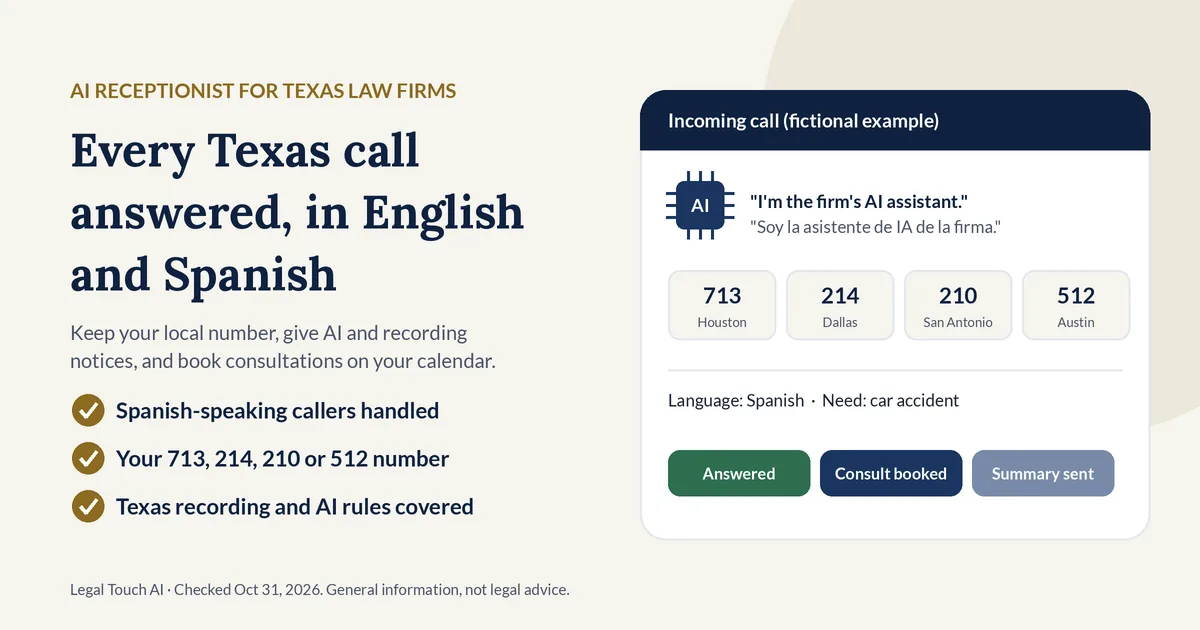
Why Texas is different: in the U.S. Census Bureau's 2024 American Community Survey, 28.2% of Texans age 5 and older speak Spanish at home, and 38.8% of them report speaking English less than "very well" (Census table S1601, Texas). A firm whose phones only work in English can lose those callers before anyone hears what they need.
What is an AI receptionist for a Texas law firm?
An AI receptionist for a Texas law firm is software that answers the firm's phone line, says it is an AI assistant, asks set intake questions, and books consultations on the firm's calendar. For Texas firms, a good setup also handles Spanish-speaking callers, keeps the firm's local number, and sends the attorney a short summary after every call.
It does not replace your judgment. It never gives legal advice, decides conflicts, or promises that your firm will take a case. Its job is to make sure every caller reaches someone, gets the right questions, and lands on your calendar or in your inbox. For the full picture of features, costs, and how to compare providers, see our main guide to choosing an AI receptionist for a law firm.
Who this guide is for: the State Bar of Texas reports 118,430 active attorney members as of Dec 31, 2025. Of the 51,955 who reported working in private practice, 33,204 (about 64%) are solo practitioners or work in firms of 2 to 10 attorneys (State Bar of Texas, Attorney Statistical Profile 2025-26). The percentage is our arithmetic from the bar's numbers.
| Practice setting (State Bar of Texas, Dec 31, 2025) | Active attorneys | Share of private practitioners |
|---|---|---|
| Solo practitioners | 16,742 | 32.2% |
| Firms of 2 to 5 attorneys | 12,290 | 23.7% |
| Firms of 6 to 10 attorneys | 4,172 | 8.0% |
| Solo through 10 attorneys, combined | 33,204 | 63.9% |
| All private practitioners who reported a setting | 51,955 | 100% |
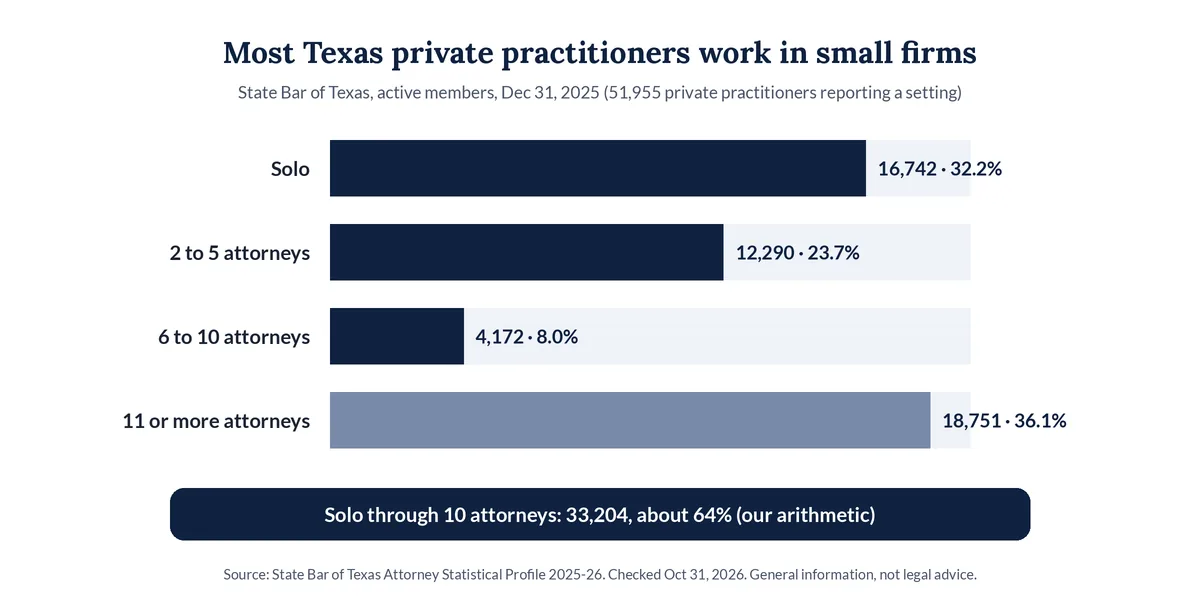
These are the firms that rarely have a full-time receptionist on every phone, every hour.
How many of your Texas callers may prefer Spanish?
In Texas, 28.2% of people age 5 and older speak Spanish at home, and 38.8% of those report speaking English less than "very well," according to the Census Bureau's 2024 American Community Survey. That is about 11 of every 100 Texans. In Houston it is about 14, and in El Paso and McAllen 25 to 29.
We pulled the same Census table (S1601, 2024 ACS 1-year estimates) for Texas and six metro areas. The last column is our arithmetic: people who speak Spanish at home and English less than "very well," per 100 residents age 5 and older.
| Area (Census metro area) | Population age 5+ | Speak Spanish at home | Of those, speak English less than "very well" | Per 100 residents age 5+ (our arithmetic) |
|---|---|---|---|---|
| Texas (statewide) | 29,339,082 | 8,272,577 (28.2%) | 3,212,475 (38.8%) | 10.9 |
| Houston-Pasadena-The Woodlands | 7,292,959 | 2,205,011 (30.2%) | 995,644 (45.2%) | 13.7 |
| Dallas-Fort Worth-Arlington | 7,819,405 | 1,704,244 (21.8%) | 687,439 (40.3%) | 8.8 |
| San Antonio-New Braunfels | 2,594,758 | 767,408 (29.6%) | 239,315 (31.2%) | 9.2 |
| Austin-Round Rock-San Marcos | 2,402,757 | 482,613 (20.1%) | 182,420 (37.8%) | 7.6 |
| El Paso | 823,316 | 538,235 (65.4%) | 206,160 (38.3%) | 25.0 |
| McAllen-Edinburg-Mission | 845,480 | 653,247 (77.3%) | 247,674 (37.9%) | 29.3 |
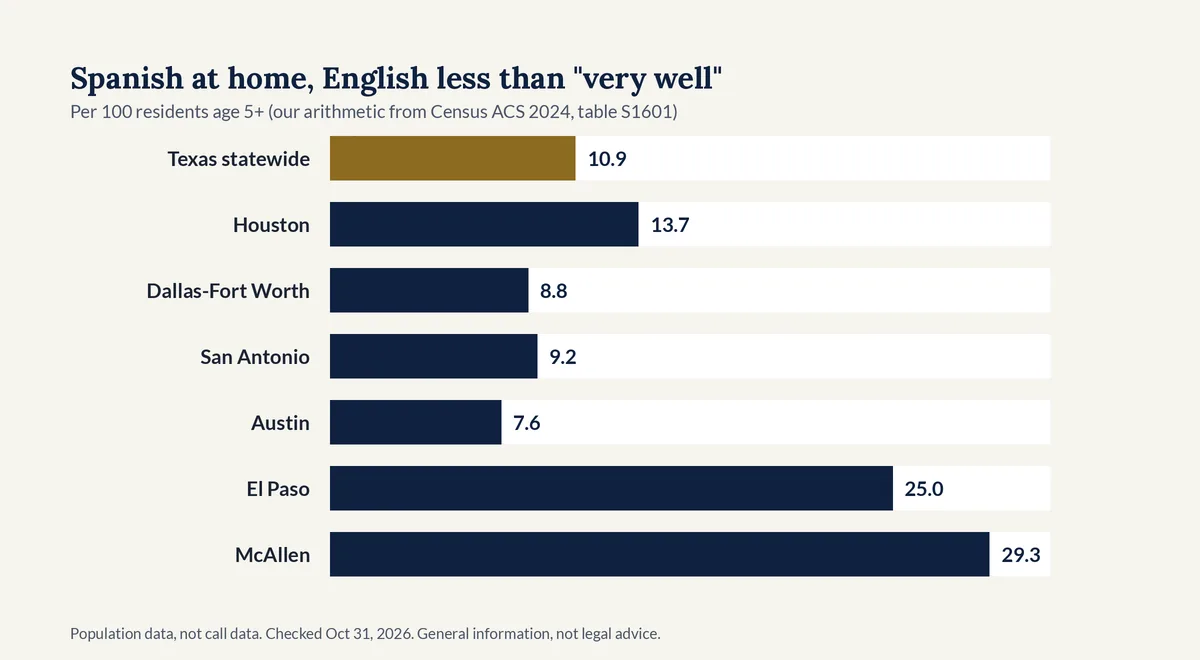
Two cautions. These are population figures, not call data, so your own share of Spanish-speaking callers depends on your practice area, marketing, and neighborhood. And "speaks English less than very well" is how people describe themselves to the Census, not a test score. The point is simple: in most Texas markets, a meaningful share of callers will be more comfortable in Spanish.
Should an AI receptionist answer calls in Spanish?
Yes, if Spanish-speaking callers are part of your market. An AI receptionist that can switch to Spanish lets those callers describe their situation in their own words, answer intake questions accurately, and book a consultation, instead of hanging up or leaving a voicemail no one on staff can understand.
What a good Spanish setup includes:
- A bilingual greeting or a quick language check at the start of the call, with no "press 2 for Spanish" menu.
- The same intake questions in both languages, reviewed by a native Spanish speaker, not just machine translated.
- Summaries in English for your team, with the caller's own words kept where they matter.
- A plan for transfers. If no one at the firm speaks Spanish, the AI should book a consultation rather than transfer to someone who can't help.
- A plan for the consultation itself. Decide whether a bilingual attorney, a staff member, or an interpreter will handle the meeting.
Test it before you go live. Have a native speaker call in Spanish, switch to English partway through, and use the everyday words your clients use. Then read the summary and check that nothing important was lost. For the questions to ask, see our guide to screening intake callers without losing good cases.
Can you keep your local Texas phone number?
Yes. Legal Touch AI, like many AI receptionists, works by call forwarding. Your firm keeps its existing number and phone company, and you forward calls to the AI service, either all calls or only the ones staff don't answer. Callers still dial your 713, 214, 210 or 512 number and see it on your website and signage.
Local numbers matter to callers because they signal a local firm. Texas metro areas often have several area codes, so a new line may get a different code than your main number. The Public Utility Commission of Texas lists these codes for the four largest metros:
| Metro area | Area codes (Public Utility Commission of Texas) |
|---|---|
| Houston | 281, 346, 621, 713, 832 |
| Dallas | 214, 469, 945, 972 |
| San Antonio | 210, 726 |
| Austin | 512, 737 |
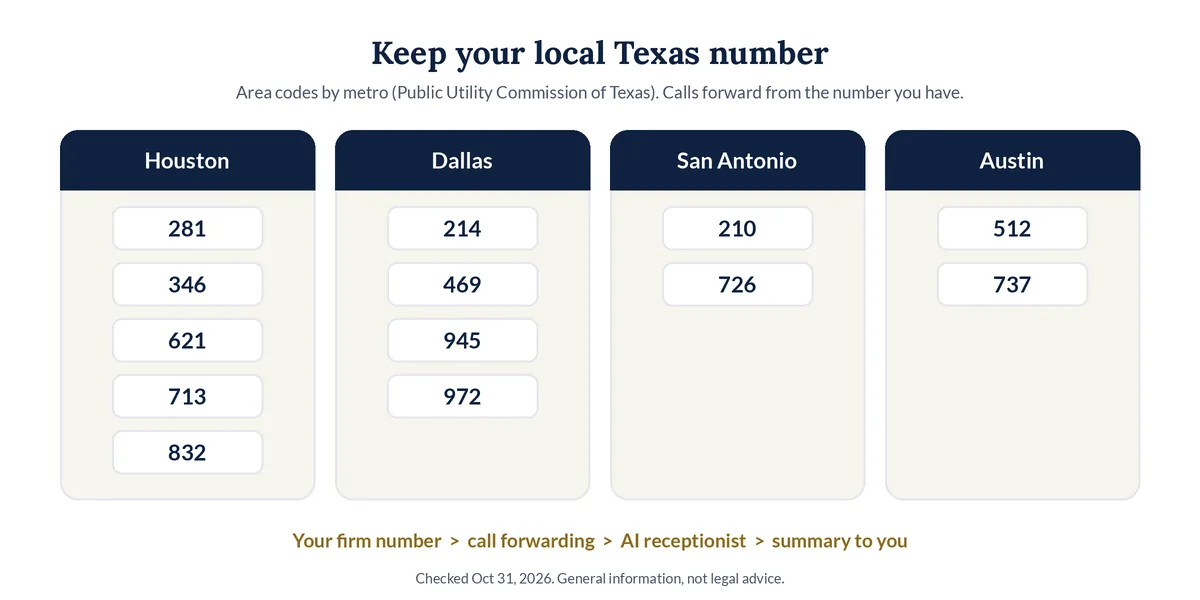
Source: Public Utility Commission of Texas, Texas area codes. The PUC notes that a Dallas business could be assigned 214, 469 or 972 when it adds lines. Forwarding avoids that problem, because callers keep using the number they already have.
Is it legal to record calls in Texas?
Yes, in most situations. Texas is a one-party consent state. Under Texas Penal Code § 16.02(c)(4), it is a defense to the interception offense when the person recording is a party to the call or one party has consented, unless the recording is made to commit an unlawful act. Callers in other states may be covered by stricter rules.
Read the statute at the Texas Penal Code, chapter 16. Three practical points for a Texas firm:
- Out-of-state callers. Some people calling a Texas firm are in states that require every party's consent. A short notice at the start of each call covers that case.
- Say it every time. The notice costs a few seconds, and callers who stay on the line after hearing it have been told.
- Keep recordings safe. A recording of an intake call can contain confidential information. Know where it is stored, who can hear it, and how long it is kept.
Our guide on the disclosure, recording and confidentiality questions for AI receptionists covers the rules state by state in more depth.
Does Texas require an AI receptionist to say it is AI?
Texas's AI law, House Bill 149 (2025), took effect Jan 1, 2026. Its disclosure section requires government agencies, and providers of health care services, to tell people they are interacting with AI. It does not list private law firms. Even so, saying "I'm an AI assistant" at the start of the call is the safer practice for a Texas firm.
The disclosure rule is in Texas Business and Commerce Code § 552.051 (enrolled text of H.B. 149). It says a disclosure must be given even if it would be obvious to a reasonable consumer that they are talking to AI, and it must be clear and conspicuous and in plain language. Those are good standards to follow even where the law doesn't apply to you.
Why disclose anyway: callers who find out later that they were talking to software may feel misled, and that is a poor start to a client relationship. Laws in other states, and federal rules, keep changing. A one-sentence disclosure removes the question.
What do Texas ethics rules say about using AI at a law firm?
Texas lawyers may use generative AI tools. Professional Ethics Committee Opinion 705 (February 2025) says a lawyer who uses them must understand how they work to a reasonable degree, protect client confidential information, verify what they produce, and stay responsible for the results, much as with a nonlawyer assistant.
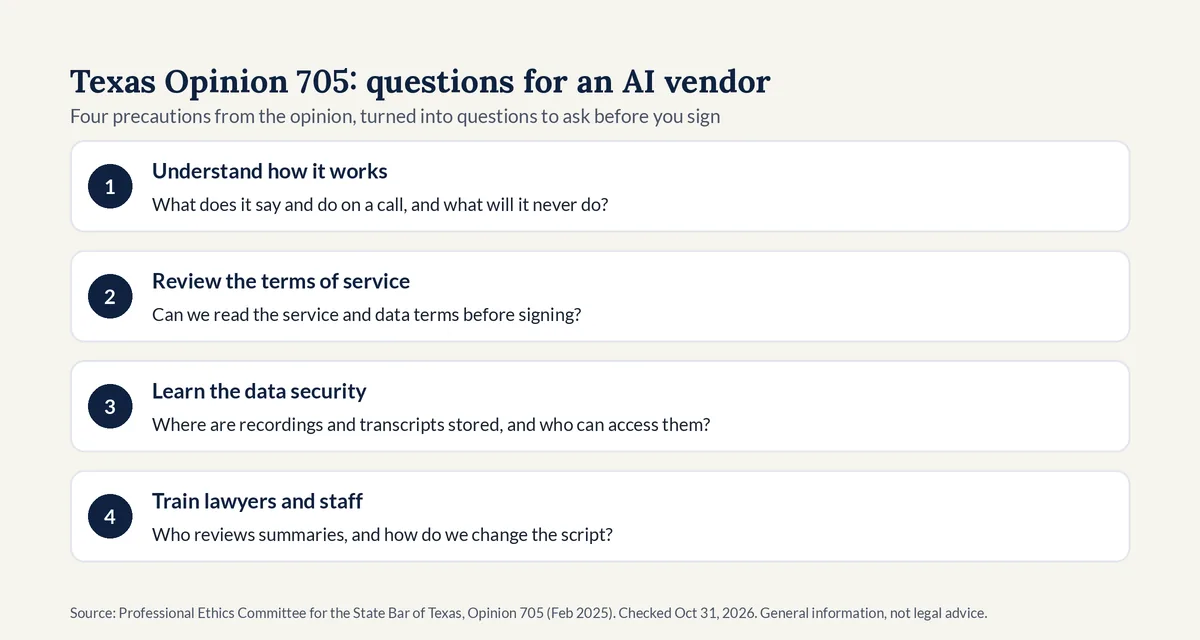
Opinion 705 lists reasonable precautions drawn from the committee's earlier Opinion 680 on cloud computing (Texas Opinion 705). We turned them into questions to ask any AI receptionist vendor:
| Opinion 705 precaution | Question to ask the vendor |
|---|---|
| Acquire a general understanding of how the technology works | What does the AI say and do on a call, and what is it set never to do? |
| Review the terms of service | Can we read the service terms and data terms before we sign? |
| Learn about data-security protections | Where are recordings, transcripts and summaries stored, and who can access them? |
| Train lawyers and staff | Who on our team reviews summaries, and how do we change the script? |
The opinion also says that if a lawyer is not reasonably satisfied a tool will protect confidential information, the lawyer should not put confidential information into it without client consultation and consent. An intake call is often a potential client's first contact, so ask early. This is general information, not legal advice. Check the opinion itself and any later guidance.
How do you set up an AI receptionist for a Texas law firm?
To set up an AI receptionist for a Texas firm, decide which calls it answers, write intake questions for each practice area in English and Spanish, set the AI and recording notices, connect your calendar, forward your local number, and test with real callers, including a native Spanish speaker. Most of the work is in the questions.
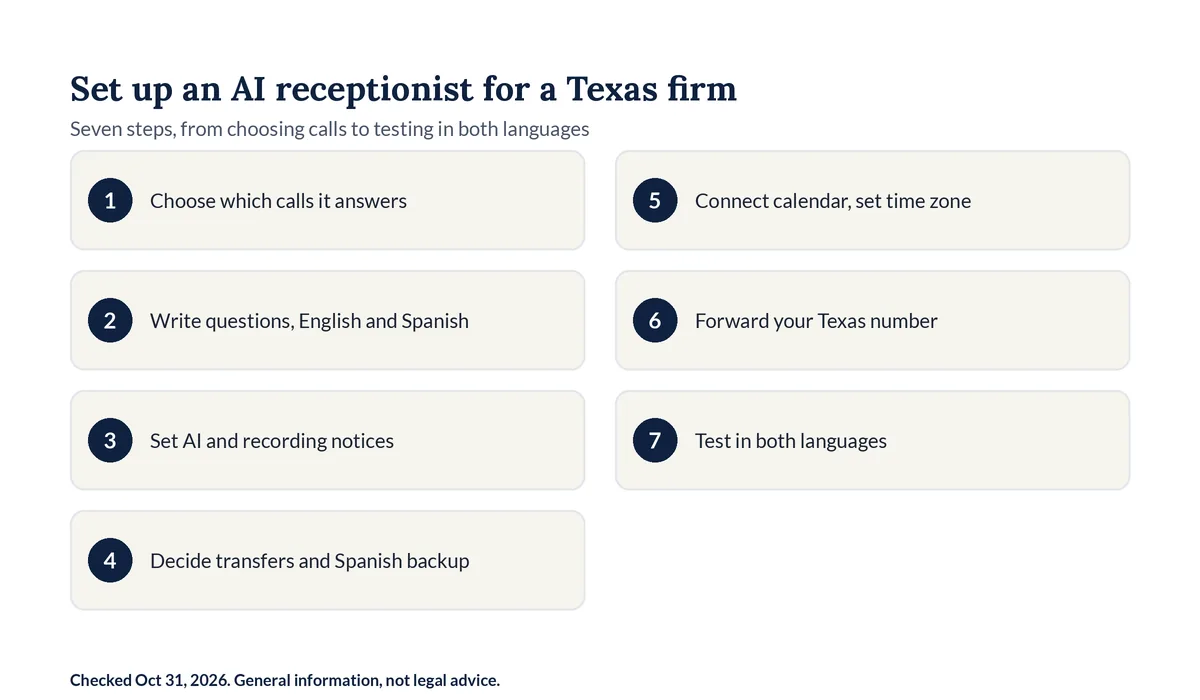
- Choose which calls the AI answers: all calls, after hours only, or calls staff don't pick up.
- Write your intake questions for each practice area, and have a native speaker review the Spanish version.
- Set the opening: an AI disclosure and a recording notice, in English and in Spanish.
- Decide who gets live transfers, and what the AI does when no Spanish speaker is available.
- Connect your calendar and set office hours in your local time zone.
- Forward your existing Texas number to the service, starting with the calls you miss today.
- Test with real calls in both languages, then review summaries weekly for the first month.
A note on time zones: most of Texas is on Central Time, but El Paso and Hudspeth counties are west of the federal Central/Mountain boundary line (49 CFR 71.7(e)), so firms there run on Mountain Time. Set office hours and booking times to match.
What does an AI receptionist cost a Texas law firm?
AI receptionists often cost a flat monthly fee for a set number of call minutes, while live answering services more often bill by the minute or call. Pricing does not change by state. Texas firms should compare total monthly cost at their own call volume, including setup, extra minutes, and any add-ons such as Spanish.
Legal Touch AI plans start at $149 a month. See Legal Touch AI plans and pricing for details.
For a full comparison of billing models at different call volumes, read our breakdown of legal answering service costs. If after-hours calls are your main problem, our guide to after-hours answering for nights, weekends and court days shows how many hours a typical office is closed. And if you are not sure how many calls you miss now, start with why law firms miss calls and what it costs.
Which Texas practice areas benefit most from an AI receptionist?
Practice areas where callers call at all hours, are stressed, or prefer Spanish benefit most: personal injury, criminal defense, family law, and immigration. Any Texas firm that books consultations by phone and misses calls during court, lunch, or after hours can benefit, especially solo and small firms without a full-time receptionist.
How the setup differs by practice area:
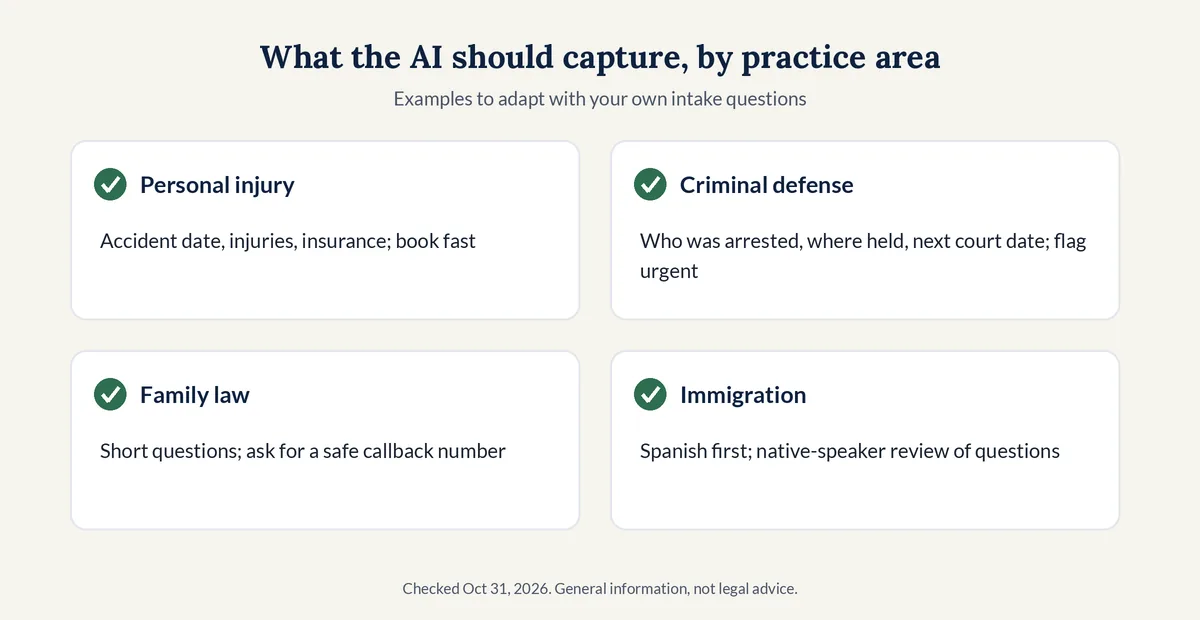
- Personal injury. Accident calls can come in nights and weekends. The AI should capture the accident date, injuries, and insurance details and book quickly. See our guide on an AI receptionist for personal injury firms.
- Criminal defense. Family members call about an arrest at any hour. The AI should capture the person's name, where they are held, and the next court date, and flag the call as urgent.
- Family law. Callers are often upset and may be calling from a shared phone. Keep questions short and ask for a safe callback number.
- Immigration. Spanish is often the caller's first language. Native-speaker review of the Spanish questions matters most here.
How does Legal Touch AI handle calls for Texas firms?
Legal Touch AI answers on the first ring with no phone menu, says it is the firm's AI assistant, and gives a recording notice. It asks your intake questions, texts you before transferring a good caller, and books consultations on your Google or Outlook calendar. You keep your Texas number and forward calls to it.
What our live site commits to, from our home page and our step-by-step page on how a call works:
- Disclosure first. Every call opens with: "I'm the firm's AI assistant, not a person. This call is recorded so the firm can follow up with you. Is that OK?"
- You keep your number. You keep your number and your phone company, forward calls to Legal Touch AI, and can switch the forwarding off any time.
- Transfers with a heads-up. You get a text before a transfer. If you don't pick up by the third ring, it goes back to the caller, books a time, and texts you.
- Booking and reminders. It offers two open times from your calendar. The caller gets a text and email confirmation, a reminder the day before, and a reschedule link.
- Summaries in about a minute. You get a short text with name, phone, need, and outcome, plus an email with every answer, the recording, and the transcript.
- Limits. It never gives legal advice or predicts a result, never decides conflicts, never promises your firm will take a case, and never pretends to be a person.
Spanish: ask about Spanish answering on the demo call, and we'll show you how it works with your own intake questions.
Why we wrote this guide
We set up Legal Touch AI on our own phone lines first, before offering it to small law firms. Our own callers are often stressed, many call after work or on weekends, and some are more comfortable in Spanish. We needed every call answered, every caller treated kindly, and every good lead sent to the right person on our team. You can read more about the Legal Touch AI team.
Hear it yourself. Book a 15-minute Legal Touch AI demo, then call the demo line in English and in Spanish and hear what your callers would hear.
Frequently asked questions
Does an AI receptionist make sense for a solo attorney in Texas?
Often, yes. A solo attorney is the receptionist, the lawyer, and the person in court, so calls get missed whenever the attorney is busy. State Bar of Texas data shows 16,742 active solo practitioners as of Dec 31, 2025. An AI receptionist answers while you work and books consultations so you can call back prepared.
Can an AI receptionist handle callers who switch between English and Spanish?
Some can, but test it yourself before you rely on it. Ask the vendor for a live demo, then have a native Spanish speaker call, switch to English partway through, and use everyday words your clients use. Read the summary afterward and check that the caller's name, phone number, and legal need came through correctly.
Do I need a new Texas phone number for an AI receptionist?
No. Many AI receptionists work by call forwarding, so you keep your existing number and phone company. Your callers keep dialing the 713, 214, 210, 512 or other Texas number on your website, cards, and signs. You can forward all calls, only after-hours calls, or only the calls your staff don't answer.
Can a Texas law firm let an AI book consultations?
Texas Ethics Opinion 705 allows lawyers to use generative AI tools if they understand how the tool works, protect confidential information, and verify its results. Booking a consultation is an administrative task, not legal advice. The attorney still decides whether to take the case and checks conflicts. This is general information, not legal advice.
What time zone will an AI receptionist use for a Texas firm?
It should use the time zone you set for your office. Most of Texas is on Central Time, but El Paso and Hudspeth counties are on Mountain Time under the federal time zone boundary in 49 CFR 71.7. Set your office hours and booking times to your local zone, and check them after daylight saving changes.
Legal Touch AI is not a law firm and does not provide legal advice. This article is general information, not legal advice. Laws and ethics rules change, and your state's laws, rules of professional conduct, and ethics opinions govern. Using Legal Touch AI does not create an attorney-client relationship.
Sources (checked Oct 31, 2026)
- U.S. Census Bureau, American Community Survey 2024 1-year estimates, table S1601 (Texas and six metro areas): https://data.census.gov/table/ACSST1Y2024.S1601?g=040XX00US48
- State Bar of Texas, Department of Research and Analysis, Attorney Statistical Profile 2025-26 (statewide columns): https://www.texasbar.com/AM/Template.cfm?ContentID=71546&Section=Demographic_and_Economic_Trends&Template=%2FCM%2FContentDisplay.cfm
- Public Utility Commission of Texas, Texas area codes: https://www.puc.texas.gov/industry/maps/areacodes/txareacodes/Default.aspx
- Texas Penal Code, chapter 16 (section 16.02): https://statutes.capitol.texas.gov/Docs/PE/htm/PE.16.htm
- Texas H.B. 149 (89th Legislature), enrolled text, adding Business and Commerce Code section 552.051: https://capitol.texas.gov/tlodocs/89R/billtext/html/HB00149F.htm
- Professional Ethics Committee for the State Bar of Texas, Opinion 705 (February 2025): https://www.texasbar.com/AM/Template.cfm?ContentID=67504&Section=Table_of_contents&Template=%2FCM%2FContentDisplay.cfm
- 49 CFR 71.7, boundary line between central and mountain zones: https://www.ecfr.gov/current/title-49/subtitle-A/part-71/section-71.7
- Legal Touch AI how it works: https://legaltouchai.com/how-it-works/
- Legal Touch AI pricing: https://legaltouchai.com/pricing/
- Legal Touch AI about: https://legaltouchai.com/about/