AI Receptionist for Criminal Defense Lawyers: Arrest Calls, Jail Calls and Intake
A criminal defense answering service is a service that answers a defense firm's phone day and night, takes down arrest and court details, and gets urgent calls to an attorney fast. This guide covers how an AI receptionist does that job: what to ask, what never to ask, jail calls, urgent routing, ethics rules, and setup, with sources checked Nov 1, 2026.
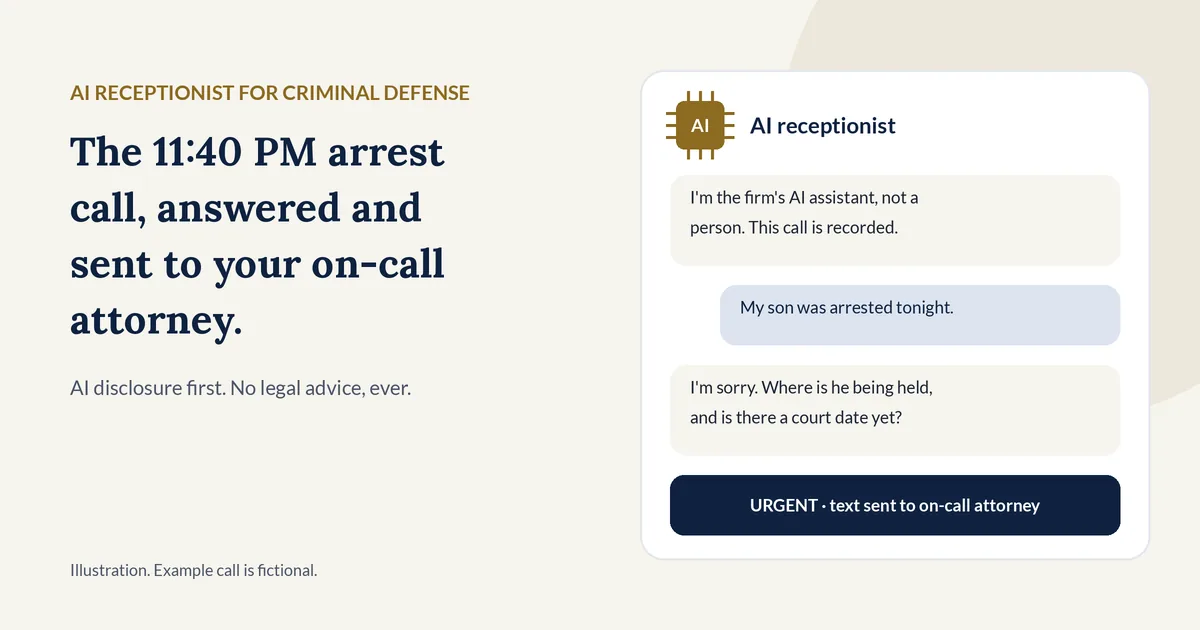
Why it matters: U.S. local jails recorded 7,627,000 admissions in the 12 months ending June 30, 2023, according to the Bureau of Justice Statistics (BJS, Jail Inmates in 2023). That works out to about 20,900 a day, or about 870 an hour (our arithmetic). Separately, in a secret-shopper study in Clio's 2019 Legal Trends Report, 39% of calls to law firms went to voicemail (Clio press release, Oct 21, 2019). A family that reaches voicemail may call the next name on the list.
What is an AI receptionist for criminal defense lawyers?
An AI receptionist for criminal defense lawyers is software that answers a defense firm's phone, says it is an AI, asks the firm's approved intake questions, flags arrests and near court dates as urgent, and books consultations. It never gives legal advice, never predicts results, and leaves every legal decision to the firm's attorneys.
On a typical call it does four jobs:
- Greets the caller with an AI disclosure and a recording notice.
- Asks short intake questions about who was arrested, where they are held, and the next court date.
- Routes the call by your rules: urgent alert, live transfer, booked consultation, or message.
- Sends you a summary with the answers, the recording, and the transcript.
For the full picture of how a call flows from greeting to summary, see our complete guide to how AI receptionists work for small law firms.
Why do criminal defense firms need 24/7 call answering?
Criminal defense firms need 24/7 answering because arrests and bookings happen every day of the year, not just during office hours. BJS counted 7,627,000 jail admissions in the 12 months ending June 30, 2023. That averages about 20,900 a day and about 870 an hour, by our arithmetic, including nights and weekends.
We pulled the 2023 figures from BJS's Jail Inmates in 2023 statistical tables. The arithmetic rows are ours.
Jail admissions by the numbers (our compiled table)
| Measure | Figure | Source |
|---|---|---|
| Jail admissions, 12 months ending June 30, 2023 | 7,627,000 | BJS Table 1 |
| Admissions per day, average | About 20,900 | Our arithmetic: 7,627,000 ÷ 365 |
| Admissions per hour, average | About 870 | Our arithmetic: daily average ÷ 24 |
| Average daily jail population | 664,800 | BJS Table 1 |
| Not convicted, at midyear 2023 | 467,600 (70%) | BJS Table 9 |
| Held for a felony, at midyear 2023 | 500,300 (75%) | BJS Table 10 |
| Average stay before release | 32 days | BJS Table 15 |
Source: Bureau of Justice Statistics, Jail Inmates in 2023, Statistical Tables (NCJ 309965), pulled Nov 1, 2026. Admissions count bookings, so one person booked twice counts twice. "Not convicted" means awaiting court action on a current charge or held for other reasons.
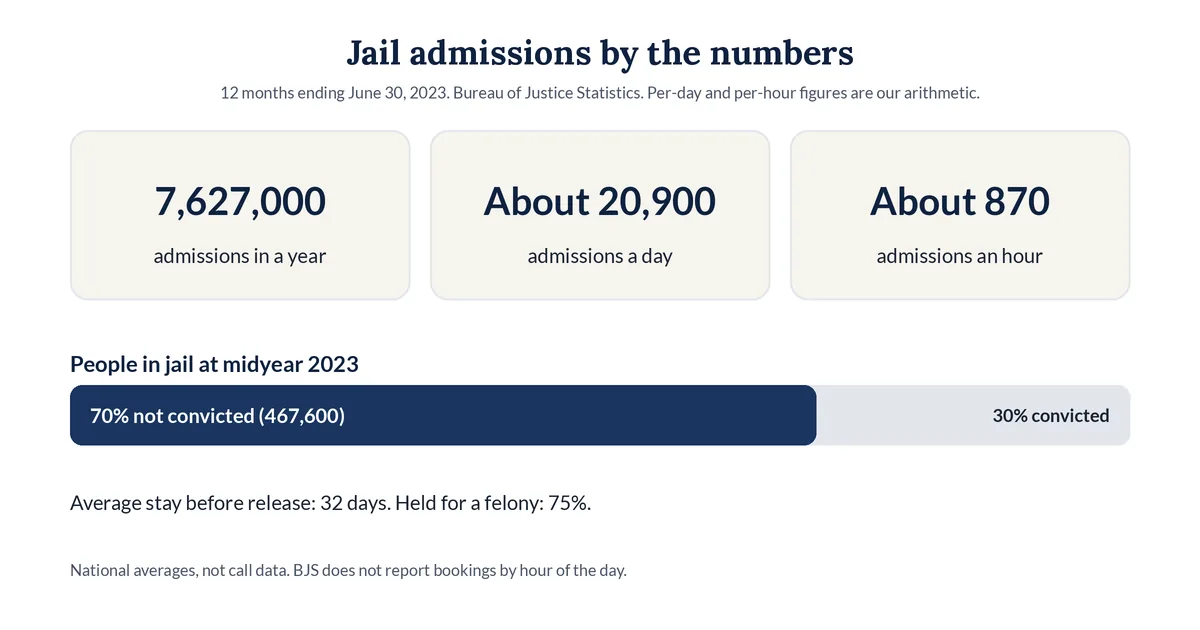
These are national averages, not your call volume. BJS does not report bookings by hour of the day, so count your own after-hours calls for a month. Our guide to night and weekend answering options for lawyers covers coverage plans, and what missed calls cost a small law firm shows how to measure the gap.
What should a criminal defense intake call ask?
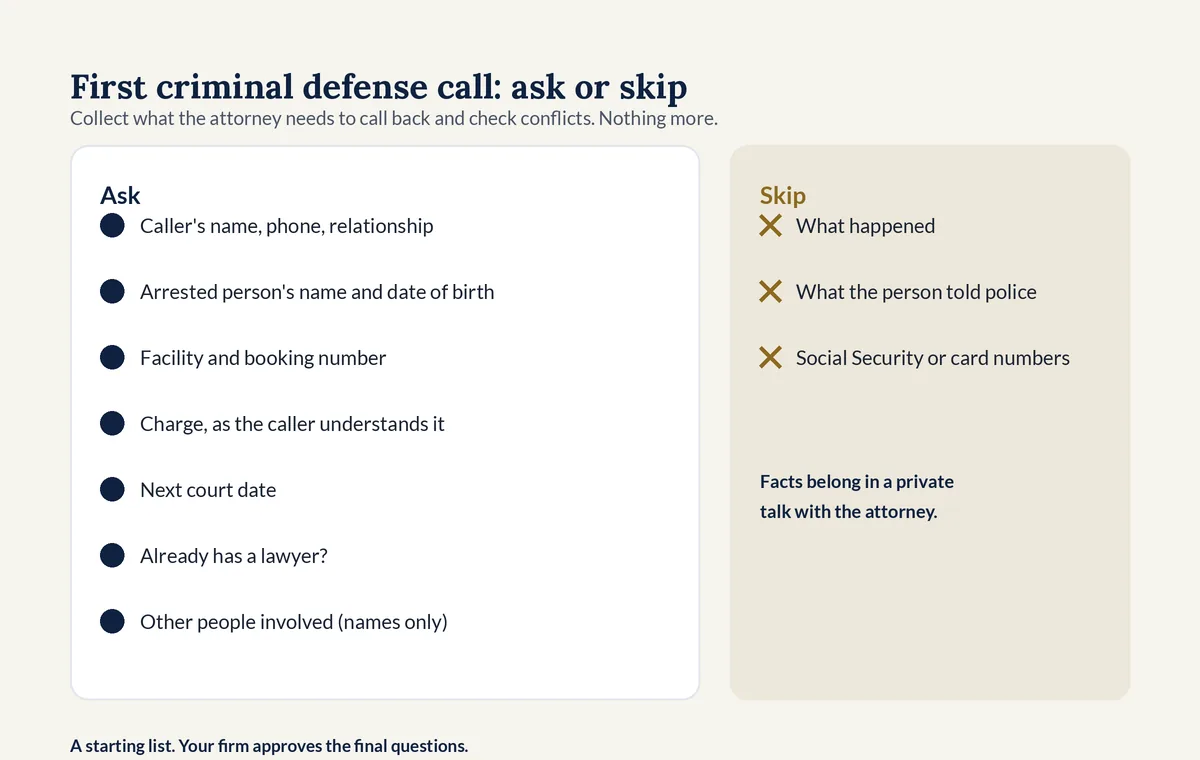
A criminal defense intake call should ask only what the attorney needs to call back and check conflicts: the caller's name, number, and relationship, the arrested person's full name and date of birth, where they are held, the charge as the caller understands it, the next court date, and whether they already have a lawyer.
Intake fields: ask or skip (our recommended starting list)
| Field | Ask on the first call? | Why |
|---|---|---|
| Caller's name, phone, and relationship | Ask | So the attorney knows who to call back and who is speaking |
| Arrested person's full name and date of birth | Ask | Needed to find the person in custody and run a conflict check |
| Facility and booking number, if known | Ask | Tells the attorney where the person is held |
| Charge, as the caller understands it | Ask | Helps match the call to the right attorney |
| Next court date, if known | Ask | Sets how urgent the call is |
| Already has a lawyer? | Ask | Avoids stepping into another lawyer's case |
| Other people involved (names only) | Ask, if your firm wants it | Lets the firm screen for conflicts before calling back |
| What happened, or what the person said to police | Skip | Facts belong in a private conversation with the attorney |
| Social Security or card numbers | Skip | Never needed on a first call |
ABA Model Rule 1.18 treats a person who consults a lawyer about possibly hiring them as a prospective client, and its Comment [4] says a lawyer should limit the first consultation to the information reasonably necessary to decide whether to take the matter. Our guide to screening intake callers without losing good cases covers screening for every practice area.
Should an AI receptionist ask what happened?
No. An AI receptionist should not ask a criminal defense caller what happened, whether the person did it, or what they told police. The caller may be a relative, a friend, or someone on a recorded jail line. Collect contact, custody, charge, and court-date details, then let the attorney discuss the facts privately.
Three habits keep the first call clean:
- Stop the story kindly. If a caller starts describing events, the AI should thank them and say the attorney will go over details privately.
- Write down who is calling. A parent or spouse often makes the call, but the arrested person is the one the attorney may represent.
- Leave payment questions for the attorney. ABA Model Rule 1.8(f) lets a lawyer accept fees from someone other than the client only with the client's informed consent and other conditions.
A sample line for your script: "Please don't tell me what happened. The attorney will talk with you about that privately. Can I get the name of the person who was arrested and where they are being held?"
Are jail calls to a lawyer recorded?
Calls from jail are usually recorded unless they go to a phone number the facility has registered as a private attorney line. The Federal Bureau of Prisons rule says staff may not monitor a properly placed call to an attorney, and county jails often ask attorneys to register each number they use with clients.
Two public examples show how this works:
- Harris County, Texas. The Sheriff's Office says its phone provider can record all outgoing inmate calls, and attorneys should file a form to mark their numbers private. It asks attorneys to list every number they use to speak with clients, "and no others" (Harris County Sheriff's Office, Recording of Inmate Telephone Calls).
- Westchester County, New York. The Department of Correction records all calls on facility phones unless the number is designated "private" or "Do-Not-Record," and calls are recorded until the number's owner gets written confirmation (Westchester County Department of Correction).
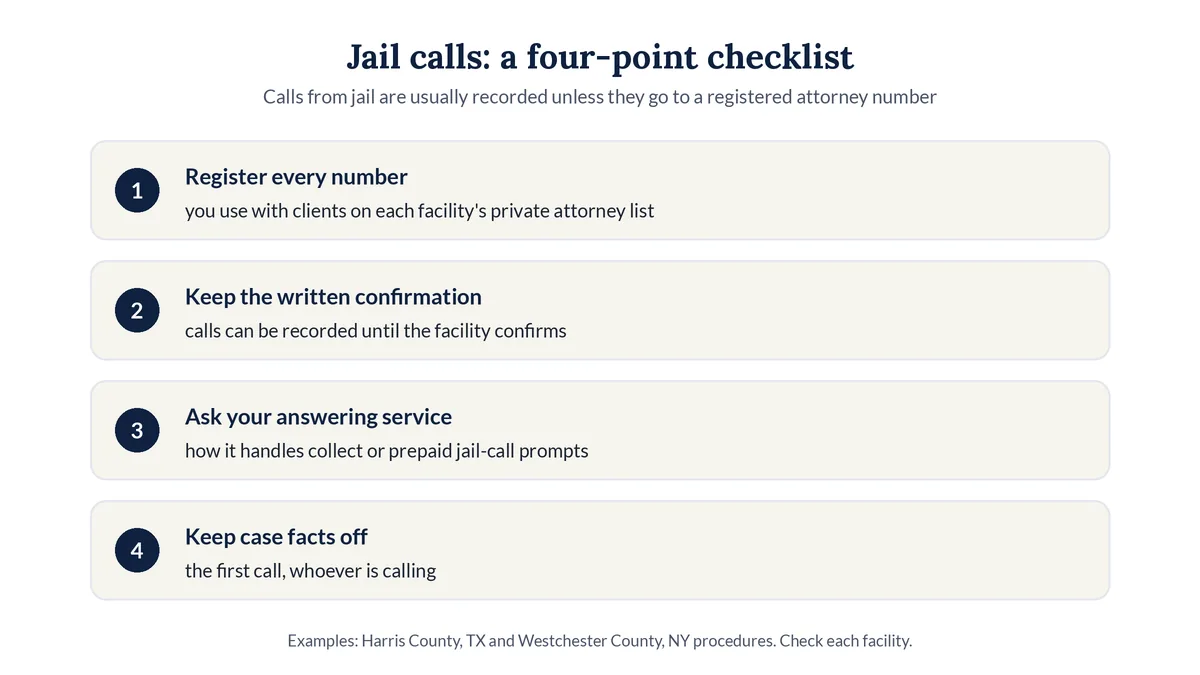
The Sixth Amendment gives the accused the right "to have the Assistance of Counsel for his defence" (National Archives, Bill of Rights transcript). Private lawyer calls are part of how that works in practice, so treat your phone setup as part of client care. If you forward your number to an answering service, ask how calls from a facility's phone system are handled. Many jail systems ask the person who answers to press a key to accept the call, or bill a prepaid account. In our review of 11 page-one pages, services differed: some said they could accept those prompts and some said they could not.
Who calls a criminal defense firm, and how to route each call
| Who is calling | What they usually need | A sensible default route |
|---|---|---|
| Family member about a new arrest | Help for someone in custody now | Short intake, urgent alert, transfer to the on-call attorney if your rules allow |
| Person calling from a jail phone | To reach their own lawyer | A number that reaches a person, registered with the facility |
| Person out on bond | A consultation before the next court date | Book a consultation, note the court date |
| Current client with a new problem | Their attorney, soon | Urgent alert or detailed message for the assigned attorney |
| Court clerk or prosecutor's office | Scheduling or case contact | Message to the assigned attorney or staff |
| Caller with a matter you don't handle | A referral | Kind reply and the referral number you approved |
Which criminal defense calls should be flagged as urgent?
Your firm decides what is urgent, and the AI follows those rules. Common choices are someone in custody right now, a bond hearing or arraignment within a day or two, a known warrant, police asking the caller to come in, or a current client arrested again. Urgent calls should reach an attorney right away.
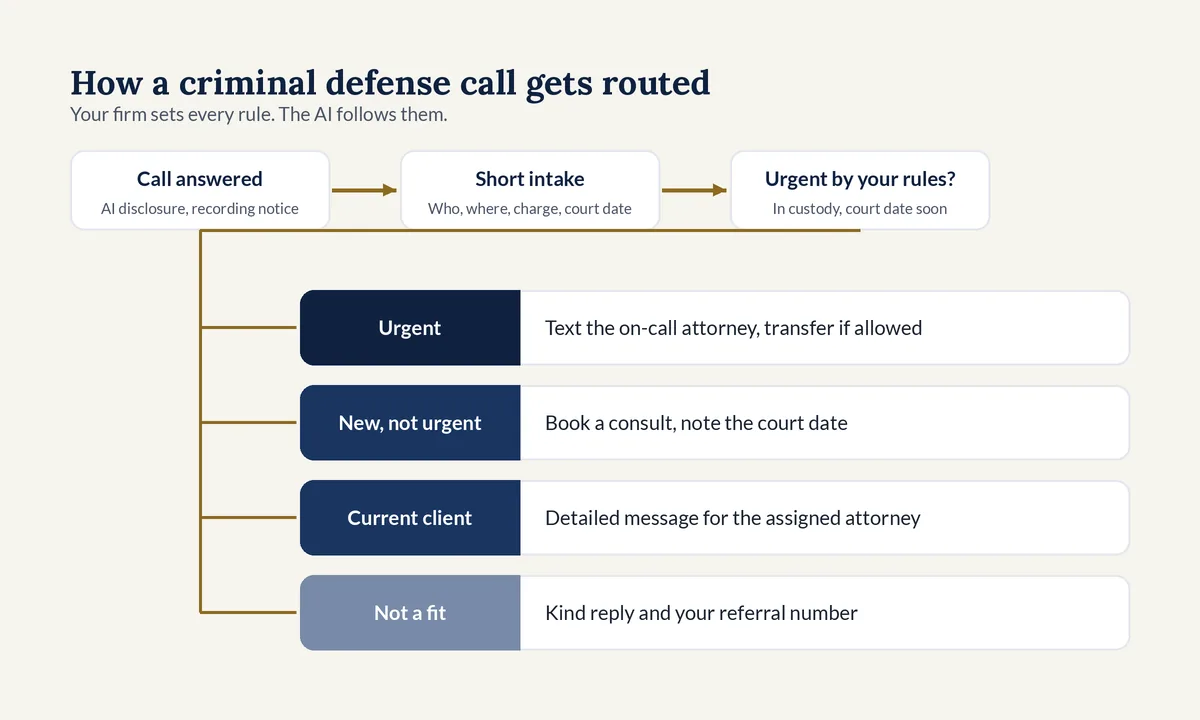
A simple routing plan:
- Urgent by your rules: text the on-call attorney, then transfer the caller if your rules allow and someone picks up.
- New caller, not urgent: book a consultation and note the court date at the top of the summary.
- Current client: take a detailed message for the assigned attorney.
- Not a fit: say so kindly and give the referral number you approved.
What do ethics rules say about AI receptionists for defense firms?
ABA Formal Opinion 512 (July 29, 2024) says lawyers using generative AI must protect client information under Model Rule 1.6, extend that care to prospective clients under Rule 1.18, and supervise outside AI providers under Rule 5.3. That means checking a vendor's security, confidentiality terms, data retention, and breach notice before it answers your phone.
This is general information, not legal advice. State rules control, and some state bars have their own AI opinions. Points that matter for a defense practice:
- Vet the vendor. Opinion 512 lists reference checks, security policies, confidentiality agreements, and whether the tool keeps data after you stop using it.
- Keep advice with lawyers. Opinion 512 says lawyers may not leave it to AI tools alone to offer legal advice to clients.
- Limit what the first call collects. Rule 1.18 protects information from prospective clients even if you never take the case.
- Answer, don't solicit. Model Rule 7.3 limits live person-to-person solicitation for pecuniary gain. An AI receptionist that only answers incoming calls and calls back people who asked is a different thing, but check your state's version before turning on text-backs or reminder calls.
For disclosure, recording consent, and confidentiality in more depth, see our guide to AI receptionist ethics, disclosure and recording rules.
How do you set up an AI receptionist for a criminal defense firm?
To set up an AI receptionist for a criminal defense firm, decide which calls it answers, write short intake questions that skip the facts, define urgent calls and who gets them, register every number with the jails you work with, connect your calendar, forward your number, and test with real call scenarios before launch.
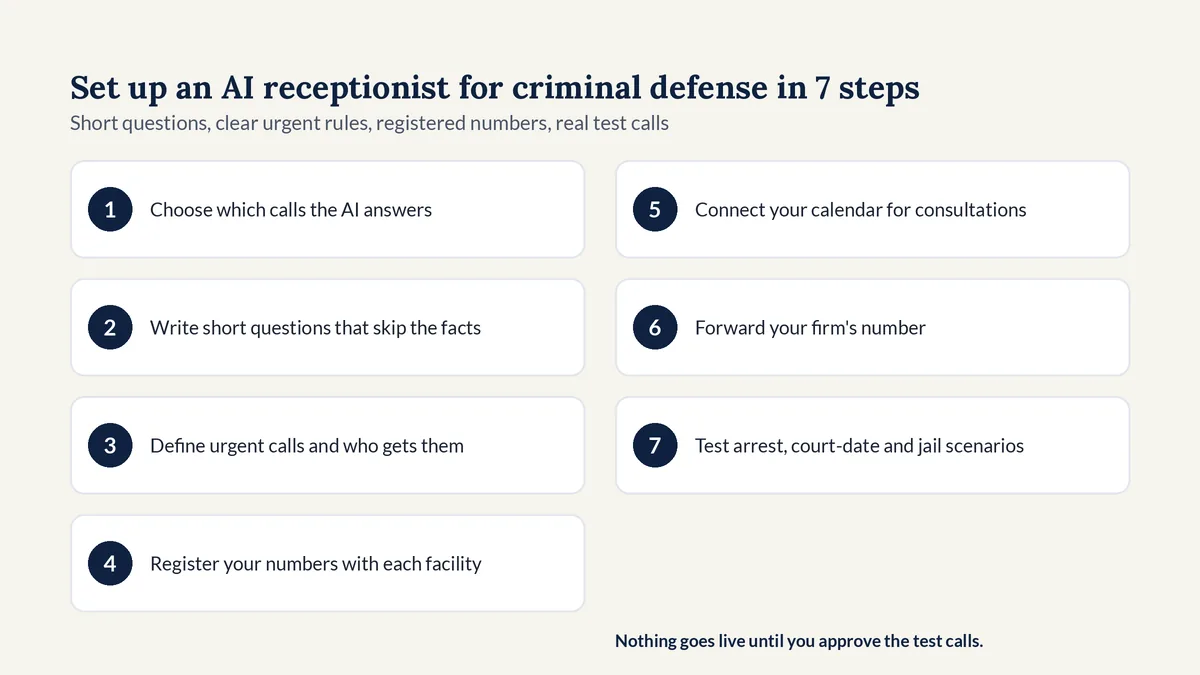
- Choose which calls the AI answers: all calls, overflow, or nights and weekends only.
- Write short intake questions that collect contact, custody, charge, and court-date details and skip the facts.
- Define urgent calls and which attorney gets the text or transfer for each one.
- Register every number you use with clients on each facility's private attorney list, and keep the written confirmation.
- Connect your calendar and set consultation times for callers who are not urgent.
- Forward your firm's number to the AI so callers keep dialing the number they know.
- Test an arrest call, a court-date call, and a caller who starts describing the facts, then read each summary.
How does Legal Touch AI handle criminal defense calls?
Legal Touch AI is an AI receptionist for small U.S. law firms. You decide what counts as urgent, such as an arrest or a court date tomorrow, and those calls get an "URGENT" text and email and can ring your cell. Every call starts with an AI disclosure and a recording notice, then your screening questions, one at a time.
What it does on every call:
- Tells callers it is an AI in its first sentence and gives a recording notice.
- Sends good callers to you live during office hours, with a text to you first.
- Books consultations on your Google or Outlook calendar after hours or when you don't pick up.
- Texts back callers who hang up early. It only texts people who called your firm.
- Sends a summary, the recording, and the transcript after every call.
It never gives legal advice, predicts a result, decides conflicts, promises that your firm will take a case, or asks for Social Security numbers, card numbers, or passwords. It answers incoming calls and does not make sales calls. You keep your number and approve every script change. Ask on the demo call how calls from a jail's phone system would reach you. For plans, see Legal Touch AI plans and pricing.
Why we wrote this guide
The Legal Touch AI team has run Legal Touch since 2021. We set up Legal Touch AI on our own phone lines first, screening callers and booking callbacks, before offering it to small law firms. On Nov 1, 2026 we read 11 page-one pages for criminal defense answering services and AI receptionists. Nine showed prices or dollar figures. Seven mentioned jail or in-custody calls. Only one explained that jail calls are usually recorded unless they go to a registered attorney number, only one cited an ABA Model Rule by number, and none cited public data. This guide fills those gaps.
What 11 page-one pages covered (our review, Nov 1, 2026)
| Topic | Pages that covered it (of 11) |
|---|---|
| Showed prices or dollar figures | 9 |
| Mentioned jail or in-custody calls | 7 |
| Said it does not give legal advice | 7 |
| Said it stays out of case facts or what to tell police | 4 |
| Explained jail calls are usually recorded unless to a registered attorney number | 1 |
| Cited an ABA Model Rule or opinion by number | 1 |
| Cited public data such as BJS | 0 |
Method: we searched "ai receptionist for criminal defense lawyers," "criminal defense answering service 24/7 jail calls," and a related query, saved the 11 distinct vendor pages that came up, and counted topics with a script, then checked each hit by hand.
Hear it answer a call. Book a 15-minute Legal Touch AI demo and try an arrest call and a court-date call with your own intake questions.
Frequently asked questions
Can an AI receptionist accept a collect call from jail?
It depends on the service, so test it. Many jail phone systems ask the person who answers to press a key to accept, or bill a prepaid account. Some services say they can handle that prompt and some say they can't. Either way, give detained clients a number that reaches a person and register it with the facility.
Is an intake call with an AI receptionist confidential?
Treat it as confidential. ABA Model Rule 1.18 protects information from prospective clients, and ABA Formal Opinion 512 says lawyers should check an AI vendor's security and confidentiality terms. Whether a given call is privileged depends on your state's law and the facts, so keep case facts off the first call.
Can the AI tell a family member if someone will get out on bail?
No. It should never predict release, bail amounts, or results. It can take down the facility, the booking number if known, and the next court date, flag the call as urgent if your rules say so, and tell the caller an attorney will follow up as soon as possible.
Who is the client when a family member calls about an arrest?
Usually the arrested person is the one the attorney may represent, even when a parent or spouse makes the call. Intake should record who called and their relationship. ABA Model Rule 1.8(f) lets a lawyer accept fees from someone else only with the client's informed consent and other conditions.
Can an AI receptionist call people after an arrest to offer help?
It shouldn't make those calls. ABA Model Rule 7.3 limits live person-to-person solicitation for pecuniary gain, and states add their own rules. Set the AI to answer incoming calls and to call or text back only people who contacted your firm, and check your state's rules before you turn that on.
Legal Touch AI is not a law firm and does not provide legal advice. This article is general information, not legal advice about criminal law, jail procedures, or professional ethics rules. Using Legal Touch AI does not create an attorney-client relationship.
Sources (checked Nov 1, 2026)
- Bureau of Justice Statistics, Jail Inmates in 2023, Statistical Tables (NCJ 309965): https://bjs.ojp.gov/library/publications/jail-inmates-2023-statistical-tables/web-report
- BJS, Table 1 (admissions and average daily population): https://bjs.ojp.gov/document/ji23stt01.csv
- BJS, Table 9 (conviction status): https://bjs.ojp.gov/document/ji23stt09.csv
- BJS, Table 10 (offense severity): https://bjs.ojp.gov/document/ji23stt10.csv
- BJS, Table 15 (average days in jail): https://bjs.ojp.gov/document/ji23stt15.csv
- Clio, Legal Trends Report press release (Oct 21, 2019): https://www.clio.com/about/press/clios-legal-trends-report-reveals-law-firms-struggle-to-respond-to-client-inquiries/
- ABA Formal Opinion 512, Generative Artificial Intelligence Tools (July 29, 2024): https://www.americanbar.org/content/dam/aba/administrative/professional_responsibility/ethics-opinions/aba-formal-opinion-512.pdf
- ABA Model Rule 1.18, Duties to Prospective Client, and Comment: https://www.americanbar.org/groups/professional_responsibility/publications/model_rules_of_professional_conduct/rule_1_18_duties_of_prospective_client/comment_on_rule_1_18_duties_of_prospective_client/
- ABA Model Rule 1.8, Current Clients: Specific Rules: https://www.americanbar.org/groups/professional_responsibility/publications/model_rules_of_professional_conduct/rule_1_8_current_clients_specific_rules/
- ABA Model Rule 7.3, Solicitation of Clients: https://www.americanbar.org/groups/professional_responsibility/publications/model_rules_of_professional_conduct/rule_7_3_direct_contact_with_prospective_clients/
- 28 CFR 540.102, Monitoring of inmate telephone calls: https://www.ecfr.gov/current/title-28/chapter-V/subchapter-C/part-540/subpart-I/section-540.102
- Harris County Sheriff's Office, Recording of Inmate Telephone Calls (rev. Oct 24, 2024): https://www.harriscountyso.org/Documents/JailInfo/Recording%20of%20Inmate%20Calls_Rev.pdf
- Westchester County Department of Correction, Attorney-Client Phone Calls: https://correction.westchestercountyny.gov/policies-and-procedures/information-regarding-attorney-client-phone-calls
- National Archives, Bill of Rights transcript (Sixth Amendment): https://www.archives.gov/founding-docs/bill-of-rights-transcript
- Legal Touch AI, how it works: https://legaltouchai.com/how-it-works/