Ruby Receptionist Alternative for Small Law Firms: Prices Compared
A Ruby receptionist alternative is any phone answering service a law firm uses in place of Ruby, whether that is another live receptionist service, an AI receptionist, or a mix of both. We checked Ruby's pricing page, help center, and terms, plus the pricing pages of 8 other services, on Nov 1, 2026, and compared them for firms with 1 to 10 attorneys.
Why it matters: in a secret-shopper study in Clio's 2019 Legal Trends Report, 39% of calls to law firms went to voicemail, and 79% of surveyed consumers said they expected a response within 24 hours (Clio press release, Oct 21, 2019). Ruby is one well-known way to fix that. We sell another. So we show every published price we could verify, and we say plainly when Ruby is the better pick.
What is the best Ruby receptionist alternative for a small law firm?
The best Ruby receptionist alternative depends on who you want answering. For a live person at a lower price, look at PATLive or LEX Reception. For people and AI on one plan, try Abby Connect. For low-cost AI you set up yourself, try Smith.ai's AI plan or ClaireAI. For AI set up and tuned for you, pick a managed service.
Pick by the job you need done, not by brand:
- A person on every call, for less. PATLive, LEX Reception, Alert Communications, or Smith.ai's live plans.
- People and AI on one bill. Abby Connect, where an AI minute counts as half a minute.
- The lowest monthly price. Smith.ai's AI plan, ClaireAI, or Intake Gateway, if you will write and tune the script yourself.
- AI that someone else builds and tunes. Legal Touch AI's done-for-you plans or Smith.ai's Enterprise AI plan.
Our side-by-side guide to legal answering services and AI receptionists covers each provider in more detail.
How much does Ruby cost in 2026?
Ruby costs $250 a month for 50 receptionist minutes, $395 for 100, $720 for 200, and $1,725 for 500, per its pricing page on Nov 1, 2026. Its help center adds a 350-minute plan at $1,210 and lists overage rates from $5.40 a minute on the smallest plan to $4.00 on the 500-minute plan.
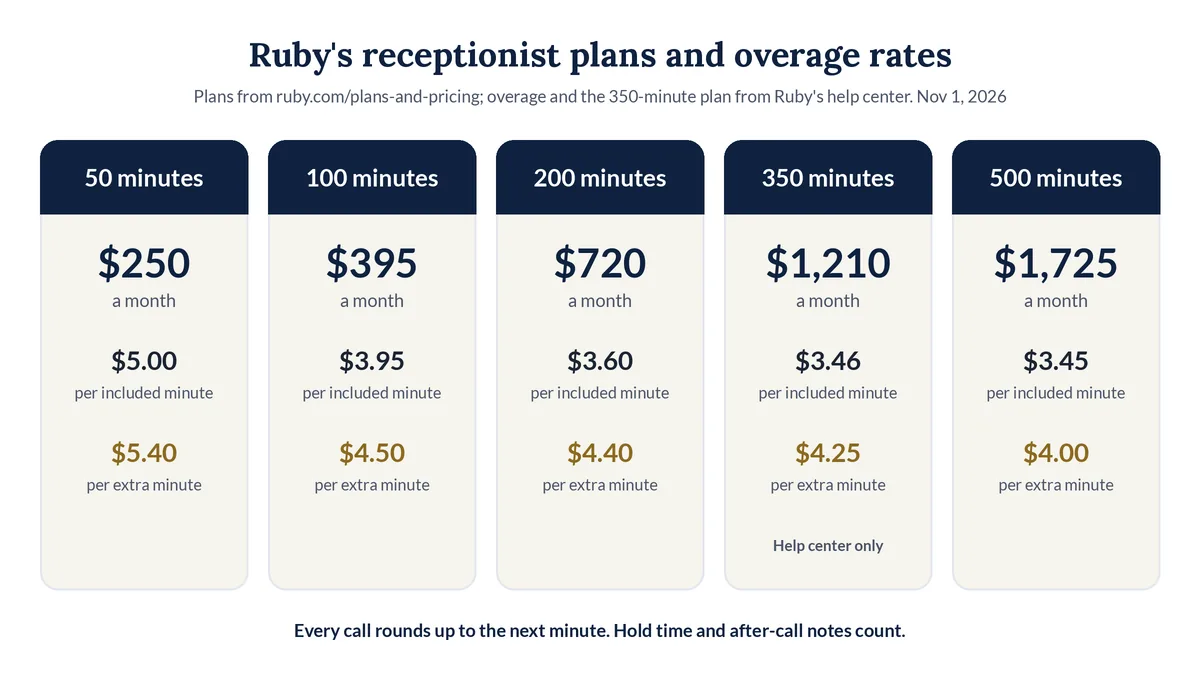
Ruby is a live virtual receptionist service: people answer every call, and you buy a monthly bundle of receptionist minutes. Here is what Ruby's own pages showed on Nov 1, 2026:
| Ruby plan | Monthly price | Included minutes | Price per included minute | Overage per minute |
|---|---|---|---|---|
| 50 minutes | $250 | 50 | $5.00 | $5.40 |
| 100 minutes | $395 | 100 | $3.95 | $4.50 |
| 200 minutes | $720 | 200 | $3.60 | $4.40 |
| 350 minutes (help center only) | $1,210 | 350 | $3.46 | $4.25 |
| 500 minutes | $1,725 | 500 | $3.45 | $4.00 |
Plan prices from ruby.com/plans-and-pricing. The 350-minute plan and all overage rates are from Ruby's help center page "Am I on the right billing plan?" Both checked Nov 1, 2026.
The pricing page says there are no fees for activation, onboarding, setup, customization, or coverage at certain times, and that optional AI enhancements come with every plan at no extra cost. Larger plans are available from Ruby's sales team.
How do Ruby's billing rules change your bill?
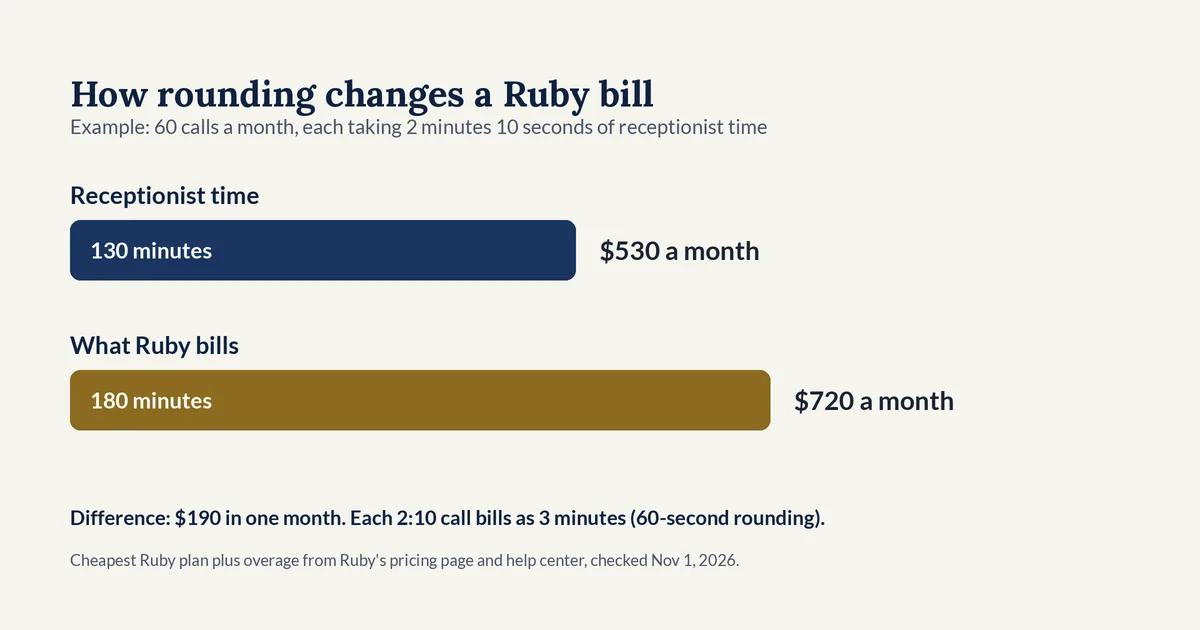
Ruby bills receptionist minutes, not talk time. Its terms say each call is rounded up to the next 60 seconds and that billing includes hold time and the time a receptionist spends finishing notes after the caller hangs up. Short calls and long intake calls both cost more than the clock on your phone suggests.
Our rounding check shows the effect. If 60 calls a month each take 2 minutes 10 seconds of receptionist time, that is 130 minutes. Ruby bills each call as 3 minutes, so 180 minutes. On Ruby's published rates, 130 minutes would cost $530 and 180 minutes costs $720, a $190 difference in one month.
Three more terms are worth knowing before you pick a plan:
- Plan changes. Ruby's help center says downgrades are allowed only after three billing periods in a row on the same plan. Its terms say an upgrade applies to the current period and at least the next two.
- Cancellation. Ruby's terms describe a 30-day contract that renews automatically. You cancel before your next invoice date, and service ends with the current billing period.
- Weekday-only services. Ruby's FAQ lists outbound call assists and bilingual service as Monday to Friday, 5 am to 6 pm Pacific, while another FAQ answer and the pricing page describe Spanish service as 24/7. Ask Ruby which applies to your account.
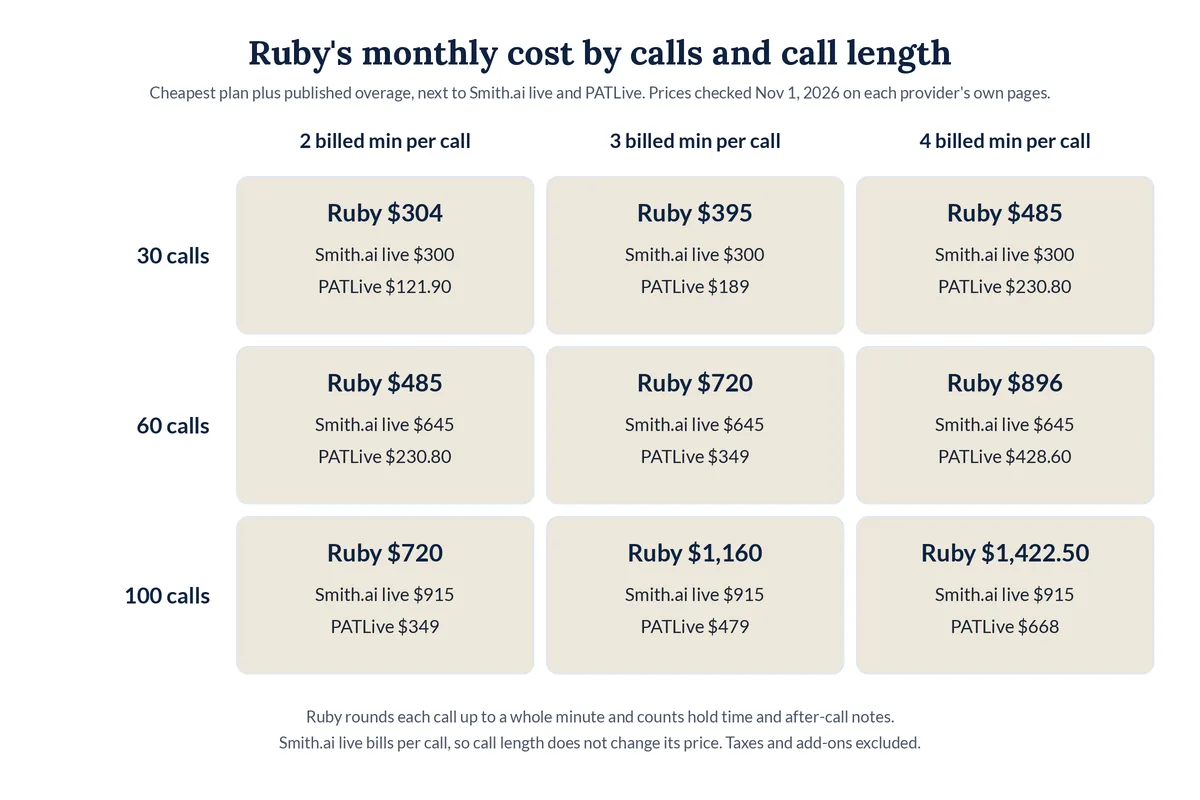
Ruby's monthly cost by call volume and call length (our compiled table)
| Calls a month | Billed minutes per call | Ruby, cheapest option | Ruby plan used | Smith.ai live | PATLive |
|---|---|---|---|---|---|
| 30 | 2 | $304 | 50 minutes + 10 extra | $300 | $121.90 |
| 30 | 3 | $395 | 100 minutes | $300 | $189 |
| 30 | 4 | $485 | 100 minutes + 20 extra | $300 | $230.80 |
| 60 | 2 | $485 | 100 minutes + 20 extra | $645 | $230.80 |
| 60 | 3 | $720 | 200 minutes | $645 | $349 |
| 60 | 4 | $896 | 200 minutes + 40 extra | $645 | $428.60 |
| 100 | 2 | $720 | 200 minutes | $915 | $349 |
| 100 | 3 | $1,160 | 200 minutes + 100 extra | $915 | $479 |
| 100 | 4 | $1,422.50 | 350 minutes + 50 extra | $915 | $668 |
Each cell is the cheapest plan plus published overage for that volume, from each provider's own pages on Nov 1, 2026. Smith.ai's live plans bill per call, so call length doesn't change its price. Taxes and add-ons are excluded.
Ruby vs Smith.ai: which costs less for a law firm?
Smith.ai's live receptionists cost less than Ruby in 7 of the 9 call patterns we priced. Smith.ai bills per call, so long intake calls don't raise the bill. Ruby bills per minute, so it wins only when calls are short: at 60 or 100 calls a month of 2 billed minutes, Ruby cost less.
Smith.ai's live plans are $300 for 30 calls, $810 for 90, and $2,100 for 300, with extra calls at $11.50, $10.50, and $8.50. Add-ons are priced per call, such as $1.50 for booking an appointment. Smith.ai also sells AI plans that start free for 25 calls a month, then $3 a call, which is far below either company's live price.
We compared the two in more depth, including Smith.ai's AI and Hybrid plans, in our honest look at Smith.ai alternatives.
What are the cheapest Ruby alternatives at 60 calls a month?
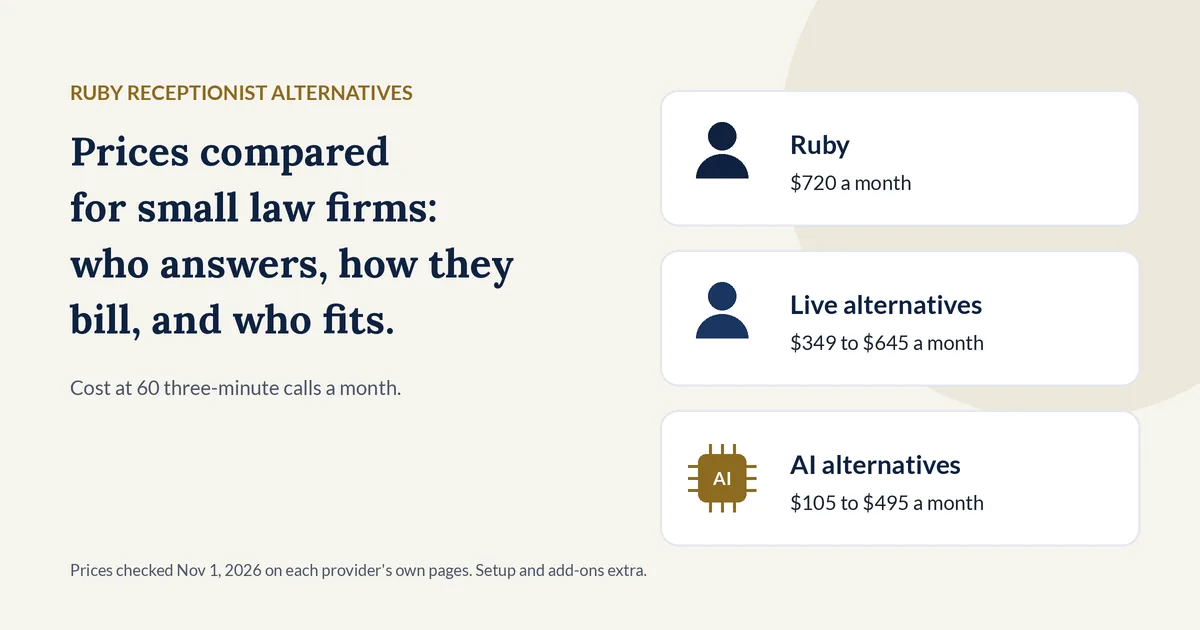
At 60 three-minute calls a month, published prices for Ruby alternatives ran from $105 to $645 on Nov 1, 2026, against $720 for Ruby. Among live services, PATLive cost $349 and LEX Reception $450. AI services cost $105 to $495, before any setup fee.
Ruby alternatives compared at 60 three-minute calls a month (our compiled table)
| Service | Who answers | How it bills | Cost at 60 calls | First 12 months | Setup fee |
|---|---|---|---|---|---|
| Ruby | People | Per minute | $720 | $8,640 | None listed |
| Smith.ai live receptionists | People | Per call | $645 | $7,740 | None |
| Abby Connect, people | People | Abby Minute | $599 | $7,188 | None |
| Alert Communications, Tier 2 | People, with intake | Per minute | $590 | $7,080 | May apply, per its page |
| LEX Reception | People, built for law firms | Per minute | $450 | $5,400 | None on this plan |
| PATLive | People | Per minute | $349 | $4,188 | None listed |
| Abby Connect, AI | AI | Abby Minute | $329 | $3,948 | None |
| Legal Touch AI | AI | Per minute of AI talk time | $149 self-setup, or $495 done for you | $1,788 or $6,935 | None, or $995 done for you |
| Intake Gateway | AI, 4 practice areas | Flat | $149 | $1,788 | None |
| ClaireAI | AI | Per minute | $129 | $1,548 | None for standard onboarding |
| Smith.ai AI Receptionist | AI, live backup | Per call | $105 | $1,260 | None listed |
Sixty calls of 3 minutes is 180 minutes. We used the cheapest published plan plus published overage where cheaper. Where overage isn't published (Abby Connect, Alert Communications), we moved up a plan instead of guessing. First 12 months is 12 months plus any setup fee. Taxes and add-ons are excluded.
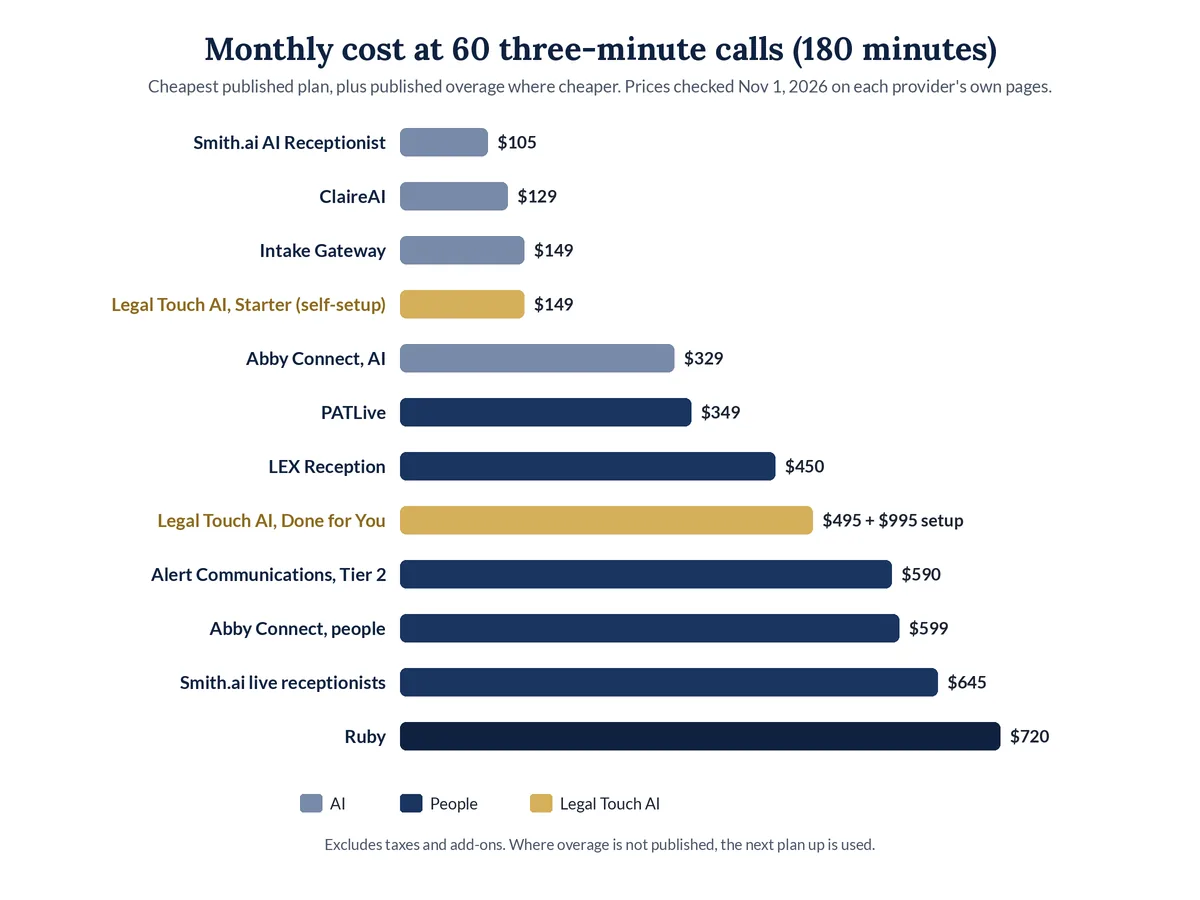
For the same math at other volumes, see our legal answering service cost breakdown at three call volumes.
When is Ruby the better pick?
Ruby is the better pick when you want a trained person to answer every call under your firm's name, and you will use more than phone answering. Ruby bundles staffed website chat, a native Clio integration, outbound call assists, and payment collection, and it lists Spanish bilingual service at no extra cost.
Choose Ruby over an alternative if:
- Your callers expect a person. Ruby's legal page says callers won't know they are talking to an outside service. An AI receptionist, ours included, tells callers it is AI.
- Your calls are short. Ruby's per-minute billing can beat Smith.ai's per-call live price when most calls bill 2 minutes or less.
- You want chat staffed by people. Ruby sells website chat plans and a 20% discount for bundling chat with phones.
- You change call handling often. Ruby lists easy-to-update call handling and real-time status updates, which suits a lawyer in and out of court.
Is an AI receptionist a good Ruby alternative for a law firm?
An AI receptionist is a good Ruby alternative when your main need is answering every new caller, asking screening questions, and booking consults, at a lower monthly price. It answers on the first ring at any hour. It is a weaker fit if callers must hear a person or calls need judgment and empathy.
AI and live receptionists differ in a few practical ways:
- Cost. At 60 three-minute calls, the AI services in our table cost $105 to $495 a month against $349 to $720 for live services.
- Billing. The AI services in our table sell a monthly block of minutes or calls, or a flat fee, so a busy month is easier to predict.
- Disclosure. A good AI receptionist says it is AI at the start of the call.
- Limits. AI should never give legal advice. It should take a message and flag the call when it isn't sure.
Our plain-English guide to how an AI receptionist answers law firm calls walks through a full call and what to test before you switch.
How do you switch from Ruby to another answering service?
To switch from Ruby, save your messages and call data, price your real volume elsewhere, and test the new service before you move your number. Then cancel with Ruby before your next invoice date. Planned this way, callers never reach a dead line, and you pay two services for as little time as possible.
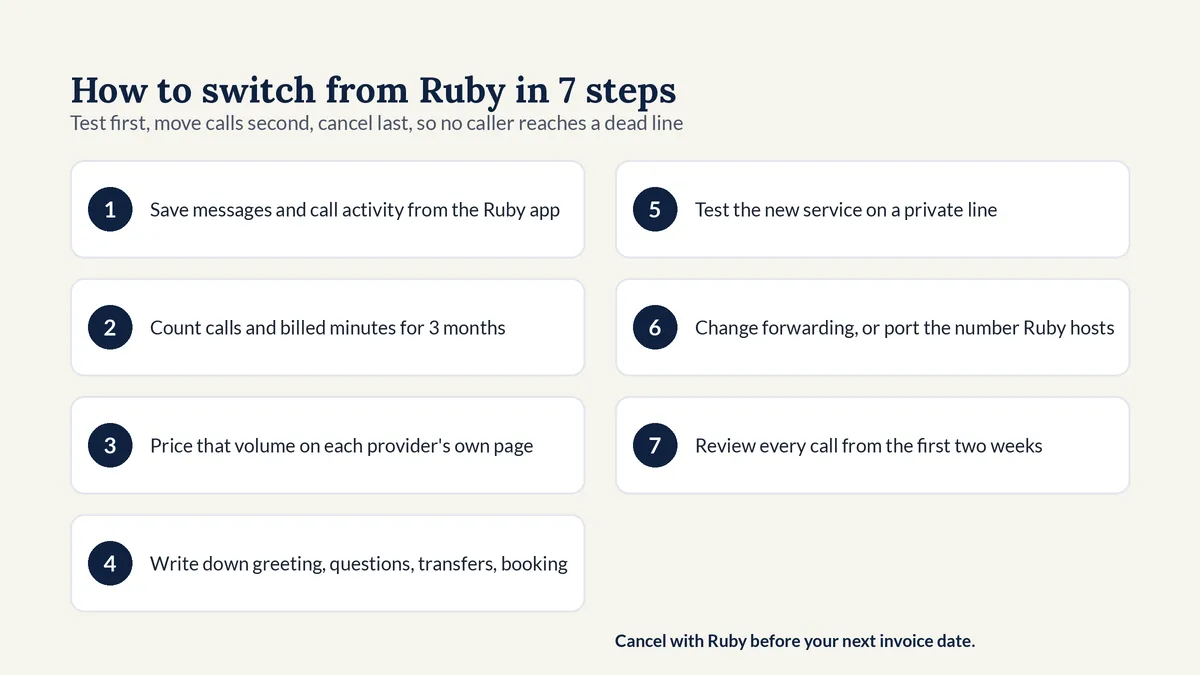
- Save your messages and call activity from the Ruby app or online portal.
- Count your monthly calls and billed minutes for the last three months.
- Price that volume on each new provider's own pricing page.
- Write down your greeting, screening questions, transfer rules, and booking rules.
- Test the new service on a private line before any real caller reaches it.
- Move your calls by changing call forwarding, or by porting the number if Ruby hosts it.
- Review every call from the first two weeks and fix gaps in the script.
If Ruby hosts your number, its terms let you port it away when your account is in good standing, and Ruby may release numbers not ported within three months after you cancel. Ask the new provider to confirm the port date before you cancel.
How does Legal Touch AI compare with Ruby?
Legal Touch AI is an AI receptionist, so it does not put a person on every call. It answers on the first ring, asks your screening questions, and sends good callers to you live during office hours, with a text to you first. At 60 calls a month, it costs less than Ruby.
At 30 calls a month, though, Ruby's smaller plans can cost less than our done-for-you plan. Here is when each fits:
- Choose Ruby if every caller must reach a person, or you want staffed website chat and outbound calls.
- Choose Legal Touch AI if you want your greeting, screening questions, and calendar built with you, consults booked on your Google or Outlook calendar, script changes usually within 1 business day, and service that is month to month.
When you don't pick up, it books a consult on your calendar and texts the caller a confirmation. You get a summary, the recording, and the transcript after every call. It never gives legal advice. Plans run from self-setup to done for you, backed by a 60-day money-back guarantee (minus costs, max $750). See Legal Touch AI plans and pricing for details.
Why we wrote this comparison
The Legal Touch AI team has run Legal Touch since 2021. We set up Legal Touch AI on our own phone lines first, screening callers and booking callbacks, before offering it to small law firms. We wrote this because "alternative" pages often hide where the brand they compare against wins, and owners deserve to see that before they choose.
Hear it answer a call. Book a 15-minute Legal Touch AI demo to hear a live call and get a written quote for your call volume.
Frequently asked questions
Does Ruby use AI to answer calls?
No. Ruby's receptionists are live people. Its pricing page says optional AI enhancements, such as AI-powered transcripts and AI-supported call flows, come with every plan at no extra cost, but a person still answers each call. For an AI receptionist, look at Smith.ai's AI plans, ClaireAI, Intake Gateway, Abby Connect's AI option, or Legal Touch AI.
Does Ruby offer a legal answering service for law firms?
Yes. Ruby has a legal page that describes 24/7 live answering, intake, consult scheduling, payment collection, and staffed website chat for law firms, with a native Clio integration listed on its integrations page. It uses the same plans and prices as every other Ruby customer, starting at $250 for 50 receptionist minutes.
Does Ruby have a contract or a free trial?
Ruby's terms describe a 30-day contract that renews automatically, with no long-term commitment. Its pricing page lists no free trial, but new customers may get a money-back guarantee if they cancel within 21 days or before using 500 receptionist minutes, whichever comes first. Ruby says the guarantee may not be offered to every customer.
Does Ruby charge for overage minutes?
Yes. Minutes past your plan are billed at that plan's overage rate after the billing cycle ends. Ruby's help center lists $5.40 a minute on the 50-minute plan, $4.50 on 100, $4.40 on 200, $4.25 on 350, and $4.00 on 500. The Ruby app alerts you at 85% and 100% of your minutes.
Can I keep my phone number if I leave Ruby?
Usually, yes. If you only forward your calls to Ruby, the number stays with your phone company and you change the forwarding. If Ruby hosts your number, its terms allow a port away when your account is in good standing. Ruby may release numbers that are not ported within three months after you cancel.
Legal Touch AI is not a law firm and does not provide legal advice. This article is general information. Using Legal Touch AI does not create an attorney-client relationship.
Sources (checked Nov 1, 2026)
- Clio, Legal Trends Report press release (Oct 21, 2019): https://www.clio.com/about/press/clios-legal-trends-report-reveals-law-firms-struggle-to-respond-to-client-inquiries/
- Ruby plans and pricing: https://www.ruby.com/plans-and-pricing/
- Ruby help center, "Am I on the right billing plan?" (overage rates, 350-minute plan, plan change rules): https://rubyhelpcenter.helpjuice.com/billing-plans/am-i-on-the-right-billing-plan
- Ruby terms of use (billing increments, contract, cancellation, number porting): https://www.ruby.com/terms/
- Ruby FAQs (overage alerts, weekday service hours, Spanish): https://www.ruby.com/faqs/
- Ruby for law firms: https://www.ruby.com/industries/legal/
- Ruby integrations (Clio): https://www.ruby.com/solutions/integrations/
- Smith.ai live receptionist pricing: https://smith.ai/pricing/receptionists
- Smith.ai AI Receptionist pricing: https://smith.ai/pricing/ai-receptionist
- PATLive pricing: https://www.patlive.com/pricing/
- LEX Reception plans: https://www.lexreception.com/plans-direct
- Abby Connect pricing: https://www.abby.com/pricing/
- Alert Communications plans: https://www.alertcommunications.com/plans/
- ClaireAI pricing: https://theclaireai.com/pricing
- Intake Gateway pricing: https://www.intakegateway.com/pricing
- Legal Touch AI pricing: https://legaltouchai.com/pricing/