AI Receptionist for Family Law Firms: Sensitive Intake, Conflict Checks and Consults
A family law answering service is a service that answers a family law firm's phone day and night, takes down the basics of a divorce, custody, support, or protective order call, and gets urgent and safety calls to the right person fast. This guide covers how an AI receptionist does that job: what to ask, conflict checks, callers who may not be safe, urgent routing, ethics rules, and setup, with sources checked Nov 1, 2026.
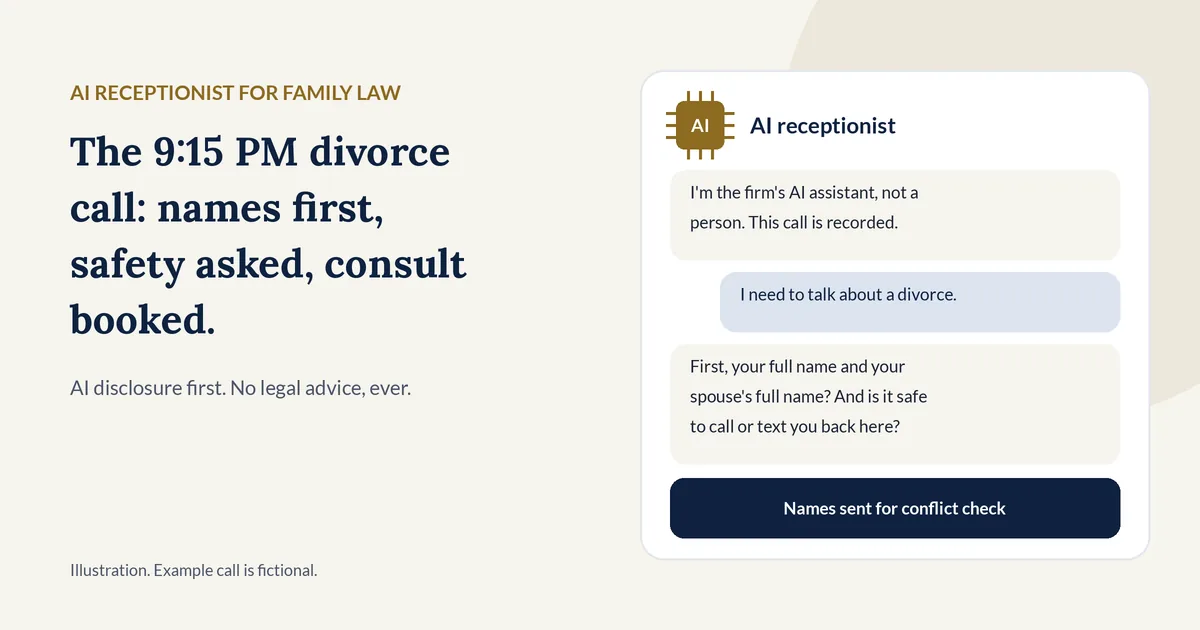
Why it matters: the CDC's National Center for Health Statistics counted 672,502 divorces in 2023 in the 45 states and D.C. that report them (CDC FastStats, Marriage and Divorce, provisional data). That works out to about 1,840 a day, or about 77 an hour (our arithmetic), before counting custody, support, and protective order matters. Separately, in a secret-shopper study in Clio's 2019 Legal Trends Report, 39% of calls to law firms went to voicemail (Clio press release, Oct 21, 2019). A parent who reaches voicemail may call the next firm on the list.
What is an AI receptionist for family law firms?
An AI receptionist for family law firms is software that answers a family law firm's phone, says it is an AI, asks the firm's approved intake questions, collects names for a conflict check, flags safety and court-deadline calls as urgent, and books consultations. It never gives legal advice, never predicts custody or support results, and never decides conflicts.
On a typical call it does four jobs:
- Greets the caller with an AI disclosure and a recording notice.
- Takes names first so your team can check conflicts before anyone hears the story.
- Routes the call by your rules: urgent alert, live transfer, booked consultation, or message.
- Sends you a summary with the answers, the recording, and the transcript.
For the full picture of how a call flows from greeting to summary, see our complete guide to how AI receptionists work for small law firms.
Why do family law firms need calls answered 24/7?
Family law firms need 24/7 answering because people decide to call about a divorce, a custody problem, or a protective order at night and on weekends, often right after a hard moment at home. Reporting states logged 672,502 divorces in 2023, about 1,840 a day by our arithmetic, and that count leaves out five states.
We pulled these figures from two CDC pages. The arithmetic rows are ours.
Family law by the numbers (our compiled table)
| Measure | Figure | Source |
|---|---|---|
| Divorces in 2023, 45 reporting states and D.C. (provisional) | 672,502 | CDC NCHS FastStats |
| Divorces per day, average | About 1,840 | Our arithmetic: 672,502 ÷ 365 |
| Divorces per hour, average | About 77 | Our arithmetic: daily average ÷ 24 |
| Divorce rate, reporting states | 2.4 per 1,000 people | CDC NCHS FastStats |
| Women who experienced contact sexual violence, physical violence, or stalking by an intimate partner in their lifetime | More than 1 in 3 (nearly 43.5 million) | CDC, NISVS 2023/2024 data brief |
| Men who experienced the same | More than 1 in 6 (20.7 million) | CDC, NISVS 2023/2024 data brief |
Sources: CDC National Center for Health Statistics, FastStats: Marriage and Divorce (provisional 2023 data, page last reviewed March 17, 2025), and CDC, About Intimate Partner Violence (updated Aug. 19, 2026), which cites the National Intimate Partner and Sexual Violence Survey (NISVS). Pulled Nov 1, 2026. The divorce count leaves out five states that do not report, and it does not include custody, support, or protective order cases filed outside a divorce.
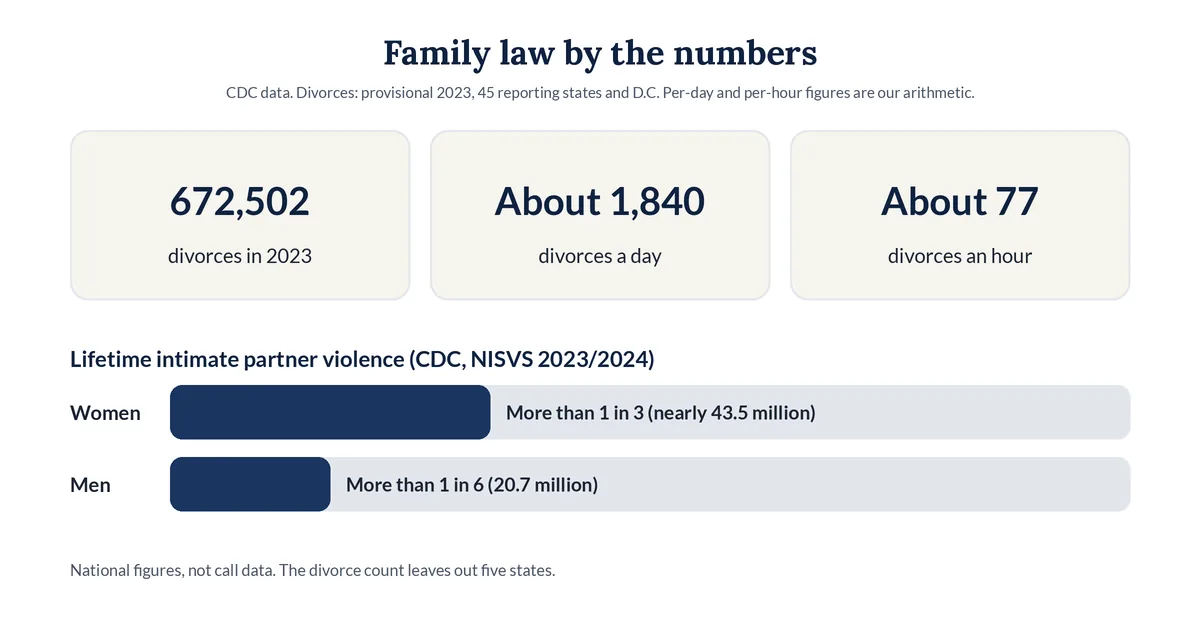
These are national figures, not your call volume. Neither source reports when people call lawyers, so count your own after-hours calls for a month. Our guide to night and weekend answering options for lawyers covers coverage plans.
What should a family law intake call ask?
A family law intake call should ask only what the attorney needs to check conflicts and call back: the caller's name and safe contact details, the other party's full name, other people involved, the type of matter, the county, any court date or papers served, whether children are involved, and whether either side has a lawyer.
Intake fields: ask or skip (our recommended starting list)
| Field | Ask on the first call? | Why |
|---|---|---|
| Caller's full name and best phone | Ask | Needed for the conflict check and the callback |
| Is it safe to call, text, or leave a voicemail at that number? | Ask | Someone else may see the phone or its call log |
| Other party's full name | Ask | The core of a family law conflict check |
| Other people involved, such as a new partner (names only) | Ask, if your firm wants it | Lets the firm screen for conflicts before calling back |
| Type of matter: divorce, custody, support, protective order, or other | Ask | Matches the call to the right attorney |
| County, and any court date or papers served | Ask | Sets where the case belongs and how urgent it is |
| Children involved? Ages, if offered | Ask | Signals custody and support issues |
| Already has a lawyer? Does the other party? | Ask | Avoids stepping into another lawyer's case |
| What happened, finances, or reasons for the split | Skip | Details belong in a private talk with the attorney after the conflict check |
| Social Security, account, or card numbers | Skip | Never needed on a first call |
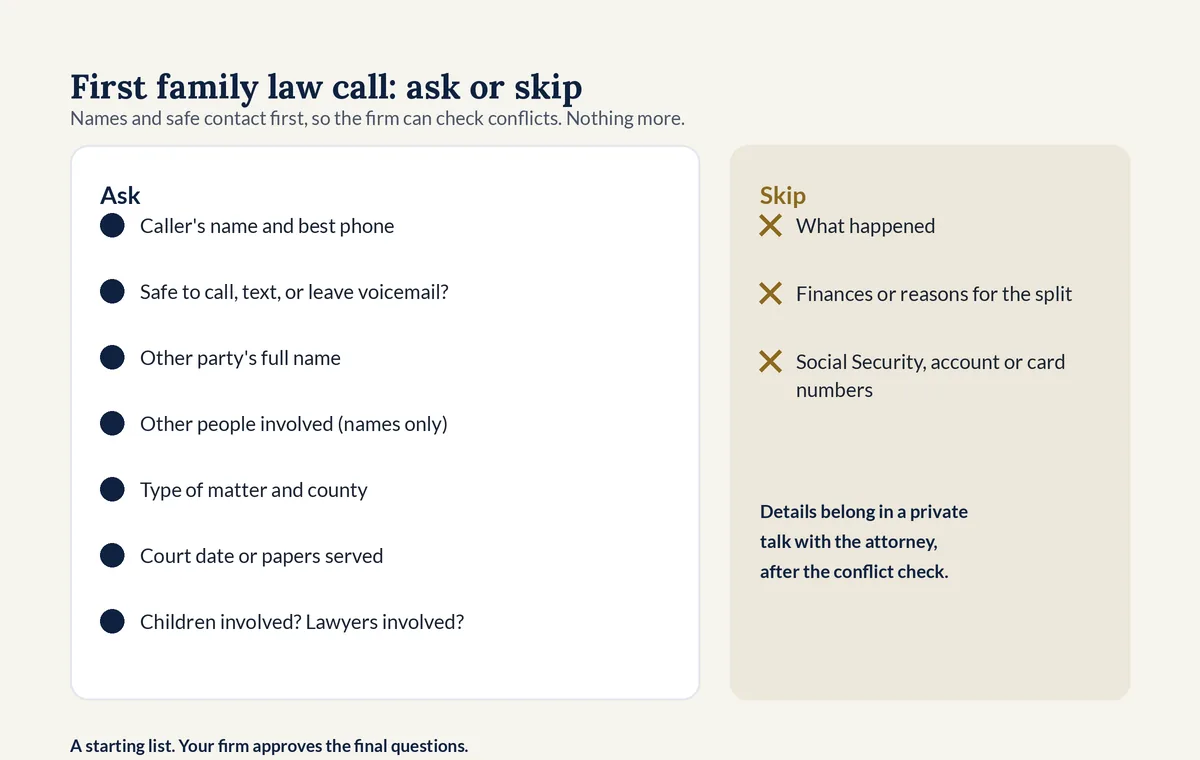
ABA Model Rule 1.18 treats a person who consults a lawyer about possibly hiring them as a prospective client, and its Comment [4] says a lawyer should limit the first consultation to the information reasonably necessary to decide whether to take the matter. Our guide to screening intake callers without losing good cases covers screening for every practice area.
How should an AI receptionist handle conflict checks in family law?
An AI receptionist should collect names first and stories later. It records the caller's name, the other party's name, and anyone else involved, then stops before the facts so your team can run the conflict check. The AI does not decide whether a conflict exists. An attorney or trained staff member reviews the names.
A conflict check is a review of a firm's current and past clients and matters to see whether taking on a new person would clash with duties the firm already owes. In family law the other party is usually a spouse, an ex, or a co-parent, so the order of questions matters more than in most practice areas.
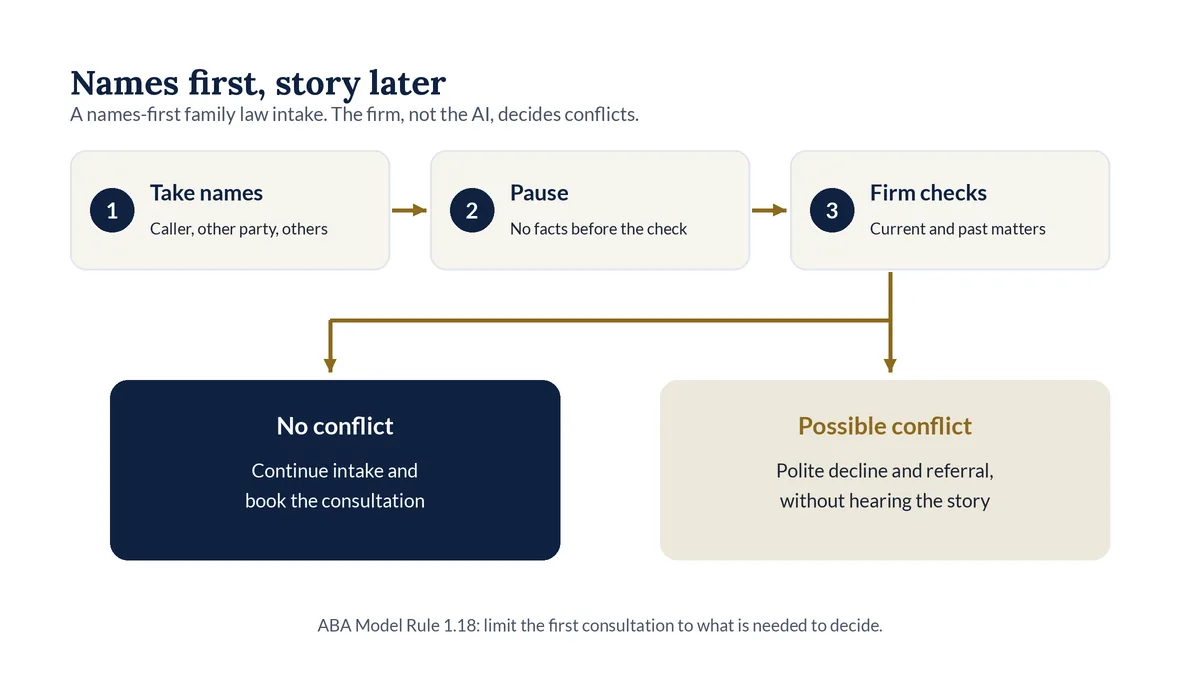
Three rules shape the script:
- Harmful details can block a firm. Under ABA Model Rule 1.18(c), a lawyer who receives information from a prospective client that could be significantly harmful to that person may not represent the other side in the same or a substantially related matter, and the bar can reach the whole firm unless Rule 1.18(d) is met.
- A call made only to block a firm is different. Comment [2] to Rule 1.18 says a person who communicates with a lawyer for the purpose of disqualifying the lawyer is not a prospective client. A short, names-first intake limits what any caller can share either way.
- The other side gets no advice. If the caller turns out to be the other party in a matter you handle, the AI should not discuss the case. ABA Model Rule 4.3 says a lawyer may not give legal advice to an unrepresented person whose interests may conflict with a client's, other than advice to get a lawyer.
A sample line for your script: "Before we talk about what's going on, may I have your full name and the full name of the other person involved? The firm checks those names first to make sure it can help you."
How should an AI receptionist handle domestic violence callers?
If a caller says they are in danger right now, the AI should tell them to call 911 first. If safety comes up otherwise, it should ask whether it is safe to talk, keep questions short, ask how the firm can safely reach them, flag the call by your rules, and offer the National Domestic Violence Hotline.
Intimate partner violence is abuse or aggression that occurs in a romantic relationship, including current and former spouses and dating partners, according to the CDC. The CDC reports that more than 1 in 3 women and more than 1 in 6 men experienced contact sexual violence, physical violence, and/or stalking by an intimate partner during their lifetimes (CDC, About Intimate Partner Violence). A family law firm will hear from some of them.
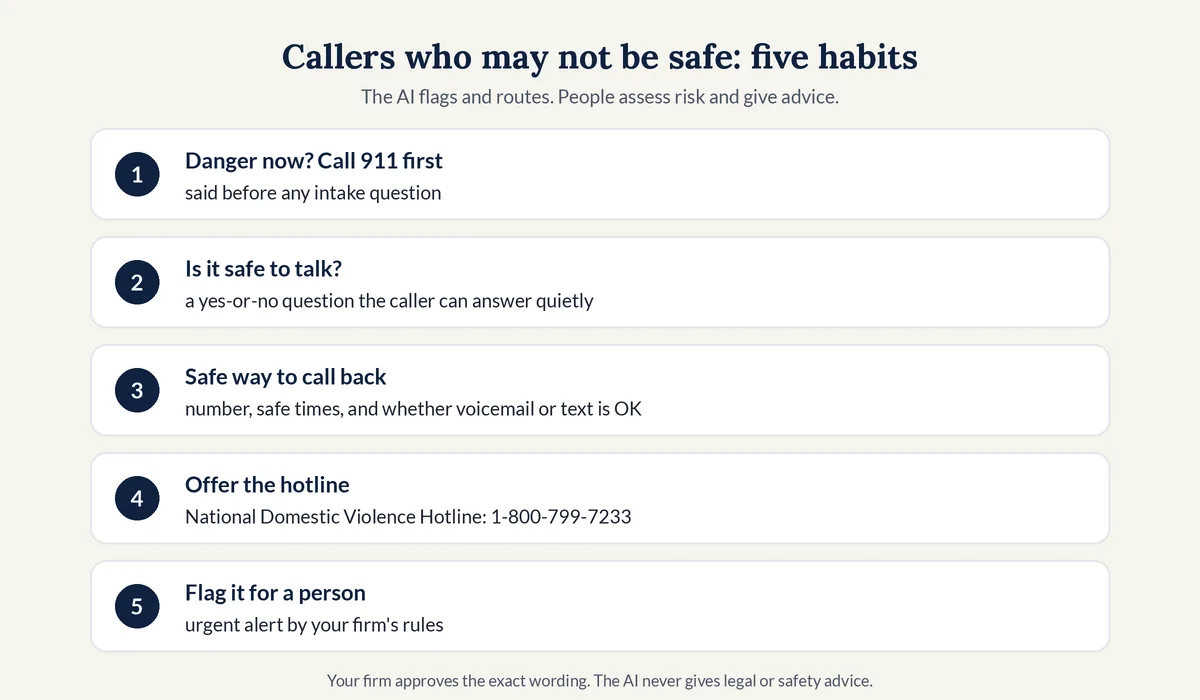
Five habits keep these calls safe:
- Put 911 first. For immediate danger, the script says to hang up and call 911 before any intake question.
- Ask if it is safe to talk. A yes-or-no question lets a caller who is not alone answer without explaining.
- Ask for a safe way to call back. Confirm the number, safe times, and whether a voicemail or text is OK. The Safety Net Project of the National Network to End Domestic Violence notes that someone with access to a phone account may be able to see call logs and billing records (Safety Net Project, cell phone tips).
- Offer the hotline. The National Domestic Violence Hotline is free, confidential, and open 24/7 at 1-800-799-7233 (SAFE), or text START to 88788 (The Hotline).
- Leave risk and advice to people. The AI should not judge how dangerous a situation is, suggest whether to leave, or explain protective order law. It flags the call for a person.
Automatic text-backs to hang-ups help most callers. For a caller whose phone is watched, a text from a law firm can cause harm. Before you turn text-backs on, ask any vendor whether they can be skipped for callers who say texts are not safe.
Which family law calls should be flagged as urgent?
Your firm decides what is urgent, and the AI follows those rules. Common choices are a caller who says they or a child are not safe, a protective order hearing, papers served with a deadline close, a court date within a few days, a child not returned after a visit, or a threatened move with the children.
Who calls a family law firm, and how to route each call
| Who is calling | What they usually need | A sensible default route |
|---|---|---|
| New caller about divorce or custody | A consultation | Names-first intake, conflict check, then book a consultation |
| Caller who says they or a child are in danger | Safety first | Tell them to call 911, then send an urgent alert to the on-call attorney by your rules |
| Caller asking about a protective order | Fast help, quietly | Short intake, safe-contact questions, urgent alert |
| The other party in a matter you handle | To talk about the case | No case discussion, short message, flag for the assigned attorney |
| Current client with a new problem | Their attorney, soon | Urgent alert or detailed message for the assigned attorney |
| Opposing counsel or court staff | Scheduling or case contact | Message to the assigned attorney or staff |
| Caller with a matter you don't handle | A referral | Kind reply and the referral number you approved |
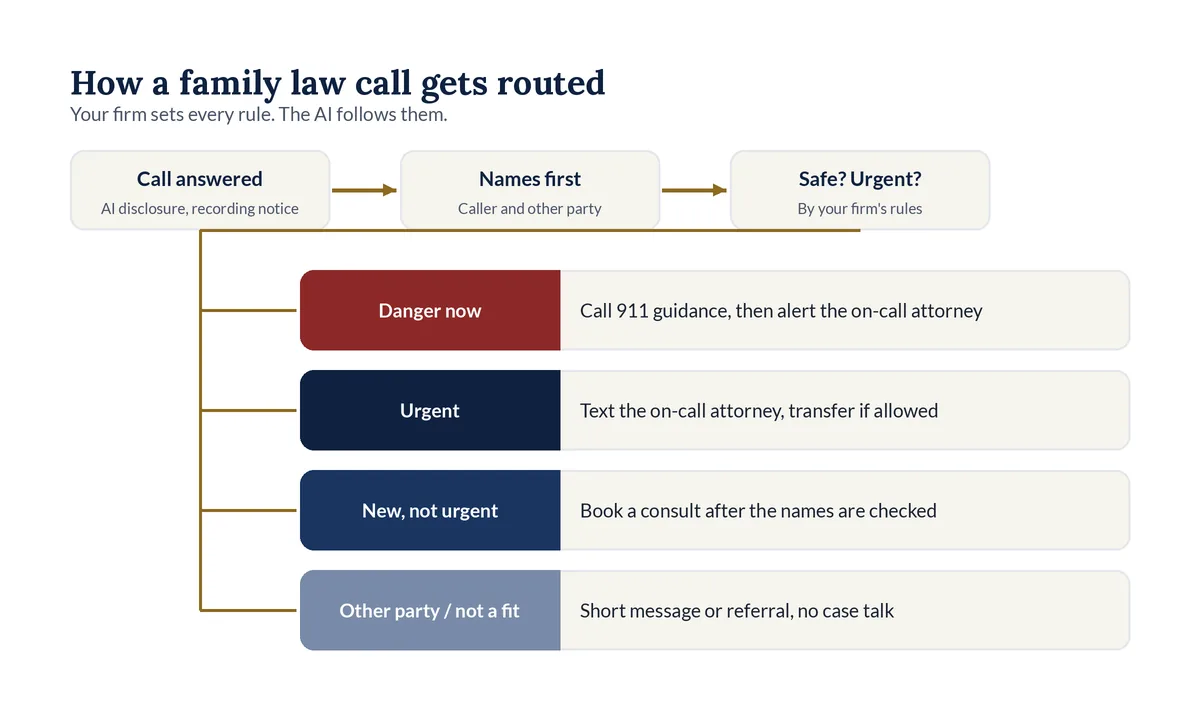
A simple routing plan:
- Danger now: tell the caller to call 911, then alert the on-call attorney by your rules.
- Urgent by your rules: text the on-call attorney, then transfer the caller if your rules allow and someone picks up.
- New caller, not urgent: book a consultation after the names are checked, and note any court date at the top of the summary.
- Other party or not a fit: take a short message or give the referral number you approved, without discussing the case.
For more on fast routing for time-sensitive calls, see our guide to urgent call routing for criminal defense lawyers.
What do ethics rules say about AI receptionists for family law firms?
ABA Formal Opinion 512 (July 29, 2024) says lawyers using generative AI must protect client information under Model Rule 1.6, extend that care to prospective clients under Rule 1.18, and supervise outside AI providers under Rule 5.3. That means checking a vendor's security, confidentiality terms, data retention, and breach notice before it answers your phone.
This is general information, not legal advice. State rules control, and some state bars have their own AI opinions. Points that matter for a family law practice:
- Vet the vendor. Opinion 512 lists reference checks, security policies, confidentiality agreements, and whether the tool keeps data after you stop using it.
- Keep advice with lawyers. Opinion 512 says lawyers may not leave it to AI tools alone to offer legal advice to clients.
- Limit what the first call collects. Rule 1.18 protects information from prospective clients even if you never take the case.
- Supervise the script. Model Rule 5.3 asks supervising lawyers to make reasonable efforts to ensure that nonlawyer help acts in a way compatible with the lawyers' professional obligations, which includes how the other party is treated on the phone.
For disclosure, recording consent, and confidentiality in more depth, see our guide to AI receptionist ethics, disclosure and recording rules.
How do you set up an AI receptionist for a family law firm?
To set up an AI receptionist for a family law firm, decide which calls it answers, write a names-first intake, add a safety script, define urgent calls and who gets them, connect your calendar with time for conflict checks, forward your number, and test real scenarios, including a caller who is not safe, before launch.
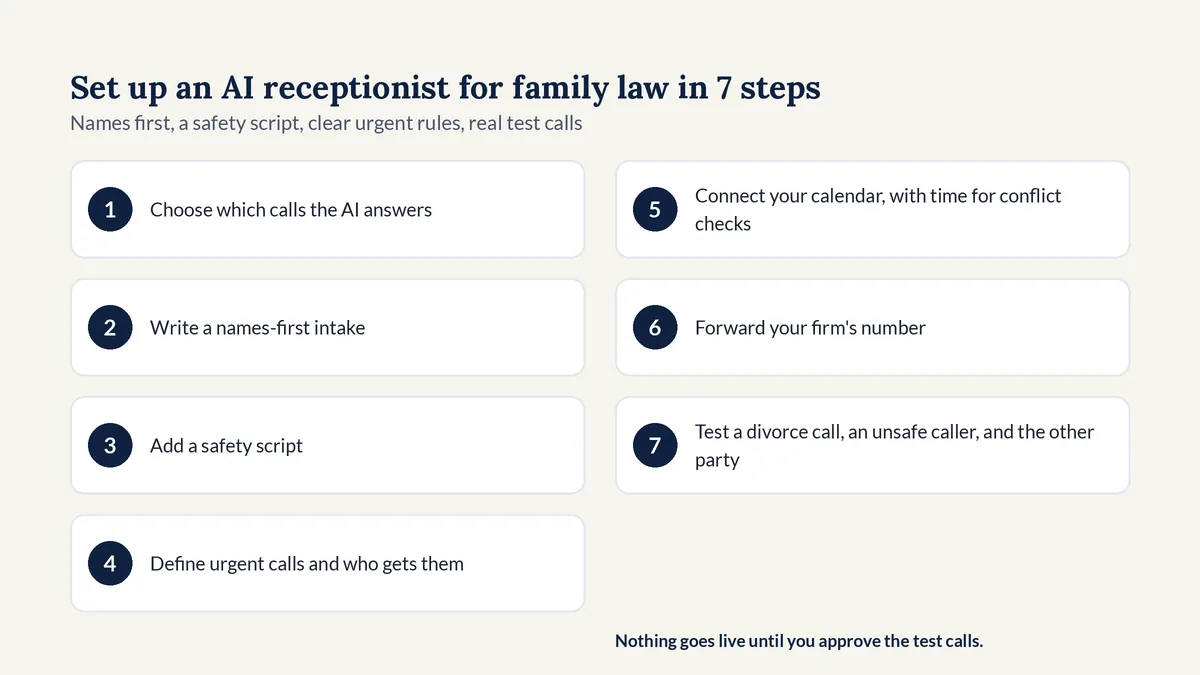
- Choose which calls the AI answers: all calls, overflow, or nights and weekends only.
- Write a names-first intake that collects both parties' names before any facts.
- Add a safety script: 911 first for danger, a safe-to-talk question, and safe-contact preferences.
- Define urgent calls and which attorney gets the text or transfer for each one.
- Connect your calendar and set consultation times, with room for a conflict check before each one.
- Forward your firm's number to the AI so callers keep dialing the number they know.
- Test a divorce call, a caller who is not safe, and a call from the other party, then read each summary.
How does Legal Touch AI handle family law calls?
Legal Touch AI is an AI receptionist for small U.S. law firms. Every call starts with an AI disclosure and a recording notice, then your screening questions, one at a time, so a names-first order is yours to set. You decide what counts as urgent, and those calls get an "URGENT" text and email and can ring your cell.
What it does on every call:
- Tells callers it is an AI in its first sentence and gives a recording notice. If a caller says no to recording, it follows the option you chose at setup, such as taking a short message.
- Sends good callers to you live during office hours, with a text to you first.
- Books consultations on your Google or Outlook calendar after hours or when you don't pick up.
- Takes a message and flags the call when it isn't sure, instead of guessing.
- Sends a summary, the recording, and the transcript after every call.
It never gives legal advice, predicts a result, decides conflicts, promises that your firm will take a case, or asks for Social Security numbers, card numbers, or passwords. It answers incoming calls and does not make sales calls. You keep your number and approve every script change. The fictional walkthrough on our how Legal Touch AI answers a call page follows a divorce caller from greeting to booked consultation. Ask on the demo call how text-backs and voicemails would work for a caller who says texts or calls are not safe. For plans, see Legal Touch AI plans and pricing.
Why we wrote this guide
The Legal Touch AI team has run Legal Touch since 2021. We set up Legal Touch AI on our own phone lines first, screening callers and booking callbacks, before offering it to small law firms. Many of our own callers are stressed when they call, so we care about how hard calls are handled. On Nov 1, 2026 we read 14 page-one pages for family law answering services and AI receptionists. Ten mentioned conflict checks and nine mentioned domestic violence or protective orders. Only two said anything about whether a caller could talk or be reached safely, only one explained the risk of being disqualified, and none cited an ABA Model Rule or public data. This guide fills those gaps.
What 14 page-one pages covered (our review, Nov 1, 2026)
| Topic | Pages that covered it (of 14) |
|---|---|
| Showed prices or dollar figures | 10 |
| Mentioned conflict checks | 10 |
| Mentioned getting the other party's name | 10 |
| Said it does not give legal advice | 9 |
| Mentioned domestic violence or protective orders | 9 |
| Mentioned 911, emergency services, or the domestic violence hotline | 6 |
| Addressed whether the caller can talk or be contacted safely | 2 |
| Explained the risk of being disqualified | 1 |
| Cited an ABA Model Rule or opinion by number | 0 |
| Cited public data such as CDC figures | 0 |
Method: we searched "ai receptionist for family law firms," "family law answering service 24/7," and two related queries, saved the 14 distinct vendor pages that came up, and counted topics with a script, then checked each hit by hand.
Hear it answer a call. Book a 15-minute Legal Touch AI demo and try a divorce call and a call from the other party with your own intake questions.
Frequently asked questions
Can an AI receptionist run a conflict check for a family law firm?
It can collect what a conflict check needs, but your firm makes the call. The AI records the caller's name, the other party's name, and anyone else involved before hearing the facts. Your team checks those names against current and past matters, and an attorney decides whether a conflict exists.
What should an AI receptionist do if a caller is in danger?
Tell the caller to hang up and call 911 if they are in danger right now. Then follow your firm's urgent rules, such as alerting the on-call attorney. The AI should not judge how dangerous things are or give safety advice. It can offer the National Domestic Violence Hotline at 1-800-799-7233.
What if the other spouse calls the firm first?
Keep the first call short and names-first so your team can spot it. ABA Model Rule 1.18 can bar a firm from representing the other side after it hears harmful information from a prospective client, but Comment [2] says someone who calls only to disqualify a lawyer is not a prospective client. An attorney should decide.
Should an AI receptionist text a domestic violence caller back?
Only if the caller says it is safe. A text, missed call, or voicemail from a law firm can be seen by someone else who uses or controls the phone. Ask every caller who raises safety how and when the firm can reach them, and ask your vendor whether automatic text-backs can be skipped for that caller.
Can the AI tell a caller if they will get custody?
No. It should never predict custody, support, or any other result, and it should not explain the law. It can take down the type of matter, the county, any court dates, and whether children are involved, then book a consultation so an attorney can answer those questions privately.
Is a family law intake call with an AI receptionist confidential?
Treat it as confidential. ABA Model Rule 1.18 protects information from prospective clients even if the firm never takes the case, and ABA Formal Opinion 512 says lawyers should check an AI vendor's security and confidentiality terms. Whether a call is privileged depends on your state's law and the facts, so keep details off the first call.
Legal Touch AI is not a law firm and does not provide legal advice. This article is general information, not legal advice about family law, safety planning, or professional ethics rules. Using Legal Touch AI does not create an attorney-client relationship. If you are in danger, call 911.
Sources (checked Nov 1, 2026)
- CDC National Center for Health Statistics, FastStats: Marriage and Divorce (provisional 2023 data): https://www.cdc.gov/nchs/fastats/marriage-divorce.htm
- CDC, About Intimate Partner Violence (updated Aug. 19, 2026): https://www.cdc.gov/intimate-partner-violence/about/index.html
- National Domestic Violence Hotline: https://www.thehotline.org/
- National Network to End Domestic Violence, Safety Net Project, cell phone tips: https://www.techsafety.org/12tipscellphones
- Clio, Legal Trends Report press release (Oct 21, 2019): https://www.clio.com/about/press/clios-legal-trends-report-reveals-law-firms-struggle-to-respond-to-client-inquiries/
- ABA Formal Opinion 512, Generative Artificial Intelligence Tools (July 29, 2024): https://www.americanbar.org/content/dam/aba/administrative/professional_responsibility/ethics-opinions/aba-formal-opinion-512.pdf
- ABA Model Rule 1.18, Duties to Prospective Client: https://www.americanbar.org/groups/professional_responsibility/publications/model_rules_of_professional_conduct/rule_1_18_duties_of_prospective_client/
- ABA Model Rule 1.18, Comment: https://www.americanbar.org/groups/professional_responsibility/publications/model_rules_of_professional_conduct/rule_1_18_duties_of_prospective_client/comment_on_rule_1_18_duties_of_prospective_client/
- ABA Model Rule 4.3, Dealing with Unrepresented Person: https://www.americanbar.org/groups/professional_responsibility/publications/model_rules_of_professional_conduct/rule_4_3_dealing_with_unrepresented_person/
- Legal Touch AI, how it works: https://legaltouchai.com/how-it-works/