AI Receptionist for Estate Planning Attorneys: Consults, Probate Calls and Care
An estate planning answering service is a service that answers an estate planning or probate firm's phone day and night, sorts new will and trust inquiries from calls after a death, takes down what the attorney needs, and books consultations. This guide covers how an AI receptionist does that job: routing, intake, grieving families, older callers, adult children calling for a parent, ethics rules, and setup, with sources checked Nov 2, 2026.
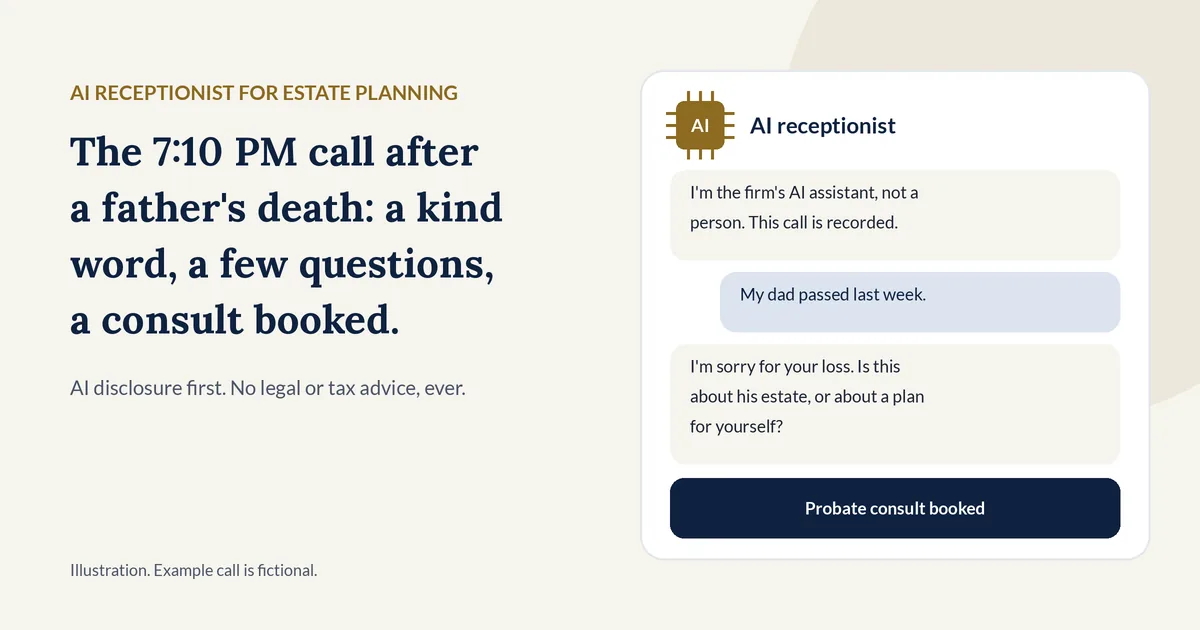
Why it matters: the CDC's National Center for Health Statistics counted 3,072,666 deaths in the United States in 2024 (CDC FastStats, Deaths and Mortality). That is about 8,420 a day, or about 351 an hour (our arithmetic), and behind each one is a family that may need help with an estate. On the planning side, only 32% of U.S. adults told Pew Research Center in September 2025 that they have created a will (Pew Research Center, Nov. 6, 2025). Separately, in a secret-shopper study in Clio's 2019 Legal Trends Report, 39% of calls to law firms went to voicemail (Clio press release, Oct 21, 2019). Someone who finally calls about a will, or calls the week a parent died, may not call twice.
What is an AI receptionist for estate planning attorneys?
An AI receptionist for estate planning attorneys is software that answers the firm's phone, says it is an AI, sorts new planning calls from probate and current-client calls, asks approved intake questions, flags urgent calls such as a client in the hospital, and books consultations. It never gives legal or tax advice, never judges capacity, and never decides conflicts.
On a typical call it does four jobs:
- Greets the caller with an AI disclosure and a recording notice.
- Sorts the call into a new plan, a change to an existing plan, or help after a death.
- Takes the basics your firm approves, including the names your team needs for a conflict check.
- Routes and reports by your rules: urgent alert, live transfer, booked consultation, or message, then a summary with the recording and transcript.
For the full picture of how a call flows from greeting to summary, see our complete guide to choosing an AI receptionist for a small firm.
Why do estate planning firms need every call answered?
Estate planning firms need every call answered because many callers have put it off for years or have just lost someone. The CDC counted 3,072,666 U.S. deaths in 2024, about 8,420 a day by our arithmetic, and only 32% of adults told Pew in 2025 that they have a will. A caller who reaches voicemail may not try again.
We pulled these figures from a CDC page and a Pew Research Center report. The arithmetic rows are ours.
Estate planning by the numbers (our compiled table)
| Measure | Figure | Source |
|---|---|---|
| U.S. deaths in 2024 | 3,072,666 | CDC NCHS FastStats |
| Deaths per day, average | About 8,420 | Our arithmetic: 3,072,666 ÷ 365 |
| Deaths per hour, average | About 351 | Our arithmetic: daily average ÷ 24 |
| Deaths from Alzheimer's disease in 2024 | 116,022 | CDC NCHS FastStats |
| U.S. adults who say they have created a will | 32% | Pew Research Center |
| U.S. adults with a living will or advance health care directive | 31% | Pew Research Center |
| Adults in their 60s with a will | 46% | Pew Research Center |
| Adults in their 70s with a will | 66% | Pew Research Center |
Sources: CDC National Center for Health Statistics, FastStats: Deaths and Mortality (2024 mortality data, page last reviewed Sept. 29, 2026), and Pew Research Center, "Experiences with estate planning and discussing end-of-life preferences" (published Nov. 6, 2025; survey of 8,750 U.S. adults, Sept. 2 to 8, 2025). Pulled Nov 2, 2026. Pew also found that about eight in ten adults in their 80s or older have a will and a living will or advance directive.
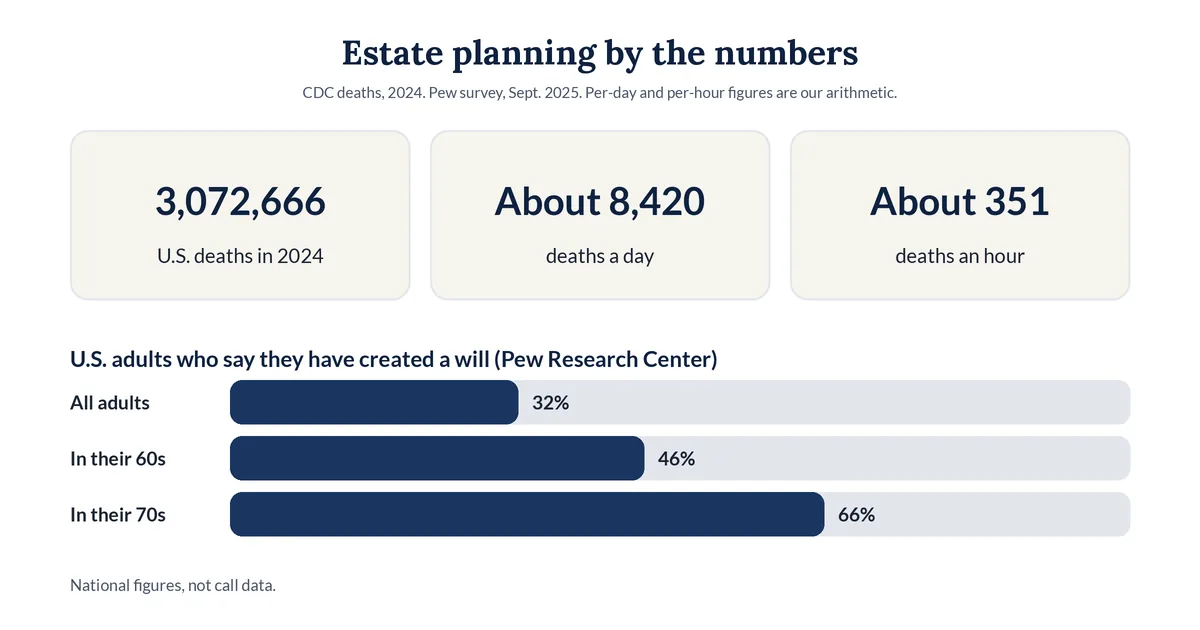
These are national figures, not your call volume. Neither source reports when people call lawyers, so count your own after-hours calls for a month. Our guide to night and weekend answering options for lawyers covers coverage plans.
How should an AI receptionist route probate calls and estate planning calls?
An AI receptionist should ask early whether the call is about planning ahead, changing an existing plan, or handling things after someone died. Planning calls get a consultation. Calls after a death get gentle questions and a probate or trust administration consultation. Current clients get a message to their attorney. Your firm sets every route.
Probate is the court process for passing on a person's property after they die. The California courts' self-help guide puts it plainly: "Probate is the legal process that you must follow to transfer or inherit property after the person who owned the property has passed away," and an estate may need probate even if the person had a will (California Courts Self-Help Guide). Rules differ by state, so your attorneys write the routing, not the AI.
Caller types and routes (our recommended starting rules)
| Caller | What to collect | Route |
|---|---|---|
| Wants a first will, trust, or power of attorney | Name, contact, who the plan is for, state and county | Book a planning consultation |
| Current client changing a plan | Name, which attorney, the change in one sentence | Message to the attorney who drafted the plan |
| Family member after a death | Caller's name and role, name of the person who died, date of death, county, whether a will or trust was found | Book a probate or trust administration consultation |
| Adult child calling about a parent's plan | Caller's name, parent's name, how to reach the parent directly | Book time that includes the parent; note who called |
| Someone in the hospital or hospice who wants to sign or change documents soon | Name, where they are, how soon, who to call | Urgent by your rules: alert the on-call attorney |
| Bank, funeral home, court, or other outside caller | Name, organization, callback number | Message only; no estate details shared |
| A matter your firm does not handle | Name and need | Polite decline and your referral number |
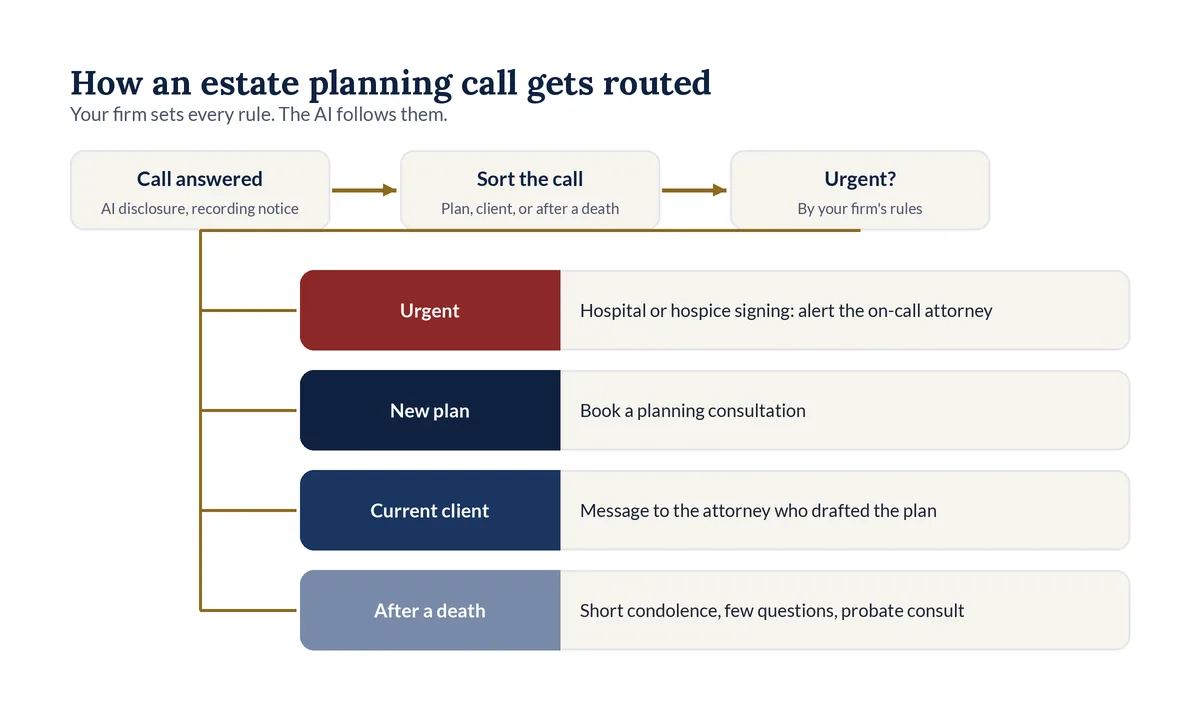
Your firm decides what counts as urgent. Common picks are a client in the hospital or hospice who wants to sign or change documents, a court date or notice the caller already has, and a caller who says an older person is being pressured about money or documents. Those calls should reach an attorney fast, not wait in a message queue.
What should an estate planning intake call ask?
An estate planning intake call should ask only what the attorney needs to check conflicts and prepare: the caller's name and contact details, who the plan is for, the names of a spouse and other key family members, the state and county, whether documents already exist, and, after a death, the name of the person who died and the date.
Intake fields: ask or skip (our recommended starting list)
| Field | Ask on the first call? | Why |
|---|---|---|
| Caller's full name and best phone | Ask | Needed for the callback and the conflict check |
| Who the plan is for, if not the caller | Ask | The attorney must know who the client would be |
| Spouse or partner and other key family names | Ask, if your firm wants it | Lets the team screen for conflicts before calling back |
| State and county, and property in another state | Ask | Shows where the plan or the estate belongs |
| Existing will, trust, or power of attorney? | Ask | Shapes what the consultation covers |
| After a death: name of the person who died, date, and the caller's role | Ask | Opens the right kind of file |
| Asset values or account balances | Skip, unless your firm wants a rough range | Details belong in the consultation |
| Health details or diagnoses | Skip | Not needed to book, and highly personal |
| Social Security, account, or card numbers | Skip | Never needed on a first call |
| Who should inherit what, and why | Skip | A private talk with the attorney |
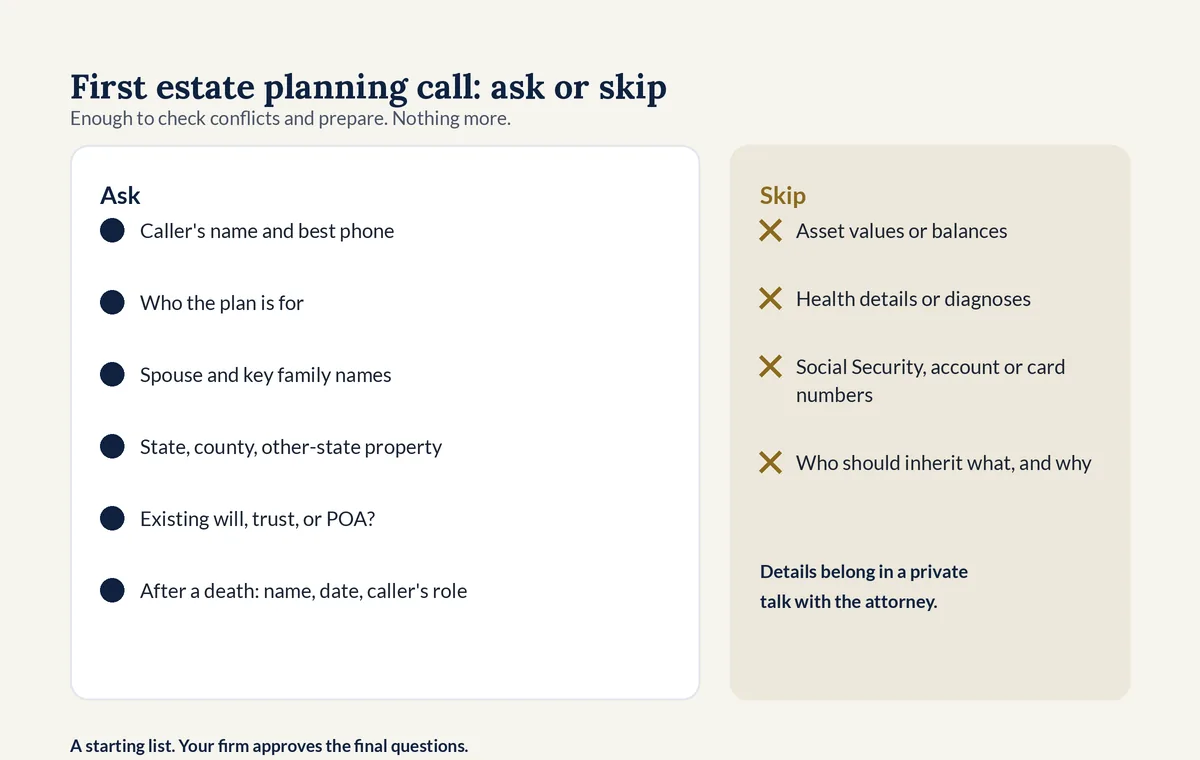
ABA Model Rule 1.18 treats a person who consults a lawyer about possibly hiring them as a prospective client, and its Comment [4] says a lawyer should limit the first consultation to the information reasonably necessary to decide whether to take the matter. Estate planning calls are full of family and money details, so a short first call protects everyone. Our guide to screening intake callers without losing good cases covers screening for every practice area.
How should an AI receptionist talk to a family after a death?
An AI receptionist should start with a short, plain condolence, ask only a few questions, and let the caller take their time. It takes the caller's name and role, the name of the person who died, the county, and whether a will or trust was found, then books a consultation. It never explains what the family must file.
Five habits make these calls go well:
- Say it once, simply. "I'm sorry for your loss." Repeating it can sound scripted.
- Ask for the role, not the story. Executor, spouse, child, or other family member, plus the name of the person who died.
- Keep estate details private. Don't confirm to any caller whether the person was a client or what a will says. ABA Model Rule 1.6(a) bars a lawyer from revealing information relating to a client's representation without informed consent or another exception, so the attorney decides what is shared.
- Record deadlines, don't explain them. If the caller mentions a court date or a notice, write it down and flag it.
- Offer a person. If the caller asks for someone, transfer during office hours or book a callback.
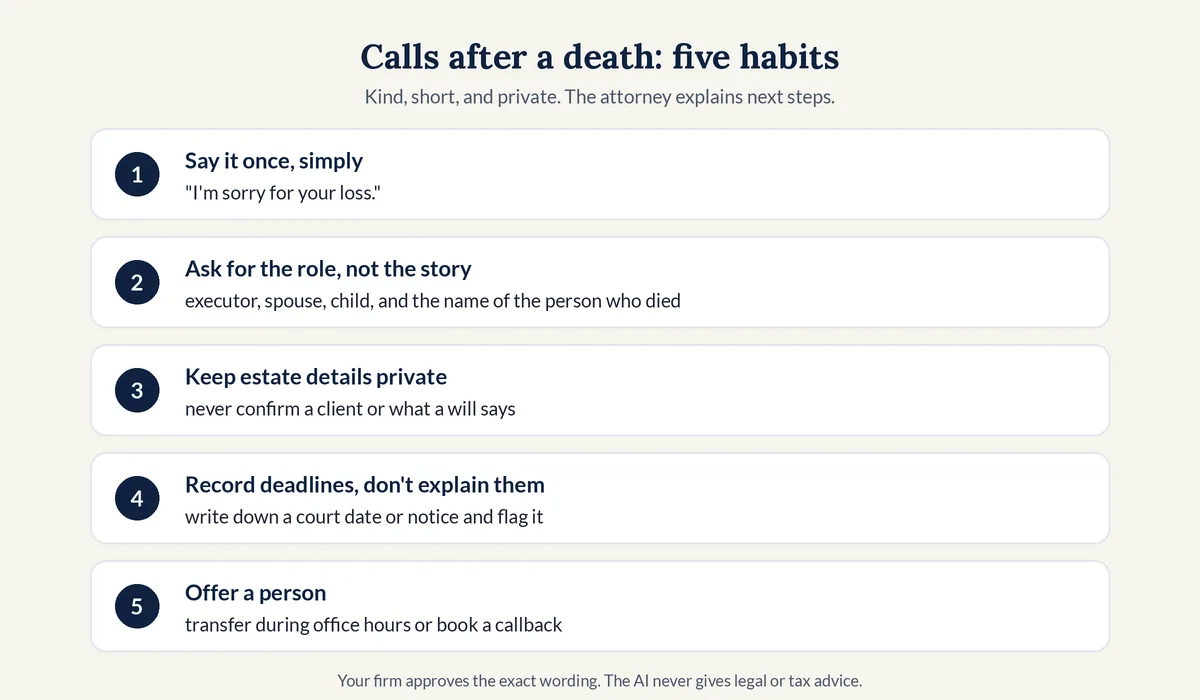
A sample line for your script: "I'm sorry for your loss. I can set up a time for you to talk with an attorney about next steps. May I have your name and your relationship to the person who passed?"
What if an adult child calls about a parent's will?
The AI should note who is calling and who the plan is for, take the parent's name and a way to reach the parent, and book a consultation that includes the parent. It should not take instructions about what the parent's will should say. ABA Model Rule 1.14 says the lawyer should identify who the client is.
Comment [6] to Rule 1.14 says that when a family member seeks a lawyer's services for someone who may have decision-making limitations, the lawyer "should identify who the client is," and that when a family member asks for help drafting a document the other person will sign, the lawyer "should be alert to the possibility of undue influence or fraud." Comment [5] adds that the lawyer must look to the client, not family members, to make decisions, and should give the client the chance to talk privately whenever possible.
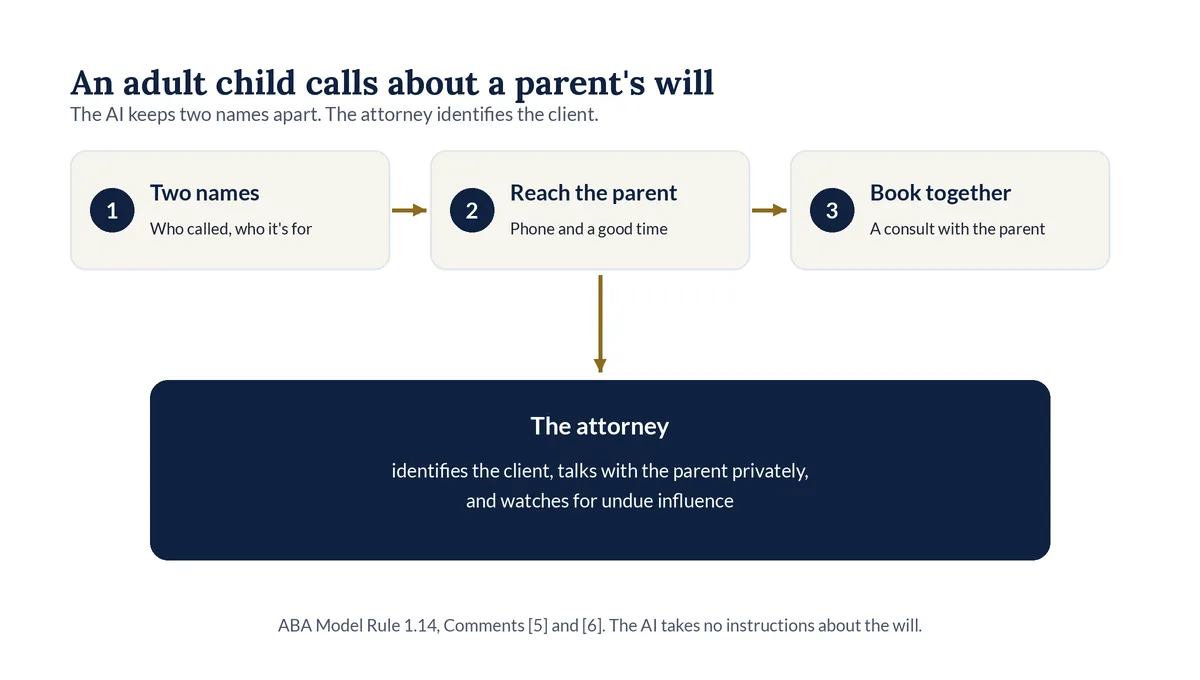
Three things your script should do:
- Keep two names apart. The summary should show the caller and the person the plan is for as separate people.
- Ask how to reach the parent. The attorney will want to speak with the parent directly.
- Note who is paying, if it comes up. ABA Model Rule 1.8(f) lets a lawyer accept payment from someone other than the client only with the client's informed consent, no interference with the lawyer's judgment, and confidentiality protected. The attorney handles that conversation.
A sample line: "I can help set that up. The attorney will want to speak with your mother directly. What's the best way to reach her, and is there a time that works for her?"
How should an AI receptionist handle older callers and capacity concerns?
An AI receptionist should slow down for older callers, ask one question at a time, repeat back names and times, and offer a person or a callback whenever asked. It should never judge whether a caller has capacity. If a caller mentions pressure about money or documents, it flags the call for an attorney.
In February 2026 the ABA amended Model Rule 1.14 and renamed it "Client with Decision-Making Limitations." It was called "Client with Diminished Capacity." Under the rule, a person has decision-making limitations if the person has substantial difficulty receiving and understanding information, evaluating information, or making or communicating decisions even with appropriate supports or accommodations. Comment [2] says these limitations "can be situational in nature and can vary in degree and over time," and Comment [13] says a lawyer should ordinarily not rely only on a medical diagnosis. That judgment belongs to the attorney. An AI on a phone call should not try to make it.
Memory loss touches many estate planning families: the CDC counted 116,022 deaths from Alzheimer's disease in 2024. Habits that help any older caller:
- One question at a time, in plain words, with time to answer.
- Read back names, phone numbers, and appointment times.
- Offer a person or a callback whenever the caller asks.
- Flag, don't assess. If a caller says someone is pressuring them, controlling their money, or keeping them from calling, mark it urgent for an attorney.
- Danger comes first. Anyone in danger right now should hear "call 911." For local services for older adults, the Eldercare Locator, a public service of the Administration for Community Living, is at 1-800-677-1116.
Comment [3] to Rule 1.14 lists supports such as plain language and meeting in a familiar setting. A calm, unhurried phone script is the first of those a firm controls.
What do ethics rules say about AI receptionists for estate planning firms?
ABA Formal Opinion 512 (July 29, 2024) says lawyers using AI tools must protect client information under Rules 1.6 and 1.18 and supervise outside AI providers under Rule 5.3. For estate planning, add Rule 1.14: the lawyer, not the AI or a relative, identifies the client and looks to that client for decisions.
This is general information, not legal advice. State rules control, and some state bars have their own AI opinions. Points that matter for an estate planning practice:
- Vet the vendor. Opinion 512 lists reference checks, security policies, confidentiality agreements, and whether the tool keeps data after you stop using it.
- Keep advice with lawyers. Opinion 512 says lawyers may not leave it to AI tools alone to offer legal advice to clients.
- Limit what the first call collects. Rule 1.18 protects information from prospective clients even if you never take the matter.
- Guard the information. Model Rule 1.6(c) asks lawyers to make reasonable efforts to prevent the inadvertent or unauthorized disclosure of client information, which includes who can see call recordings and summaries.
- Supervise the script. Model Rule 5.3 asks supervising lawyers to make reasonable efforts to ensure that nonlawyer help acts in a way compatible with the lawyers' professional obligations.
For disclosure, recording consent, and confidentiality in more depth, see our guide to AI receptionist ethics, disclosure and recording rules.
How do you set up an AI receptionist for an estate planning firm?
To set up an AI receptionist for an estate planning firm, choose which calls it answers, write separate intake paths for new plans, current clients, and calls after a death, add a condolence line and a slower pace, define urgent calls, set a rule for relatives calling for someone else, connect your calendar, forward your number, and test each path.
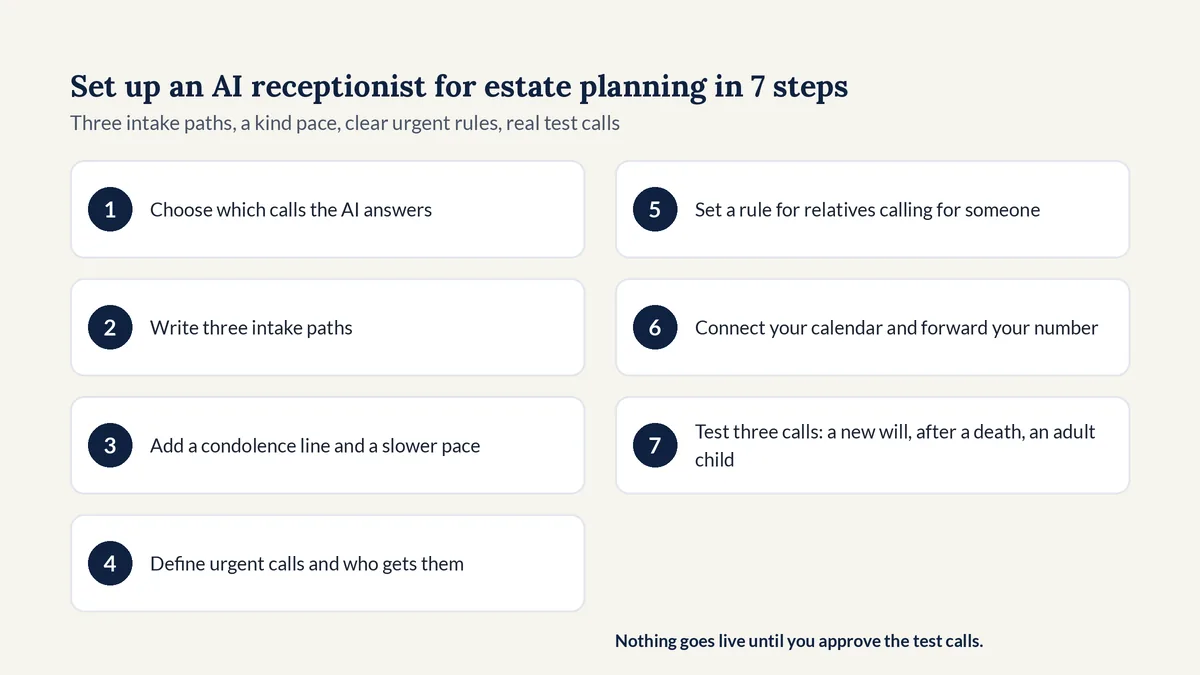
- Choose which calls the AI answers: all calls, overflow, or nights and weekends only.
- Write three short intake paths: new plan, current client, and help after a death.
- Add a short condolence line and a one-question-at-a-time pace for older callers.
- Define urgent calls, such as a hospital or hospice signing, and who gets each alert.
- Set a rule for relatives calling for someone else: record who called and who the plan is for.
- Connect your calendar and forward your number so callers keep dialing the number they know.
- Test a new will call, a call after a death, and an adult child calling for a parent, then read each summary.
If your firm tracks leads in practice management software, our guide to connecting an AI receptionist to Clio or MyCase explains what can sync and what to ask a vendor.
How does Legal Touch AI handle estate planning calls?
Legal Touch AI is an AI receptionist for small U.S. law firms. Every call starts with an AI disclosure and a recording notice, then your screening questions, one at a time, so separate planning and after-a-death paths are yours to set. Calls you mark urgent get an "URGENT" text and email and can ring your cell.
What it does on every call:
- Tells callers it is an AI in its first sentence and gives a recording notice. If a caller says no to recording, it follows the option you chose at setup, such as taking a short message.
- Sends good callers to you live during office hours, with a text to you first.
- Books consultations on your Google or Outlook calendar after hours or when you don't pick up, and the caller gets a text and email confirming the time.
- Gets callers to a person when they ask. During your office hours it transfers them to the person you choose. After hours it books a callback and texts them the time.
- Takes a message and flags the call when it isn't sure, instead of guessing.
- Sends a summary, the recording, and the transcript after every call.
It never gives legal advice, predicts a result, decides conflicts, promises that your firm will take a matter, pretends to be a person, or asks for Social Security numbers, card numbers, or passwords. It quotes your fees only if you approve the exact wording. It answers incoming calls and does not make sales calls. You keep your number, and nothing goes live without your OK. See how Legal Touch AI answers a call step by step, and ask on the demo call how a condolence line and a slower pace would sound for your callers. For plans, see Legal Touch AI plans and pricing.
Why we wrote this guide
We set up Legal Touch AI on our own phone lines first, greeting callers, asking our screening questions, and booking callbacks, before offering it to law firms. Our own callers are often stressed, and many call after work or on weekends, so we care about how hard calls are handled. On Nov 2, 2026 we read 16 page-one pages for estate planning and probate answering services and AI receptionists. Fourteen mentioned probate and twelve mentioned grief or a recent death. Only four mentioned conflict checks, three mentioned an adult child calling about a parent, two mentioned capacity concerns, and one mentioned undue influence or elder abuse. None said the attorney should be able to talk with the client privately, none used the ABA's February 2026 Rule 1.14 wording, and none cited public data. This guide fills those gaps.
What 16 page-one pages covered (our review, Nov 2, 2026)
| Topic | Pages that covered it (of 16) |
|---|---|
| Mentioned probate | 14 |
| Mentioned grief or a recent death | 12 |
| Showed prices or dollar figures | 8 |
| Addressed legal advice, such as saying it gives none | 8 |
| Mentioned conflict checks | 4 |
| Mentioned an adult child calling about a parent | 3 |
| Mentioned capacity concerns or memory loss | 2 |
| Named an ABA Model Rule by number | 2 |
| Said the firm must identify who the client is | 1 |
| Mentioned undue influence or elder abuse | 1 |
| Said the attorney should talk with the client privately | 0 |
| Used Rule 1.14's February 2026 wording, "decision-making limitations" | 0 |
| Cited public data such as CDC or Pew figures | 0 |
Method: we searched "ai receptionist for estate planning attorneys," "estate planning answering service," "virtual receptionist for probate attorneys," and two related queries, saved the 16 distinct vendor pages that came up, counted topics with a script, and checked each hit by hand. One of the two ABA hits was only a link to a related article.
Hear it answer a call. Book a 15-minute Legal Touch AI demo and try a new will call and a call after a death with your own intake questions.
Frequently asked questions
Can an AI receptionist tell a caller whether they need a will or a trust?
No. Choosing between a will, a trust, or other documents is legal advice, and only an attorney should give it. The AI can say what kinds of planning your firm handles, take down who the plan is for and the state and county, and book a consultation where the attorney answers that question.
Can an AI receptionist handle probate calls after a death?
Yes, within limits your firm sets. It can offer a short condolence, take the caller's name and role, the name of the person who died, the date and county, and whether a will or trust was found, then book a consultation. It should not explain deadlines, filings, or who inherits, and it should flag any court date for an attorney.
Should an AI receptionist take instructions from an adult child about a parent's will?
No. It can take a message and book a consultation, but the attorney decides who the client is. ABA Model Rule 1.14 Comment [6] says the lawyer should identify the client and watch for undue influence when a relative asks for a document the other person will sign. The AI should ask how to reach the parent directly.
Can an AI receptionist tell if an older caller lacks capacity?
No, and it should not try. The ABA's Model Rule 1.14 leaves that judgment to the lawyer and says a lawyer should ordinarily not rely only on a medical diagnosis. The AI's job is to be patient: one question at a time, read back details, offer a person, and flag any mention of pressure for an attorney.
Can an AI receptionist quote our flat fees for a will or trust?
Only if you want it to. A good setup quotes fees only in the exact wording your firm approves and otherwise tells the caller the attorney will go over fees at the consultation. It should never quote what probate will cost a family, because that depends on the estate and the state.
Is an estate planning intake call with an AI receptionist confidential?
Treat it as confidential. ABA Model Rule 1.18 protects information from prospective clients even if the firm never takes the matter, and ABA Formal Opinion 512 says lawyers should check an AI vendor's security and confidentiality terms. Whether a call is privileged depends on your state's law and the facts, so keep details off the first call.
Legal Touch AI is not a law firm and does not provide legal advice. This article is general information, not legal advice about estate planning, probate, or professional ethics rules. Using Legal Touch AI does not create an attorney-client relationship. If someone is in danger, call 911.
Sources (checked Nov 2, 2026)
- CDC National Center for Health Statistics, FastStats: Deaths and Mortality (2024 data): https://www.cdc.gov/nchs/fastats/deaths.htm
- Pew Research Center, Experiences with estate planning and discussing end-of-life preferences (Nov. 6, 2025): https://www.pewresearch.org/social-trends/2025/11/06/experiences-with-estate-planning-and-discussing-end-of-life-preferences/
- California Courts Self-Help Guide, Guide to property after someone dies: https://selfhelp.courts.ca.gov/probate
- Eldercare Locator, Administration for Community Living: https://eldercare.acl.gov/
- Clio, Legal Trends Report press release (Oct 21, 2019): https://www.clio.com/about/press/clios-legal-trends-report-reveals-law-firms-struggle-to-respond-to-client-inquiries/
- ABA Formal Opinion 512, Generative Artificial Intelligence Tools (July 29, 2024): https://www.americanbar.org/content/dam/aba/administrative/professional_responsibility/ethics-opinions/aba-formal-opinion-512.pdf
- ABA Model Rule 1.14, Client with Decision-Making Limitations (amended February 2026; ABA page dated Feb. 17, 2026): https://www.americanbar.org/groups/professional_responsibility/publications/model_rules_of_professional_conduct/rule-1-14-client-with-decision-making-limitations/
- ABA Model Rule 1.14, Comment: https://www.americanbar.org/groups/professional_responsibility/publications/model_rules_of_professional_conduct/rule-1-14-client-with-decision-making-limitations/comment-on-rule-1-14/
- ABA Model Rule 1.6, Confidentiality of Information: https://www.americanbar.org/groups/professional_responsibility/publications/model_rules_of_professional_conduct/rule_1_6_confidentiality_of_information/
- ABA Model Rule 1.8, Current Clients: Specific Rules: https://www.americanbar.org/groups/professional_responsibility/publications/model_rules_of_professional_conduct/rule_1_8_current_clients_specific_rules/
- ABA Model Rule 1.18, Duties to Prospective Client: https://www.americanbar.org/groups/professional_responsibility/publications/model_rules_of_professional_conduct/rule_1_18_duties_of_prospective_client/
- ABA Model Rule 1.18, Comment: https://www.americanbar.org/groups/professional_responsibility/publications/model_rules_of_professional_conduct/rule_1_18_duties_of_prospective_client/comment_on_rule_1_18_duties_of_prospective_client/
- ABA Model Rule 5.3, Responsibilities Regarding Nonlawyer Assistance: https://www.americanbar.org/groups/professional_responsibility/publications/model_rules_of_professional_conduct/rule_5_3_responsibilities_regarding_nonlawyer_assistant/
- Legal Touch AI, how it works: https://legaltouchai.com/how-it-works/