Answering Service for Lawyers in San Antonio: Presiding Court Mornings, 210 and 726, and Bexar County Callers
An answering service for lawyers in San Antonio is a service that answers a law firm's phone when nobody at the firm is free, asks the firm's own intake questions, and passes each caller's details to the firm under its routing instructions. For San Antonio firms, useful details include Bexar County's Presiding Court docket calls, the 210 and 726 area codes, and Spanish-speaking callers. Sources checked Nov 11, 2026.
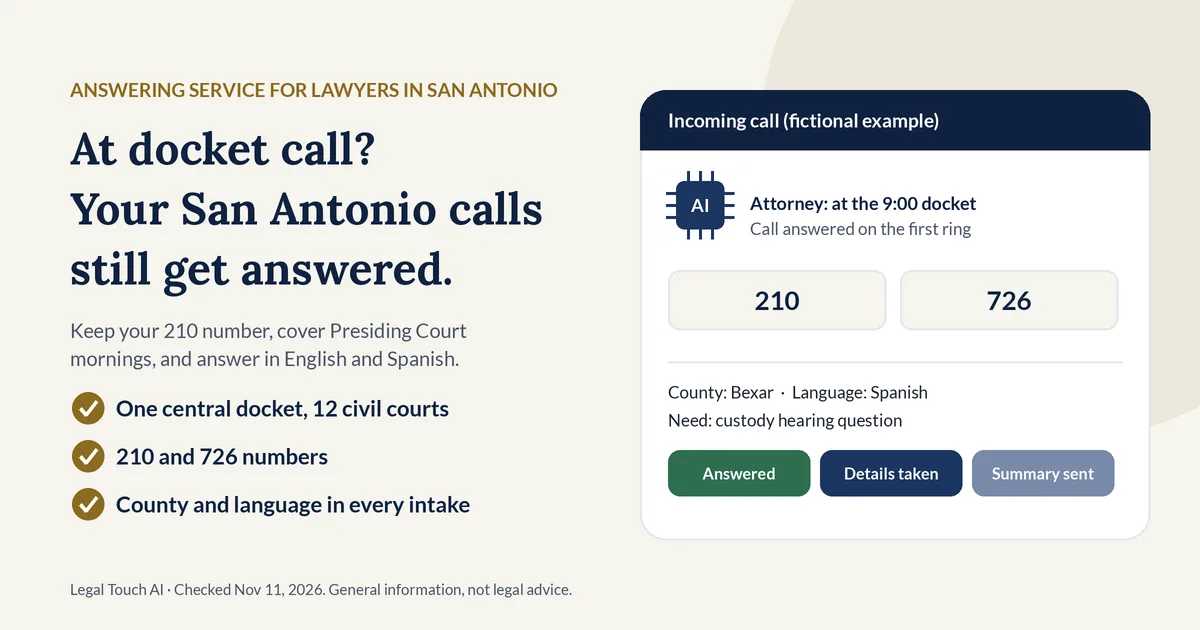
What is an answering service for lawyers in San Antonio?
An answering service for lawyers in San Antonio answers calls when a firm's staff cannot, records the caller's contact details and reason for calling, and follows the firm's routing instructions. Providers may use people, AI, or both. For San Antonio firms, useful setup decisions include docket-call coverage, keeping a 210 number, and Spanish intake.
An AI receptionist for a San Antonio law firm is software that answers in a natural voice, tells callers it is an AI assistant, follows the firm's intake script, and can book consultations when a calendar is connected. Whichever kind you choose, first decide which calls it should answer:
| Coverage setup | Which calls it answers | Often a fit when |
|---|---|---|
| All calls | Every call, day and night | Nobody is assigned to the front desk |
| Overflow only | Calls nobody at the firm picks up within a set number of rings | A receptionist is on duty but can't take two calls at once |
| After hours only | Calls outside office hours | Days are covered, but nights and weekends are not |
| Docket-call mornings | Calls during the hours you set for Presiding Court or Monitoring Court | An attorney is downtown several mornings a week |
For a full feature and cost checklist, see our buyer's guide to AI receptionists for small law firms. To see named providers side by side, read our comparison of legal answering services and AI receptionists.
How many lawyers practice in Bexar County, and how many work in small firms?
Bexar County had 6,704 active State Bar of Texas members on Dec 31, 2025, or 5.7% of the bar's 118,430 active members. Among 3,203 Bexar County attorneys reporting a private practice setting, 2,330 worked solo or in firms of 2 to 10 attorneys. That is 72.7% by our calculation, and solo practitioners alone were 37.8%.
We compared the bar's Bexar County columns for 2015-16 and 2025-26. The change column is our arithmetic.
| Bexar County private practice setting (State Bar of Texas) | 2015-16 | 2025-26 | Change in ten years (our arithmetic) |
|---|---|---|---|
| Solo practitioners | 1,489 | 1,212 | down 18.6% |
| Firms of 2 to 5 attorneys | 839 | 840 | up 0.1% |
| Firms of 6 to 10 attorneys | 305 | 278 | down 8.9% |
| Solo through 10 attorneys, combined | 2,633 | 2,330 | down 11.5% |
| Firms of 11 or more attorneys | 811 | 873 | up 7.6% |
| All private practitioners who reported a setting | 3,444 | 3,203 | down 7.0% |
Source: State Bar of Texas, Bexar County Attorney Statistical Profile 2025-26. Over the same period, total active Bexar County attorneys rose 11.2%, from 6,029 to 6,704. The median Bexar County attorney was 52 years old in 2025-26, up from 50, and 24% were older than 65.
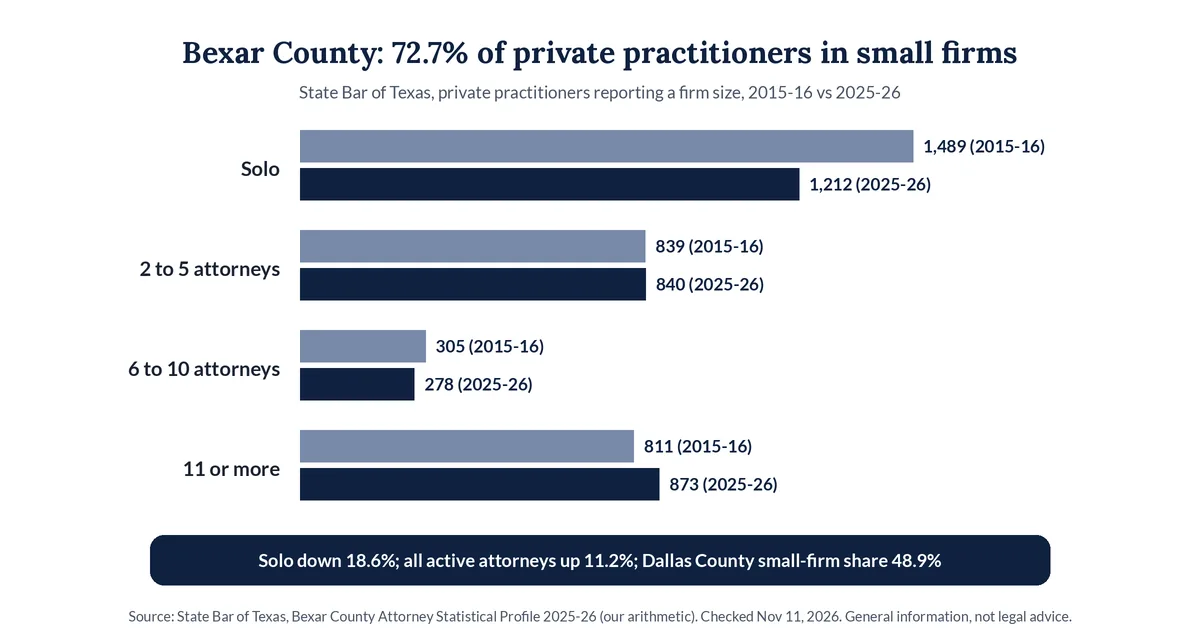
Those counts describe where attorneys say they work, not how many firms exist or how many calls they get. Still, the pattern matters for phones. In Bexar County, about seven in ten private practitioners work where there may be no full-time receptionist, or only one. With 315 active attorneys per 100,000 Bexar County residents (our math using the 2024 Census count), many small offices handle a steady stream of calls with very few people. Use your own call log to see how many calls ring while you are away from the desk.
How do Bexar County's Presiding Court dockets affect a firm's phones?
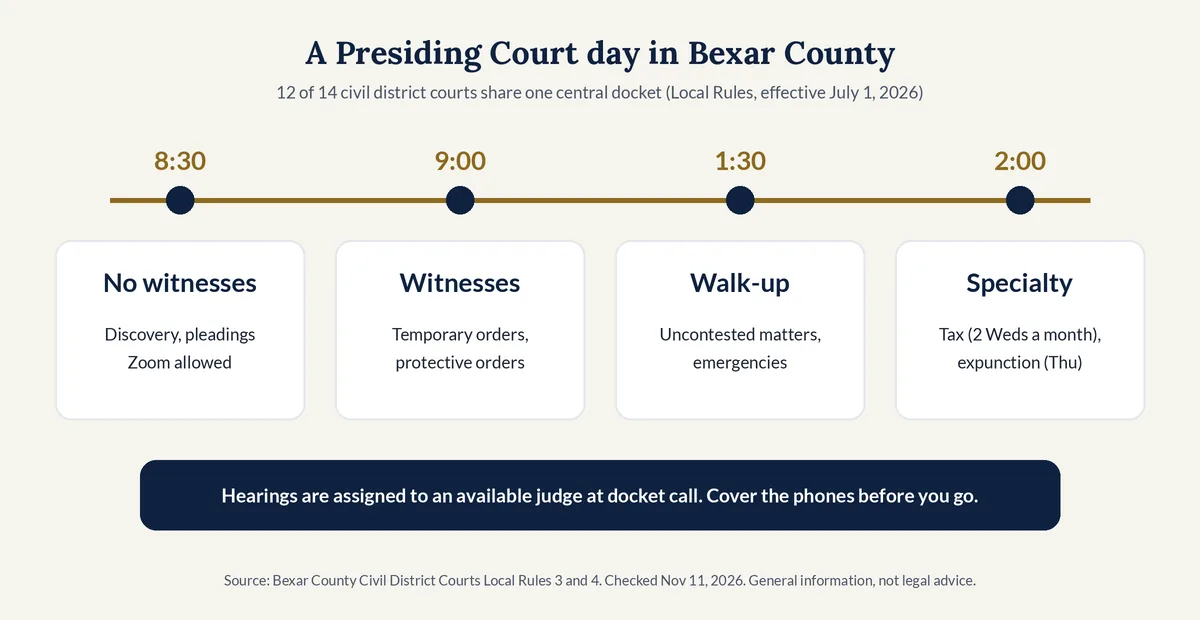
Most Bexar County civil district courts share a central docket. The Presiding Judge calls dockets at 8:30, 9:00 and 1:30, then assigns each hearing to whichever judge is free. An attorney can spend a morning waiting for an assignment with the phone silenced. Coverage for docket-call mornings keeps new callers from reaching voicemail.
The Bexar County Civil District Courts' local rules, effective July 1, 2026, list 14 civil district courts. Twelve take part in the Presiding Court and Monitoring Court system. The 225th and 285th District Courts have elected not to participate and keep their own settings. Family law, including divorce and custody, is heard in these civil district courts, so family lawyers live by the same docket calls. A resolution of the civil district judges traces the Presiding Court system to 1962.
| Docket (Presiding Court, Bexar County Courthouse) | What the rules say it hears | What it can mean for your phones |
|---|---|---|
| 8:30 docket | Matters without witnesses, such as discovery hearings and pleading disputes. Zoom allowed | A short hearing can still mean an hour away from the desk |
| 9:00 docket | Matters with witnesses or long court time: nonjury trials, temporary orders, injunctions, family law protective orders. In person unless the parties qualify for Zoom | Attorney out for the morning, sometimes the day |
| 1:30 walk-up docket | Uncontested matters and emergencies, such as prove-ups, agreed orders, and ex parte protective order requests | Afternoon gap, often on short notice |
| 2:00 specialty dockets | Tax docket twice a month on Wednesdays; expunction docket every Thursday | Predictable recurring afternoons |
| Monitoring Court, Monday 8:30 | Jury trial announcements for that week's trial docket | A trial can be assigned any day through Thursday |
Bexar County also lists 10 criminal district courts, the 144th through the 437th, plus specialty courts such as a felony drug court and a veterans treatment court. The county gives two downtown addresses for its courts: the Bexar County Courthouse at 100 Dolorosa and the Cadena-Reeves Justice Center at 300 Dolorosa.
Three habits help on docket days:
- Turn on coverage before you leave. Set docket-call mornings as covered hours, not just after hours.
- Pick one urgent rule. Decide what counts as urgent (for example, an arrest or a hearing tomorrow) and who gets that call.
- Separate new callers from opposing counsel. The local rules ask attorneys with conflicting settings to give opposing counsel a cell phone number for the day of the hearing, so tell the service which calls go straight to that cell.
Our guides for family law firms and criminal defense lawyers go deeper on screening questions for those practices.
How can San Antonio language data help plan phone coverage?
Census language estimates can help San Antonio firms plan phone coverage, but they do not measure what callers prefer. In 2024, about 12 of every 100 San Antonio residents age 5 and older spoke Spanish at home and English less than very well. Use your firm's call logs to decide what Spanish coverage to arrange.
In the City of San Antonio, 37.0% of residents age 5 and up speak Spanish at home, and 33.3% of that group rate their English below "very well," the Census Bureau's 2024 American Community Survey shows. Per 100 residents age 5 and older, that is roughly 12 in the city, roughly 10 across Bexar County, and roughly 2 in Comal County to the northeast.
| Place (Census 2024) | Residents | Residents age 5+ | Spanish spoken at home | Of those, English below "very well" | Per 100 residents age 5+ (our math) |
|---|---|---|---|---|---|
| City of San Antonio | 1,526,621 | 1,430,790 | 528,775 (37.0%) | 176,185 (33.3%) | 12.3 |
| Bexar County | 2,127,737 | 1,994,200 | 656,060 (32.9%) | 209,603 (31.9%) | 10.5 |
| Comal County | 201,628 | 190,585 | 24,449 (12.8%) | 4,632 (18.9%) | 2.4 |
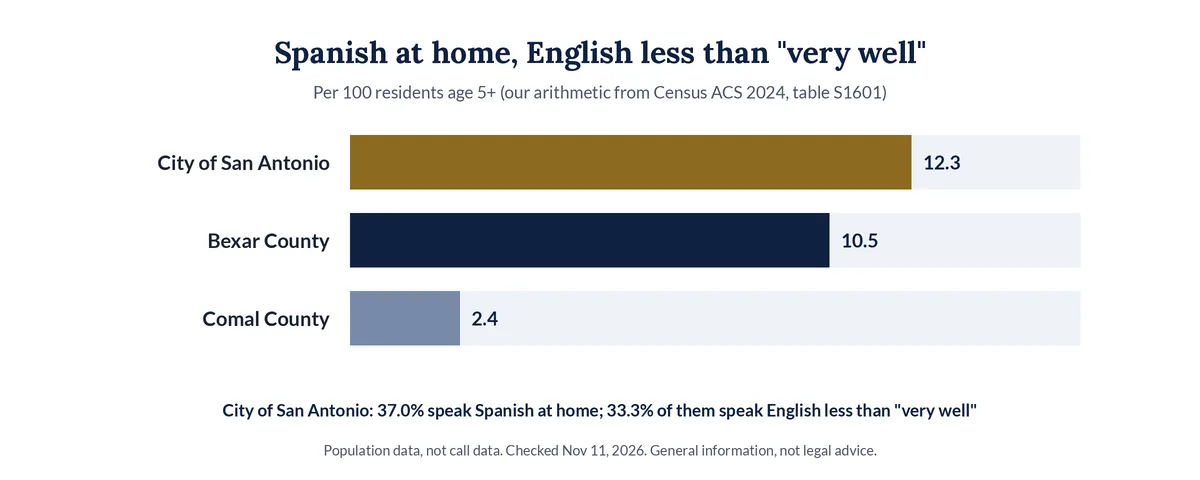
Sources: Census table S1601, City of San Antonio, Census table S1601, Bexar County, Census table S1601, Comal County, and ACS table B01003 for the resident totals. The language counts are survey estimates with margins of error, including plus or minus 16,814 for city residents who speak Spanish at home.
Spanish also shows up at the courthouse. The civil district courts' local rules ask parties who need an interpreter for any language other than Spanish to arrange it at least 10 days ahead; Spanish interpreters are left out of that advance-notice step. On our live pricing page, Spanish is included in Done for You at no extra cost, and it answers in English and Spanish. Our Houston guide lists five questions to ask any provider about Spanish calls, and our Spanish intake guide for bilingual immigration practices goes deeper on scripts.
Can a San Antonio law firm keep its 210 number?
Yes. Call forwarding lets a firm keep its 210 or 726 number and phone company while calls ring through to the answering service. Callers still dial the number on your website and signs. The 726 overlay added new numbers for the same area in 2017; it did not change anyone's existing 210 number.
San Antonio has used 210 since 1992. The Public Utility Commission of Texas approved 726 as an overlay in 2016, and the North American Numbering Plan Administrator assigned it, according to KENS 5's July 2016 report and the San Antonio Report, which quoted the commission.
| Date | Event |
|---|---|
| 1992 | 210 becomes San Antonio's area code |
| July 2016 | 726 approved and assigned as an overlay for the 210 area |
| Sept 23, 2017 | Ten-digit dialing becomes mandatory for local calls |
| Oct 23, 2017 | 726 numbers can be issued |
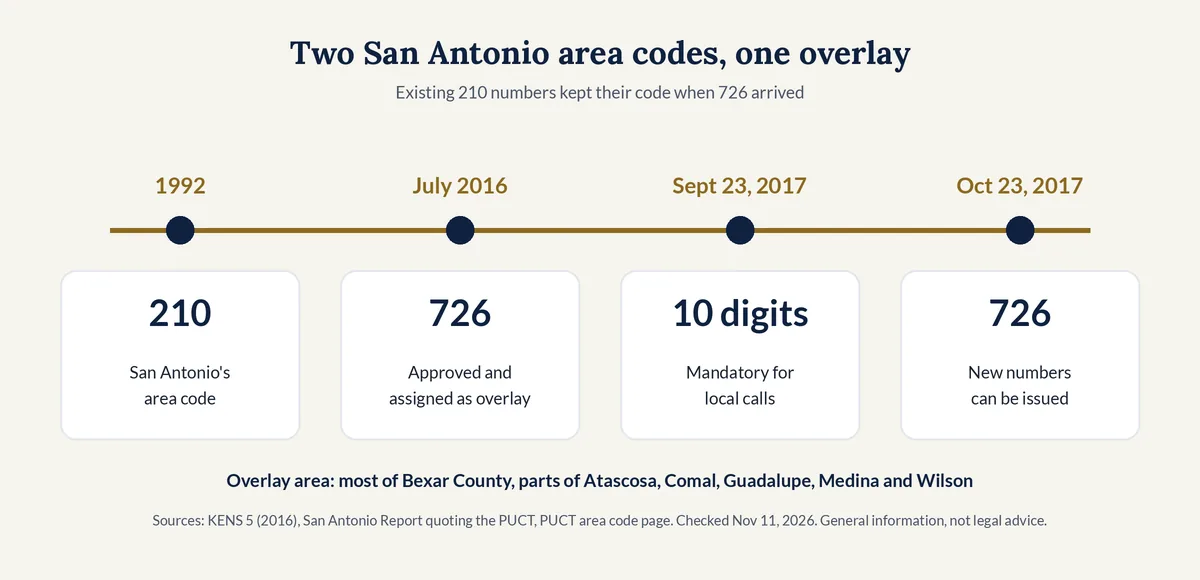
The overlay covers most of Bexar County and parts of Atascosa, Comal, Guadalupe, Medina and Wilson counties. The Public Utility Commission's San Antonio area code page lists both codes. Two practical points for a firm: a caller's 210 or 726 number does not tell you which county their matter is in, so ask; and any number you publish should be dialed with all ten digits in scripts and voicemail greetings.
How do you set up an answering service for a San Antonio law firm?
Start with a month of call logs so you know when calls go unanswered, then choose which calls the service should take and write your intake questions, including county and language. Set transfer rules for docket-call mornings, forward your existing 210 or 726 number, and test with real calls before you rely on it.
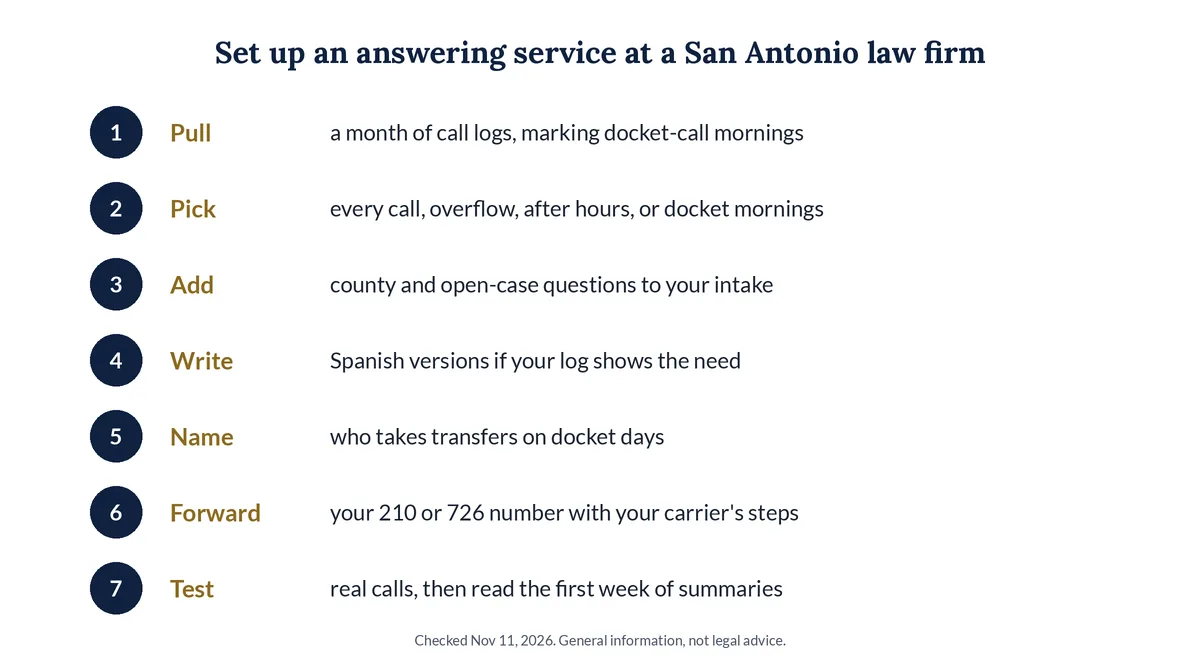
- Pull a month of call logs and mark the calls that rang while an attorney was at a Presiding Court or Monitoring Court docket call.
- Pick your coverage: every call, overflow, after hours, or docket-call mornings.
- Add questions for the caller's county and whether a court case is already open, so the firm can decide who calls back.
- Write Spanish versions of your questions if your call log shows Spanish-speaking callers.
- Name the person who takes live transfers on docket days and the person who returns the rest.
- Forward your existing number to the service using your phone company's instructions, then confirm the routing.
- Test with calls from a cell phone and a landline, then read the first week of summaries.
Planning a vacation? The local rules ask attorneys to send a vacation letter at least two weeks ahead, and in family law cases to name alternate counsel for emergencies. Give your answering service the same alternate name and dates so urgent calls reach that person. Not sure how many calls you lose today? Our guide to why law firms miss calls and what it costs shows how to count them. Statewide rules on call recording and AI disclosure are covered once, in our Texas guide to AI receptionist rules and setup.
Does Bexar County's AI certification rule apply to an AI receptionist?
Bexar County's AI certification covers pleadings, not phones. The civil district courts require a signed certificate that any language, citations or analysis produced by generative AI in a filing was verified through traditional legal sources. An AI receptionist that answers calls does not draft filings, but your firm should confirm how the rule applies to its work.
The approved certificate form is short. Its focus is accuracy in court filings. A phone answering tool works on a different part of the practice: it collects contact details and the caller's reason for calling, then hands the matter to a person. Still, the rule is a good reminder of a principle that applies to any AI used in legal work: a person checks the output. Read every call summary before you act on it, and never let an answering service, AI or human, give legal advice. Our guide to ethics rules for AI receptionists at law firms covers supervision and confidentiality.
What does an answering service cost a San Antonio law firm?
The price depends on how the service bills and how many calls you get. Many AI receptionists charge a flat monthly amount that includes a block of minutes, and many live services bill per minute or per call. A San Antonio firm should price its real monthly volume, plus setup fees and any charge for Spanish, before comparing.
Legal Touch AI's Done for You plan is $495 a month plus a $495 setup. See Legal Touch AI plans and what each includes for included minutes and current plan details. To compare published plans at different call volumes, use our cost comparison of legal answering services.
How does Legal Touch AI answer calls for San Antonio firms?
Legal Touch AI answers forwarded calls in English and Spanish, identifies itself as AI, and follows the firm's approved intake instructions. For a San Antonio firm, setup can include docket-call hours, county and language questions, and callback rules. Live transfers during office hours and calendar booking are part of Done for You.
From our home page, pricing page, and our step-by-step walk-through of a Legal Touch AI call:
- It says what it is. The greeting identifies the service as AI and includes a recording notice. Your firm approves the wording during setup.
- Transfers and booking. Done for You lists live transfers during office hours with an email alert, and consult booking on your Google or Outlook calendar. Text alerts are coming soon.
- Summaries. Your firm gets a summary of each call, with recording and transcript access under your settings.
- Same number. You keep your 210 or 726 number and your phone company.
- Clear limits. It never gives legal advice or predicts a result, never decides conflicts, never promises your firm will take a case, and never pretends to be a person.
- Hours you choose. After-hours answering is a setting on every plan, so it can cover nights, weekends, or your docket-call mornings.
Short answers to 25 more questions are in our AI receptionist FAQ for small law firms.
Why we wrote this guide
We wrote this guide to help small San Antonio law firms plan phone coverage around Bexar County's central docket and a bilingual city. Bexar County's local rules, the State Bar's county profile, and Census language estimates give local context. Each firm should use its own call log to choose coverage hours, intake questions and transfer rules. You can read more about Legal Touch AI and how we work.
Want to hear it on a real call? Book a 15-minute Legal Touch AI demo and ask it the questions your San Antonio callers ask.
Frequently asked questions
Will San Antonio callers know they are talking to an AI receptionist?
Yes. Legal Touch AI identifies itself as the firm's AI assistant and includes a recording notice in its greeting. Your firm approves the wording during setup. Ask any provider to let you hear the exact greeting your callers will receive, and test what happens when a caller asks for a person.
Can I keep my 210 number if I start using an answering service?
Yes. You keep your existing line and phone company and forward calls to the answering service using your carrier's instructions. Clients keep dialing the 210 or 726 number on your website and signs. Test the routing before launch and ask your carrier about any forwarding charges.
Can an answering service cover only my Presiding Court mornings?
Often, yes. Many services let you forward calls only during hours you choose or only when nobody picks up. Legal Touch AI treats after-hours answering as a setting on every plan, so it can cover nights, weekends, or the mornings you spend at Presiding Court or Monitoring Court docket calls.
Does a San Antonio answering service need to speak Spanish?
It depends on your callers. Census estimates show about 12 in 100 San Antonio residents age 5 and up speak Spanish at home and English less than very well, but your call log is the better guide. Legal Touch AI includes Spanish in Done for You at no extra cost.
Can an answering service tell a San Antonio caller whether they have a case?
No. Deciding whether someone has a case is the attorney's job. A well-run answering service gathers the facts, books a consultation, or transfers the call. Legal Touch AI never gives legal advice or predicts a result, and it won't promise your firm will take the matter.
Legal Touch AI is not a law firm and does not provide legal advice. This article is general information, not legal advice. Court rules, court lists, and phone rules change, so check current sources before you rely on them. Using Legal Touch AI does not create an attorney-client relationship.
Sources (checked Nov 11, 2026)
- State Bar of Texas, Department of Research and Analysis, Bexar County Attorney Statistical Profile 2025-26: https://www.texasbar.com/AM/Template.cfm?ContentID=71540&Section=Demographic_and_Economic_Trends&Template=%2FCM%2FContentDisplay.cfm
- U.S. Census Bureau, American Community Survey 2024 1-year estimates, table S1601, City of San Antonio: https://data.census.gov/table/ACSST1Y2024.S1601?g=160XX00US4865000
- U.S. Census Bureau, American Community Survey 2024 1-year estimates, table S1601, Bexar County: https://data.census.gov/table/ACSST1Y2024.S1601?g=050XX00US48029
- U.S. Census Bureau, American Community Survey 2024 1-year estimates, table S1601, Comal County: https://data.census.gov/table/ACSST1Y2024.S1601?g=050XX00US48091
- U.S. Census Bureau, American Community Survey 2024 1-year estimates, table B01003 (total population): https://data.census.gov/table/ACSDT1Y2024.B01003?g=160XX00US4865000,050XX00US48029,050XX00US48091
- Bexar County Civil District Courts, Local Rules, effective July 1, 2026: https://www.bexar.org/DocumentCenter/View/40194
- Bexar County Civil District Courts, Resolution Regarding Local Rules and Presiding Court System: https://www.bexar.org/DocumentCenter/View/43167
- Bexar County Civil District Courts, Approved AI Certificate: https://www.bexar.org/DocumentCenter/View/40780
- Bexar County, Civil District Courts: https://www.bexar.org/1703/Civil-District-Courts
- Bexar County, Criminal District Courts: https://www.bexar.org/4023/Criminal-District-Courts
- Bexar County, Domestic Relations Office (courthouse addresses): https://www.bexar.org/3186/Domestic-Relations-Office
- Public Utility Commission of Texas, Texas Area Codes, San Antonio: https://www.puc.texas.gov/industry/maps/areacodes/txareacodes/sanantonio/
- KENS 5, "New overlay area code assigned to San Antonio" (July 21, 2016): https://www.kens5.com/article/news/local/new-overlay-area-code-assigned-to-san-antonio/273-279100480
- San Antonio Report, "Area Code 210: Last call for San Antonio's iconic area code": https://sanantonioreport.org/last-call-for-area-code-210/
- Legal Touch AI how it works: https://legaltouchai.com/how-it-works/
- Legal Touch AI pricing: https://legaltouchai.com/pricing/