Answering Service for Lawyers in Dallas: Courthouse Days, Four Area Codes and Suburban Callers
An answering service for lawyers in Dallas is a service that answers a law firm's phone when nobody at the firm is free, asks the firm's own intake questions, and passes each caller's details to the firm under its routing instructions. For Dallas firms, useful phone-coverage details include hearings at George Allen, Frank Crowley and Henry Wade, four local area codes, and callers whose matters involve neighboring counties. The State Bar's reported practice settings and Census language estimates provide context, while your own call logs should guide coverage hours and intake questions. Sources checked Nov 9, 2026.
What is an answering service for lawyers in Dallas?
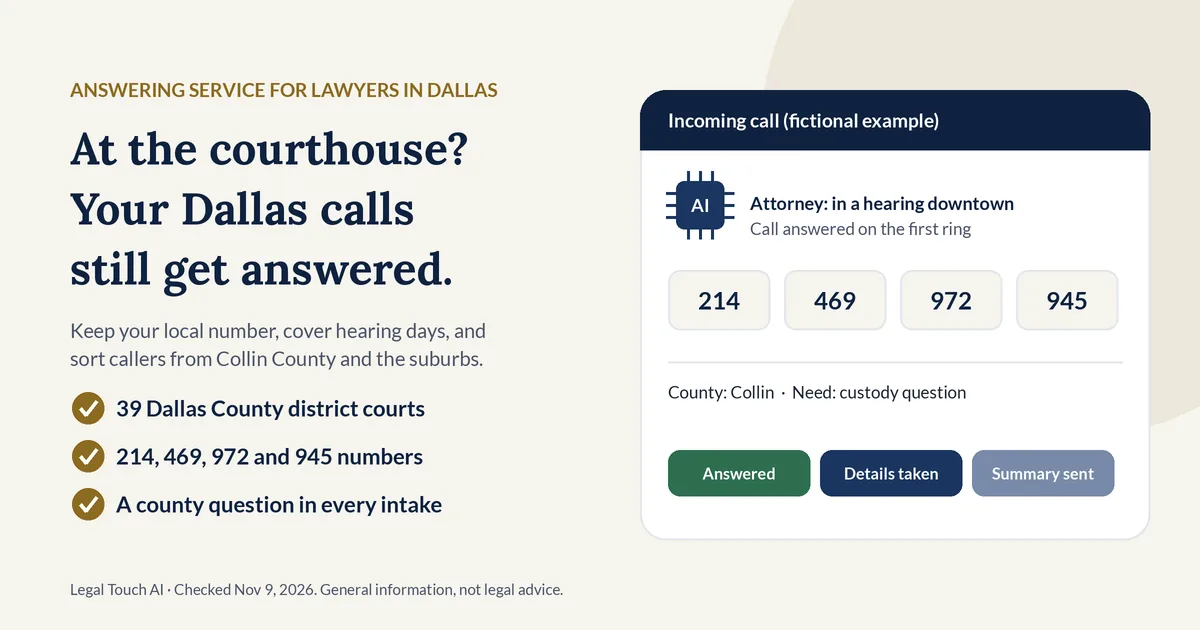
An answering service for lawyers in Dallas answers calls when a firm's staff cannot, records the caller's contact details and reason for calling, and follows the firm's routing instructions. Providers may use people, AI, or both. For Dallas firms, useful setup decisions include hearing coverage, existing-number forwarding, and questions about the county involved.
An AI receptionist for a Dallas law firm is software that answers in a natural voice, tells callers it is an AI assistant, follows the firm's intake script, and can book consultations when a calendar is connected. Whichever kind you pick, the first decision is which calls it should answer. These are the four common setups:
| Coverage setup | Which calls it answers | Often a fit when |
|---|---|---|
| All calls | Every call, day and night | No one is assigned to the front desk |
| Overflow only | Calls nobody at the firm picks up within a set number of rings | A receptionist is on duty but can't take two calls at once |
| After hours only | Calls outside office hours | Days are covered, but nights and weekends are not |
| Court-day schedule | Calls during the hours you set for hearings | An attorney is at the courthouse several mornings a week |
For a full feature and cost checklist, see our buyer's checklist for AI receptionists at small law firms. To see named providers next to each other, read our side-by-side review of legal answering services. Night and weekend coverage is covered in our guide to after-hours call coverage for attorneys.
How many lawyers practice in Dallas County, and how many work in small firms?
Dallas County had 17,719 active State Bar of Texas members on Dec 31, 2025, representing 15.0% of the bar's 118,430 active members, including those outside Texas. Among 8,603 Dallas County attorneys reporting a private practice setting, 4,206 worked solo or in firms of 2 to 10 attorneys, or 48.9% by our calculation.
We compared the bar's Dallas County columns for 2015-16 and 2025-26. The change column is our arithmetic.
| Dallas County private practice setting (State Bar of Texas) | 2015-16 | 2025-26 | Change in ten years (our arithmetic) |
|---|---|---|---|
| Solo practitioners | 2,334 | 1,913 | down 18.0% |
| Firms of 2 to 5 attorneys | 1,858 | 1,562 | down 15.9% |
| Firms of 6 to 10 attorneys | 825 | 731 | down 11.4% |
| Solo through 10 attorneys, combined | 5,017 | 4,206 | down 16.2% |
| Firms of 11 or more attorneys | 4,495 | 4,397 | down 2.2% |
| All private practitioners who reported a setting | 9,512 | 8,603 | down 9.6% |
Source: State Bar of Texas, Dallas County Attorney Statistical Profile 2025-26. Over the same period, total active Dallas County attorneys rose 9.5%, from 16,182 to 17,719 (the bar's column totals; our percentage).
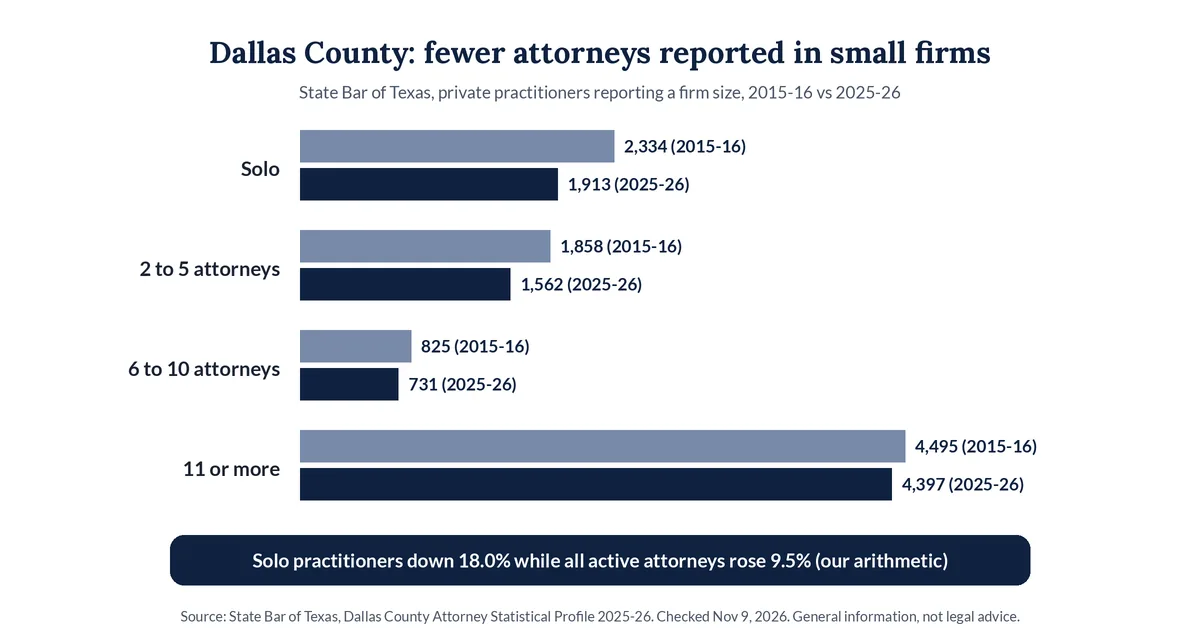
The bar's numbers don't explain the shift, and we won't guess at the reasons. Among Dallas County attorneys reporting a private practice setting, 4,206 worked solo or in firms of up to 10 attorneys, compared with 4,397 at larger firms. These counts describe reported attorney settings, not the number of law firms or their call volume. Use your firm's staffing and call logs to plan coverage.
How can Dallas language data help plan phone coverage?
Census language estimates can help Dallas firms plan phone coverage, but they do not measure callers' preferences. In 2024, about 16 of every 100 Dallas city residents age 5 and older spoke Spanish at home and English less than very well. Use your firm's call logs to decide what language coverage to arrange.
In the City of Dallas, 35.5% of residents age 5 and up speak Spanish at home, and 46.2% of that group rate their English below "very well," the Census Bureau's 2024 American Community Survey shows. Per 100 residents age 5 and older, that is roughly 16 in the city, roughly 15 across Dallas County, and roughly 4 in Collin County.
The table uses Census table S1601 (2024 ACS 1-year estimates) for the city, Dallas County, and Collin County. For the final column, we divided the English-below-"very well" count by residents age 5 and up and multiplied by 100.
| Place (Census 2024) | Residents | Residents age 5+ | Spanish spoken at home | Of those, English below "very well" | Per 100 residents age 5+ (our math) |
|---|---|---|---|---|---|
| City of Dallas | 1,326,093 | 1,237,552 | 438,905 (35.5%) | 202,650 (46.2%) | 16.4 |
| Dallas County | 2,656,028 | 2,476,605 | 839,160 (33.9%) | 365,516 (43.6%) | 14.8 |
| Collin County | 1,254,658 | 1,182,663 | 124,286 (10.5%) | 41,757 (33.6%) | 3.5 |
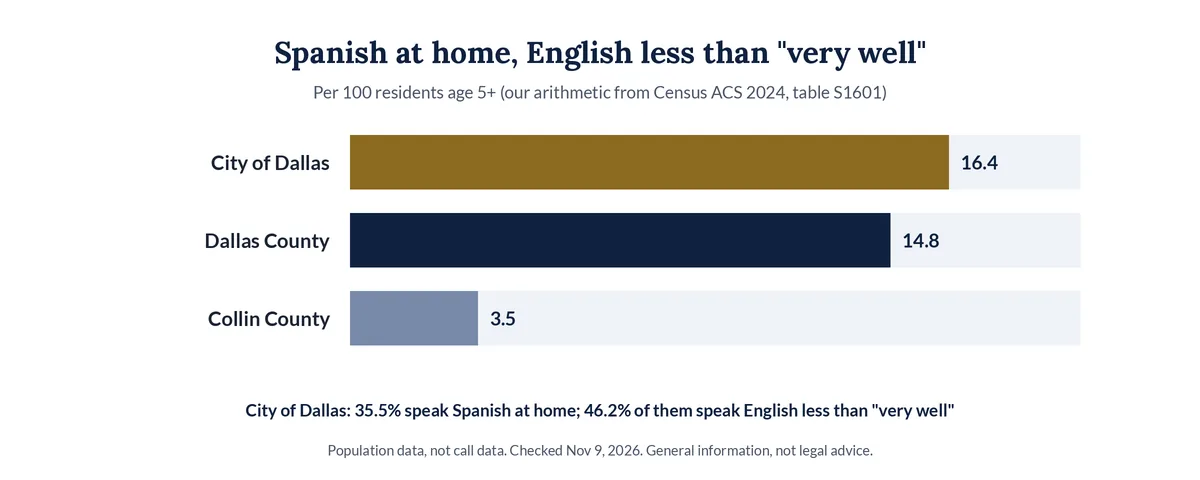
Sources: Census table S1601, City of Dallas, Census table S1601, Dallas County, Census table S1601, Collin County, and ACS table B01003 for the resident totals. The language counts are survey estimates with margins of error, including plus or minus 17,296 for Dallas city residents who speak Spanish at home. They describe residents, not callers. These city and county estimates provide context for planning phone coverage. Use your firm's actual call logs to decide how often callers request Spanish and what coverage to arrange.
On our live pricing page, a "Spanish and English receptionist" is part of the Done for You Plus plan, and "Spanish on Starter or Done for You is quoted separately." Our Houston guide lists five questions to ask any provider about Spanish calls, and our Spanish intake guide for bilingual immigration practices goes deeper on scripts.
Can a Dallas law firm keep its 214, 469 or 972 number?
Yes. Call forwarding lets a Dallas firm keep its current number and phone company while the answering service takes the calls. Clients keep dialing the 214, 469, 972 or 945 number printed on your cards, signs and website. That matters because a line your firm adds today may be assigned 945 instead of a code your clients already know.
Here is how the Dallas codes developed, per the Public Utility Commission of Texas (PUCT):
| Year | What changed (Public Utility Commission of Texas and the national numbering administrator) |
|---|---|
| 1947 | 214 created as one of the original area codes of the North American Numbering Plan |
| 1996 | 214 split into 214 and 972 |
| 1999 | The 214 and 972 split line was eliminated, and 469 was added as an overlay for the combined area |
| 2020 | PUCT approved a fourth code, 945, in docket 48765 |
| 2021 | 945 went into service on Jan 15, 2021 |
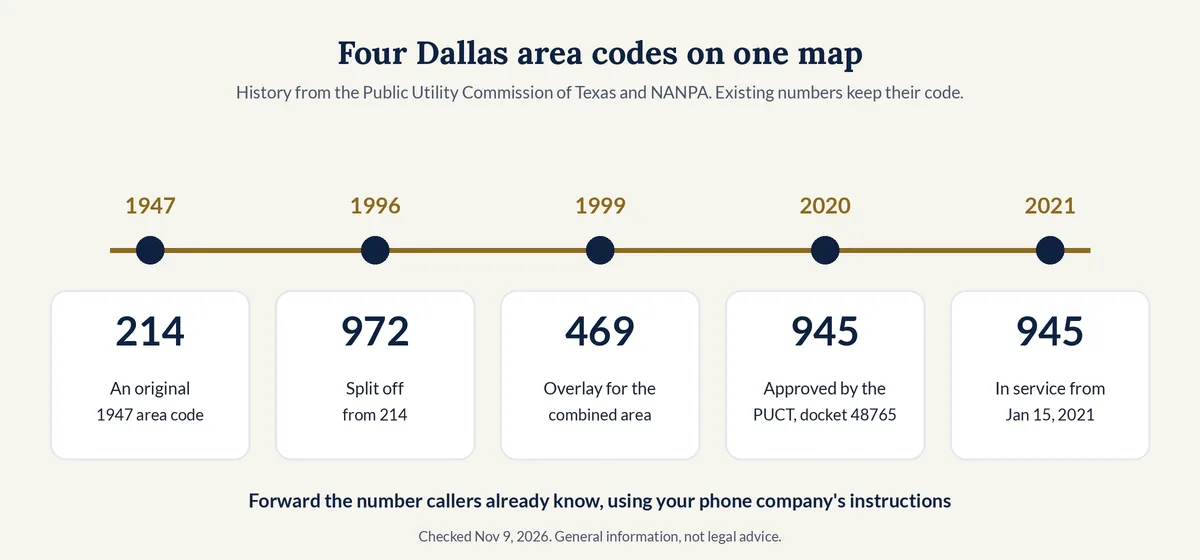
Sources: PUCT news release approving the 945 area code (March 3, 2020), PUCT order in Project No. 48765, and NANPA planning letter PL-537. The PUCT order says all current customers keep their 214, 469 or 972 numbers and that local calls in the region are dialed with all 10 digits.
Two practical points for a Dallas firm. First, follow your phone company's forwarding instructions and include the destination's area code. Confirm any required prefix, activation code, and forwarding charges before testing the route. Second, the region is bigger than the city: the PUCT order lists parts of eight counties, Collin, Dallas, Denton, Fannin, Hunt, Johnson, Kaufman, and Tarrant. A caller with a 972 number could live in Frisco, Grand Prairie or Rockwall.
How do Dallas County court days affect a firm's phones?
Dallas County lists 39 state district courts: 13 civil, 17 criminal, 7 family, and 2 juvenile. Its court pages also list 5 county courts at law, 11 county criminal courts, 2 county criminal courts of appeals, and 3 probate courts. While an attorney is before any of them, the office phone needs someone else to answer it.
We counted the principal courts in each listed division, excluding auxiliary courts, associate judges and magistrates, and checked the county's directories and individual court pages for locations. The last column is our general description, not data.
| Court group (Dallas County) | Courts listed | Building, per the county's directories | Calls it often brings to a small firm (our general description) |
|---|---|---|---|
| Civil district courts | 13 | George Allen Courts Building | Injury claims, contract and business disputes |
| Family district courts | 7 | George Allen Courts Building | Divorce, custody, child support |
| County courts at law | 5 | George Allen Courts Building | Smaller civil cases |
| Probate courts | 3 | George Allen Courts Building, 600 Commerce Street | Wills, estates, guardianships |
| Criminal district courts | 17 | Frank Crowley Courts Building | Felony cases, often urgent calls from relatives |
| County criminal courts and courts of appeals | 11 and 2 | Frank Crowley Courts Building | Misdemeanor cases |
| Juvenile district courts | 2 | Henry Wade Juvenile Justice Building, 2600 Lone Star Drive | Calls from parents |
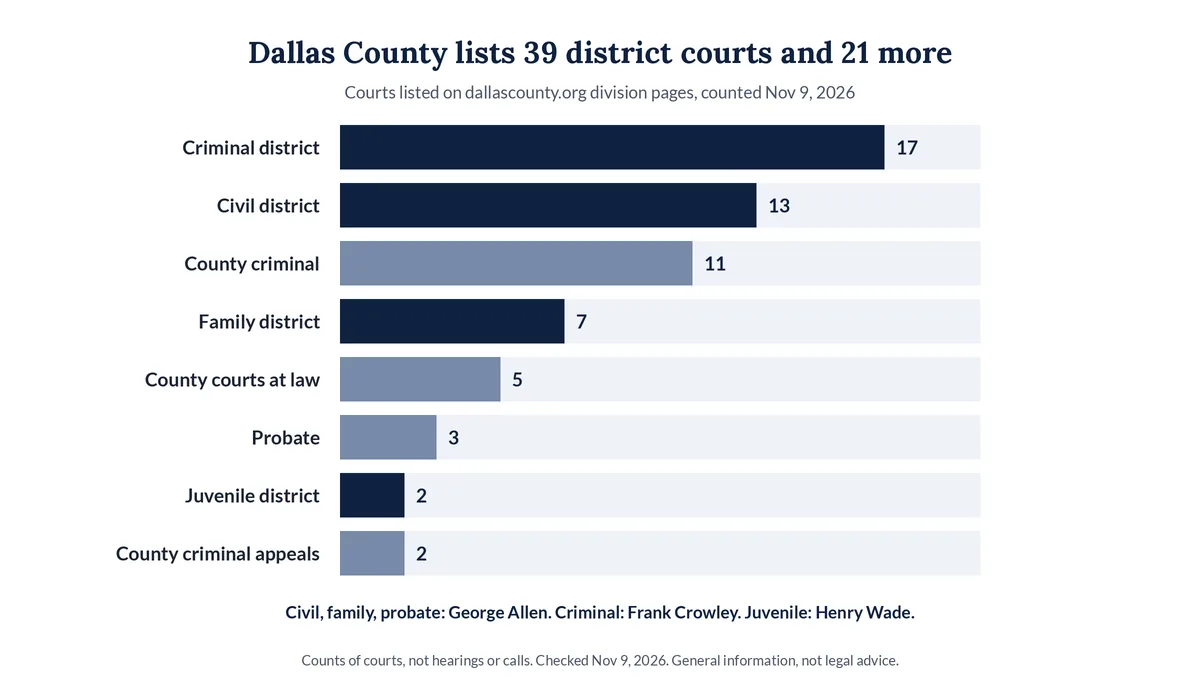
Sources: Dallas County pages for civil district courts, criminal district courts, family district courts, juvenile district courts, county courts at law, county criminal courts, and probate courts, plus the county's directories for the George Allen Courts Building and the Frank Crowley Courts Building, and the 304th and 305th juvenile court pages.
The locations matter for phones. Civil, family and probate courts sit in one building, criminal courts in another, and the juvenile district courts in a third. An attorney handling family and criminal matters may need coverage while traveling between George Allen and Frank Crowley, as well as during hearings. Decide who answers during those periods and when routine callbacks can be offered. Three habits help on hearing days:
- Turn on court-day coverage the night before, not from the hallway.
- Tell the service when you expect to be free so it can offer callback times that are real.
- Set an urgent-call rule that routes qualifying calls to an available backup contact while the attorney is in court, with a clear fallback if that person cannot answer. Practice-area detail is in our guides for criminal defense lawyers who are in court all day, family law firms and protective order calls, and estate planning and probate attorneys.
Why should a Dallas firm ask callers which county they are in?
Ask where the caller lives, where the events occurred, and whether a court is already handling the matter. Dallas area codes cover a wider region, so the number alone does not identify the relevant county. Record these details for the firm's review and route the call under its instructions without deciding legal venue.
Collin County is the clearest example. It has its own county courts, a bar that grew from 2,700 to 4,289 active attorneys between the bar's 2015-16 and 2025-26 profiles, and a different reported firm mix from Dallas County. Even a city name may not settle the county: Frisco spans Collin and Denton counties, so record where the relevant events occurred and any court already named in the caller's notice, then pass those details to the firm.
| Measure (sources below) | Dallas County | Collin County |
|---|---|---|
| Active attorneys, Dec 31, 2025 (State Bar of Texas) | 17,719 | 4,289 |
| Private practitioners who reported a setting | 8,603 | 1,802 |
| Solo practitioners | 1,913 | 561 |
| Solo through 10 attorneys, share of private practitioners who reported a setting (our arithmetic) | 48.9% | 65.2% |
| Spanish at home, English less than "very well," per 100 residents age 5+ (Census 2024, our arithmetic) | 14.8 | 3.5 |
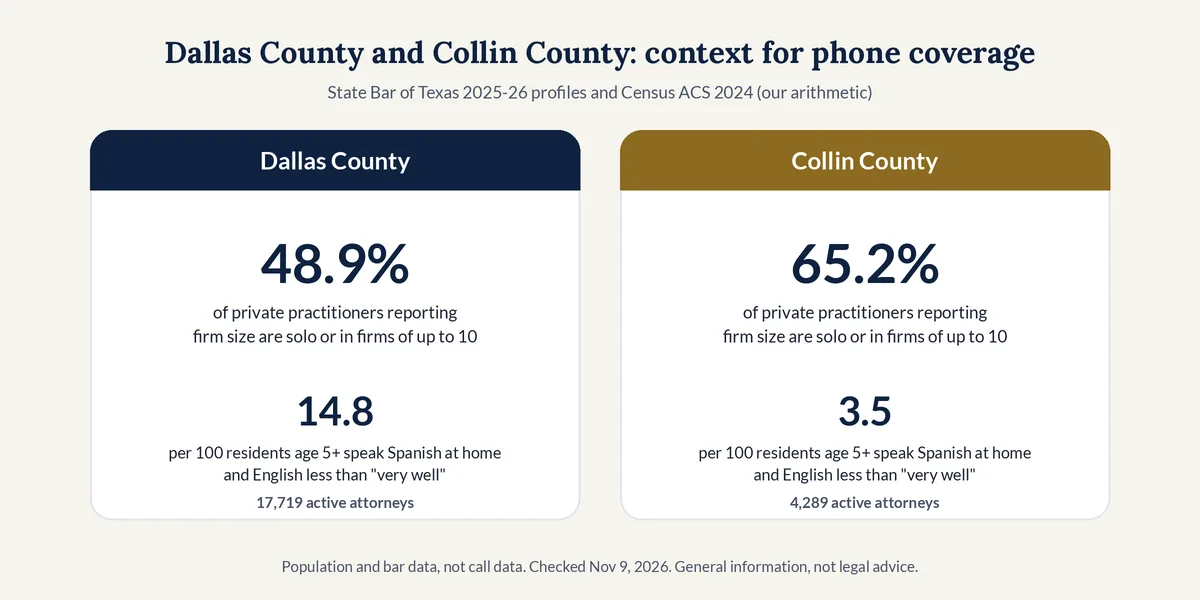
Sources: State Bar of Texas, Collin County Attorney Statistical Profile 2025-26, the Dallas County profile above, Census table S1601, and the City of Frisco Citizen's Financial Report 2025.
Intake questions that help a Dallas firm sort suburban callers:
- Which county do you live in, and where did this happen? The two can differ.
- Is there a court date already set? If so, ask for the date and the court.
- Which city is closest to you? It helps the attorney picture the drive.
- How did you hear about us? It tells you which suburbs your marketing reaches.
How do you set up an answering service for a Dallas law firm?
Begin with a month of call logs so you know when calls go unanswered, then choose the calls the service should take and add a county question to your intake script. Write Spanish versions if your log calls for them, set transfer rules for hearing days, forward your number, and test before you rely on it.
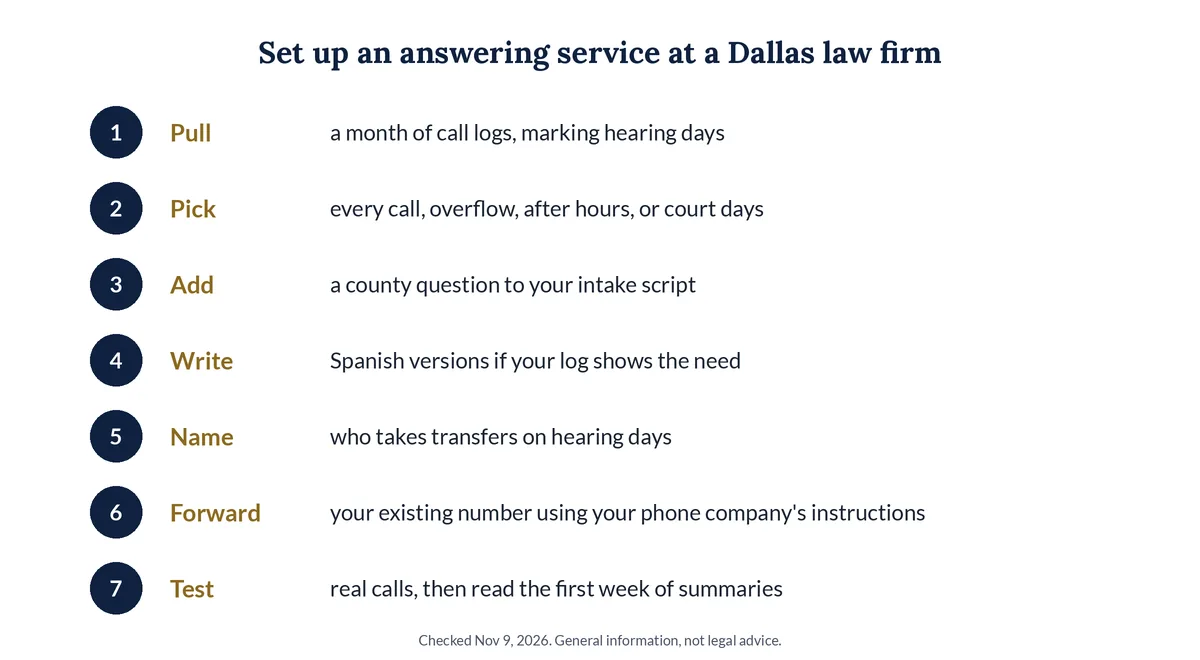
- Pull a month of call logs and mark the calls that rang while an attorney was at the George Allen or Frank Crowley building.
- Pick your coverage: every call, overflow, after hours, or a court-day schedule.
- Add a county question to your intake script so the firm can see which county is involved before deciding who calls back.
- Write Spanish versions of your questions if your call log shows Spanish-speaking callers.
- Name the person who takes live transfers on hearing days and the person who returns the rest.
- Forward your existing number to the service's destination number using your phone company's instructions, then test the routing.
- Test with real calls from a cell phone and a landline, then read the first week of summaries.
Not sure how many calls you lose today? Our guide to why law firms miss calls and what it costs shows how to count them. State rules on call recording, AI disclosure, and attorney ethics apply the same way in Dallas as anywhere else in Texas, so we cover them once, in our Texas guide to AI receptionist rules and setup.
What does an answering service cost a Dallas law firm?
The price depends on how the service bills and how many calls you get. Many AI receptionists charge a flat monthly amount that includes a block of minutes, and many live services bill per minute or per call. A Dallas firm should price its real monthly volume, plus setup fees and any charge for Spanish, before comparing.
Legal Touch AI's plans start at $149 a month. See Legal Touch AI plans and what each includes for included minutes, setup fees, and current plan details.
To see published plans priced at 30, 60, and 120 calls a month, use our cost comparison of legal answering services by call volume.
How does Legal Touch AI answer calls for Dallas firms?
Legal Touch AI answers forwarded calls, identifies itself as AI, and follows the firm's approved intake instructions. For a Dallas firm, setup can include hearing hours, county questions, and callback rules. Live transfers and calendar booking are listed under Done for You and Done for You Plus, so confirm the features included in your plan.
From our home page, pricing page, and our step-by-step walk-through of a Legal Touch AI call:
- It says what it is. The greeting identifies the service as AI and includes a recording notice. Your firm reviews the wording and the response to a caller who declines recording during setup.
- Transfers and booking by plan. Our pricing page lists live transfers during office hours, with a text to you first, and consult booking on your Google or Outlook calendar under Done for You and Done for You Plus. Starter does not list either feature.
- Summaries and recordings. Our pricing page lists a call summary, recording, and transcript after every call. Recording and transcript access follow your configured settings.
- Same number. You keep your number and your phone company, and you can switch the forwarding off any time.
- Clear limits. It never gives legal advice or predicts a result, never decides conflicts, never promises your firm will take a case, and never pretends to be a person.
- Hours you choose. After-hours answering is a setting in every plan, so it can cover nights, weekends, holidays, or your hearing mornings.
- Test the configured call flow. Confirm the selected plan's transfer rules, calendar availability, message delivery, and recording settings before launch. Test an unanswered transfer and a caller who declines recording.
Short answers to 25 more questions are in our AI receptionist FAQ for small law firms.
Why we wrote this guide
We wrote this guide to help small Dallas law firms plan phone coverage around hearings and calls from nearby counties. Dallas County court directories, State Bar profiles, and Census language estimates provide local context. Each firm should use its own call log to choose coverage hours, intake questions, and transfer rules. You can read more about Legal Touch AI and how we work.
Planning phone coverage for a Dallas firm? Compare Legal Touch AI plans and setup options, including the features available for hearing-day coverage and intake routing.
Frequently asked questions
Will Dallas callers know they are talking to an AI receptionist?
Yes. Legal Touch AI identifies itself as the firm's AI assistant and includes a recording notice. The greeting is configured during setup, so ask to hear the actual version your callers will receive. Also test what happens when someone declines recording or asks to speak with a person.
Can I keep my 214 number if I start using an answering service?
Yes, when your phone service supports the required forwarding. Keep your existing line active and forward calls to the answering service using your carrier's instructions. Clients continue dialing your published Dallas number, including 214, 469, 972 or 945. Test the routing before launch and confirm any forwarding charges with your carrier.
Can an answering service cover only my courthouse mornings in Dallas?
Often, yes. Many services let you forward calls only during hours you choose or only when nobody picks up. Legal Touch AI treats after-hours answering as a setting in every plan, so the AI can cover nights, weekends, holidays, or any hours you choose, such as mornings at the George Allen or Frank Crowley building.
Should a Dallas law firm's answering service ask which county the caller is in?
Yes. Ask about the caller's county, the location of the events, and any court already handling the matter. A Dallas area code does not establish any of those details. The answering service should record the answers and follow the firm's routing instructions, leaving decisions about the proper court and representation to the attorney.
Can an answering service tell a Dallas caller whether they have a case?
No. Deciding whether someone has a case is the attorney's job. A well-run answering service gathers the facts, books a consultation, or transfers the call. Legal Touch AI never gives legal advice or predicts a result, and it won't promise your firm will take the matter. This page is general information, not legal advice either.
Does an answering service need an office in Dallas?
No. An answering service can handle your Dallas firm's calls remotely through call forwarding. What matters is whether it follows your office hours, intake questions, transfer instructions, and calendar settings. Ask the provider to demonstrate the call flow using your existing number and the Dallas County or neighboring-county scenarios your firm actually handles.
Legal Touch AI is not a law firm and does not provide legal advice. This article is general information, not legal advice. Laws, court lists, and phone rules change, so check current sources before you rely on them. Using Legal Touch AI does not create an attorney-client relationship.
Sources (checked Nov 9, 2026)
- U.S. Census Bureau, American Community Survey 2024 1-year estimates, table S1601, City of Dallas: https://data.census.gov/table/ACSST1Y2024.S1601?g=160XX00US4819000
- U.S. Census Bureau, American Community Survey 2024 1-year estimates, table S1601, Dallas County: https://data.census.gov/table/ACSST1Y2024.S1601?g=050XX00US48113
- U.S. Census Bureau, American Community Survey 2024 1-year estimates, table S1601, Collin County: https://data.census.gov/table/ACSST1Y2024.S1601?g=050XX00US48085
- U.S. Census Bureau, American Community Survey 2024 1-year estimates, table B01003 (total population): https://data.census.gov/table/ACSDT1Y2024.B01003?g=160XX00US4819000,050XX00US48113,050XX00US48085
- State Bar of Texas, Department of Research and Analysis, Dallas County Attorney Statistical Profile 2025-26: https://www.texasbar.com/AM/Template.cfm?ContentID=71544&Section=Demographic_and_Economic_Trends&Template=%2FCM%2FContentDisplay.cfm
- State Bar of Texas, Department of Research and Analysis, Collin County Attorney Statistical Profile 2025-26: https://www.texasbar.com/AM/Template.cfm?ContentID=71542&Section=Demographic_and_Economic_Trends&Template=%2FCM%2FContentDisplay.cfm
- Dallas County, Civil District Courts: https://www.dallascounty.org/government/courts/civil_district/
- Dallas County, Criminal District Courts: https://www.dallascounty.org/government/courts/criminal_district/
- Dallas County, Family District Courts: https://www.dallascounty.org/government/courts/family_district/
- Dallas County, Juvenile District Courts: https://www.dallascounty.org/government/courts/juvenile/
- Dallas County, County Courts at Law: https://www.dallascounty.org/government/courts/county_court_at_law/
- Dallas County, County Criminal Courts: https://www.dallascounty.org/government/courts/county_criminal/
- Dallas County, Probate Courts: https://www.dallascounty.org/government/courts/probate/
- Dallas County, George Allen Courts Building directory: https://www.dallascounty.org/about-us/maps/george-allen-courts-building-map.php
- Dallas County, Frank Crowley Courts Building directory: https://www.dallascounty.org/about-us/maps/frank-crowley-courts-building-map.php
- Dallas County, 304th District Court (Henry Wade Juvenile Justice Building): https://www.dallascounty.org/government/courts/juvenile/304th/
- Dallas County, 305th District Court (Henry Wade Juvenile Justice Building): https://www.dallascounty.org/government/courts/juvenile/305th/
- City of Frisco, Citizen's Financial Report 2025 (Frisco in Collin and Denton counties): https://www.friscotexas.gov/DocumentCenter/View/40309/Citizens-Financial-Report-9-30-25-PDF
- Public Utility Commission of Texas, "PUC Approves Additional Area Code for the Dallas Area" (March 3, 2020): https://ftp.puc.texas.gov/public/puct-info/agency/resources/pubs/news/2020/PUCTX-MR-PR-AREACODES-DALLAS-945-FIN.pdf
- Public Utility Commission of Texas, order in Project No. 48765 (214/469/972 area code relief): https://interchange.puc.texas.gov/Documents/48765_12_1053823.PDF
- North American Numbering Plan Administrator, Planning Letter PL-537, NPA 214/469/972 and 945 overlay (April 8, 2020): https://nanpa.com/sites/default/files/planning_letters/PL-537.pdf
- Public Utility Commission of Texas, Texas Area Codes, Dallas: https://www.puc.texas.gov/industry/maps/areacodes/txareacodes/dallas/
- Legal Touch AI home: https://legaltouchai.com/
- Legal Touch AI how it works: https://legaltouchai.com/how-it-works/
- Legal Touch AI pricing: https://legaltouchai.com/pricing/