Answering Service for Lawyers in Austin: Central Docket Weeks, 512 and 737, and Travis County Callers
An answering service for lawyers in Austin is a service that picks up a law firm's calls when nobody at the firm can, asks the firm's intake questions, and sends each caller's details to the right person. For Austin firms, the useful details are Travis County's Central Docket, the 512 and 737 area codes, and callers from Williamson and Hays counties. Sources checked Nov 12, 2026.
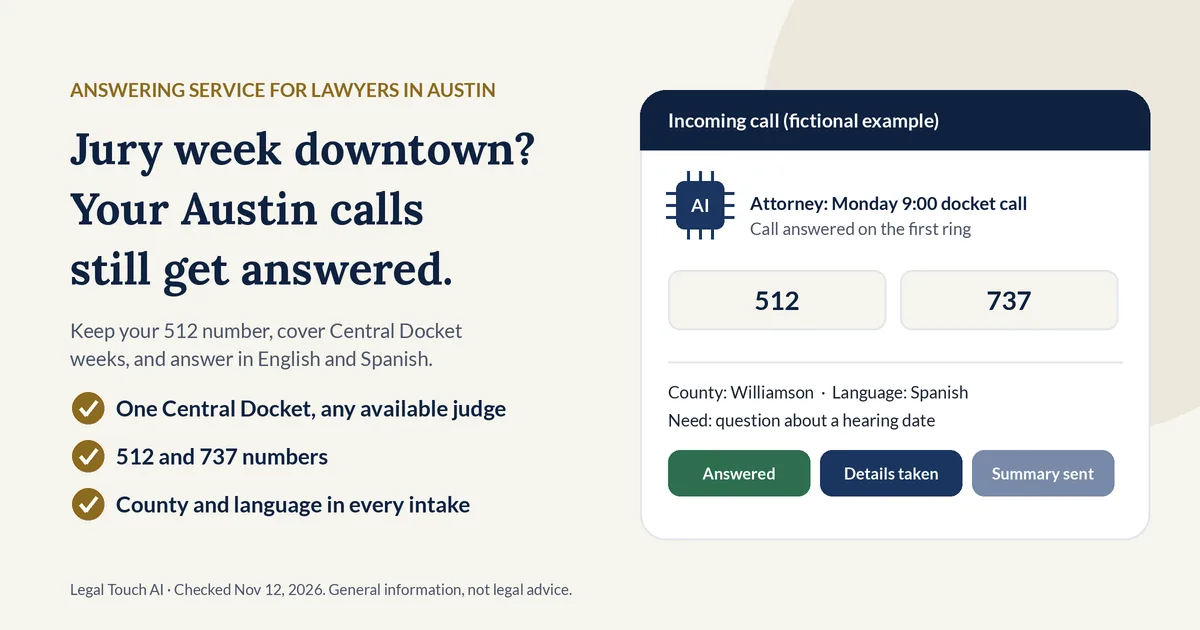
What is an answering service for lawyers in Austin?
An answering service for lawyers in Austin answers a firm's calls when staff cannot, takes down who is calling and why, and follows the firm's rules for transfers and callbacks. Some use live operators, some use AI, and some mix both. Austin firms should plan around Central Docket weeks, 512 and 737 numbers, and callers from neighboring counties.
An AI receptionist for an Austin law firm is software that answers in a natural voice, says it is an AI assistant, asks the firm's approved questions, and can book consultations when a calendar is connected. Before you compare providers, match the coverage to the gap you actually have:
| Coverage setup | Which calls it answers | Often a fit when |
|---|---|---|
| All calls | Every call, day and night | The firm has no front desk |
| Overflow only | Calls nobody picks up within a set number of rings | One receptionist gets two calls at once |
| After hours only | Calls outside office hours | Days are covered, nights and weekends are not |
| Hearing days | Calls during hours you set, such as a jury week or a family docket morning | An attorney is at 1700 Guadalupe or 509 W. 11th Street |
Our buyer's guide to AI receptionists for small law firms lists features and questions for any vendor, and our side-by-side comparison of legal answering services names the main providers.
How are Travis County lawyers split between private practice and government work?
Travis County had 11,667 active attorneys on Dec 31, 2025, or 9.9% of the State Bar of Texas. Of the 8,366 who reported a primary occupation, 4,741 were in private practice and 1,527 were government attorneys. At 18.3%, the government share is far above the 10.1% statewide, a pattern that fits a state capital.
The State Bar's Travis County profile also shows how private practice is split by firm size. The change column is our arithmetic.
| Travis County private practice setting (State Bar of Texas) | 2015-16 | 2025-26 | Change in ten years (our arithmetic) |
|---|---|---|---|
| Solo practitioners | 1,535 | 1,305 | down 15.0% |
| Firms of 2 to 5 attorneys | 1,175 | 999 | down 15.0% |
| Firms of 6 to 10 attorneys | 483 | 498 | up 3.1% |
| Solo through 10 attorneys, combined | 3,193 | 2,802 | down 12.2% |
| Firms of 11 or more attorneys | 1,711 | 1,939 | up 13.3% |
| All private practitioners who reported a setting | 4,904 | 4,741 | down 3.3% |
Source: State Bar of Texas, Travis County Attorney Statistical Profile 2025-26. Total active Travis County attorneys rose 14.3% over the decade, from 10,204 to 11,667, while government attorneys fell from 1,772 to 1,527. Solo practitioners were 27.5% of private practitioners in 2025-26. The median Travis County attorney was 49, up from 47.
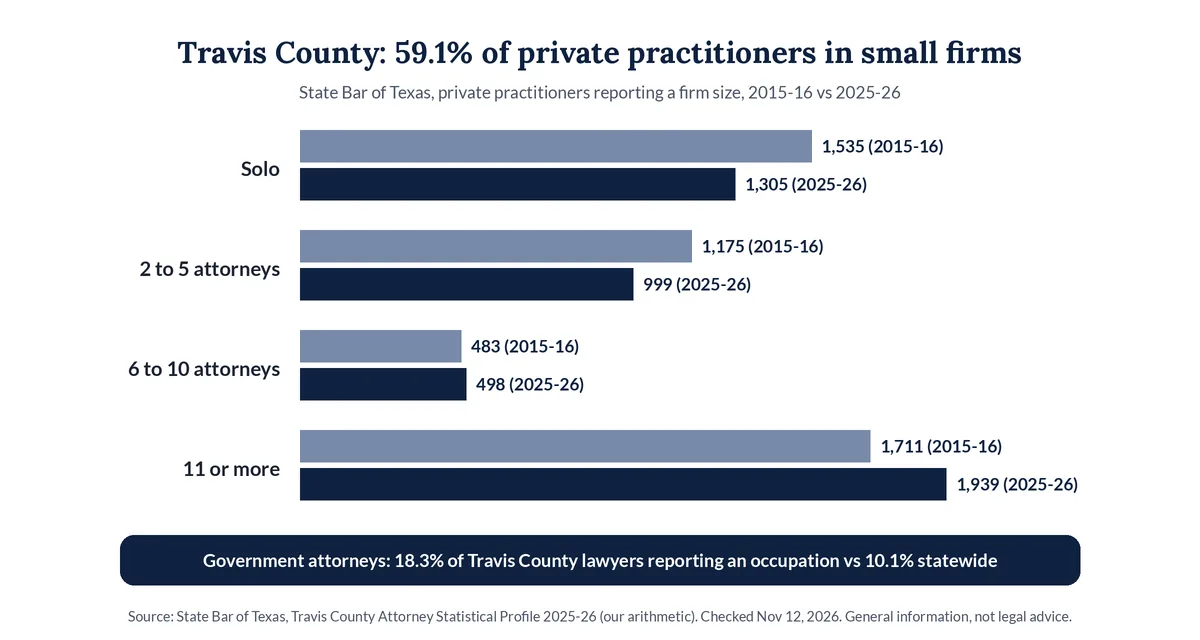
What this means for phones: 2,802 Travis County private practitioners work solo or in firms of 10 or fewer, where one person may answer every line. With roughly 855 active attorneys per 100,000 Travis County residents (our math using the 2024 Census count), callers have many firms to try. A caller who reaches voicemail can simply dial the next firm. Your own call log is the best measure of how often that happens.
How does the Travis County Central Docket affect a firm's phones?
Travis County's civil and family district courts share a Central Docket. Your case number names a court, but a hearing can go to any available judge. Lawyers must announce settings during a fixed window, then wait for an assignment, sometimes for days. That waiting and courtroom time is when calls go unanswered unless coverage is set.
The courts' overview of practice says any of the twelve civil and family district judges, the associate judges, or the two civil county court at law judges may hear a matter. Settings and announcements go through the Court Administrator, not a judge's staff, and hearing assignments are generally made at the end of the week before. The local rules, effective Nov 15, 2024, set the timing:
| Central Docket timing (Travis County local rules) | What happens | What it can mean for your phones |
|---|---|---|
| Week before a non-jury hearing, Monday 8:00 a.m. to Wednesday 5:00 p.m. | Parties announce ready and give a time estimate | A task with a deadline that pulls you away from calls |
| Monday 9:00 a.m. of a jury week | Jury docket call; unassigned cases can be assigned any time before noon Wednesday | Up to three days on standby |
| Monday 9:00 a.m. of a non-jury week | Non-jury long docket; can be reached any time before noon Thursday | Days where you must be ready on short notice |
| 9:00 a.m. or 2:00 p.m., Monday to Thursday, non-jury weeks | Non-jury short docket, heard during that half day | A half day out of the office |
| Friday mornings | Only matters needing 15 minutes or less | Brief, predictable absences |
| Family docket, 8:30 a.m. | Monday for settings over 3 hours; Wednesday to Friday for 3 hours or less; continuances Thursday at 1:30 p.m. | Family lawyers have their own fixed mornings |
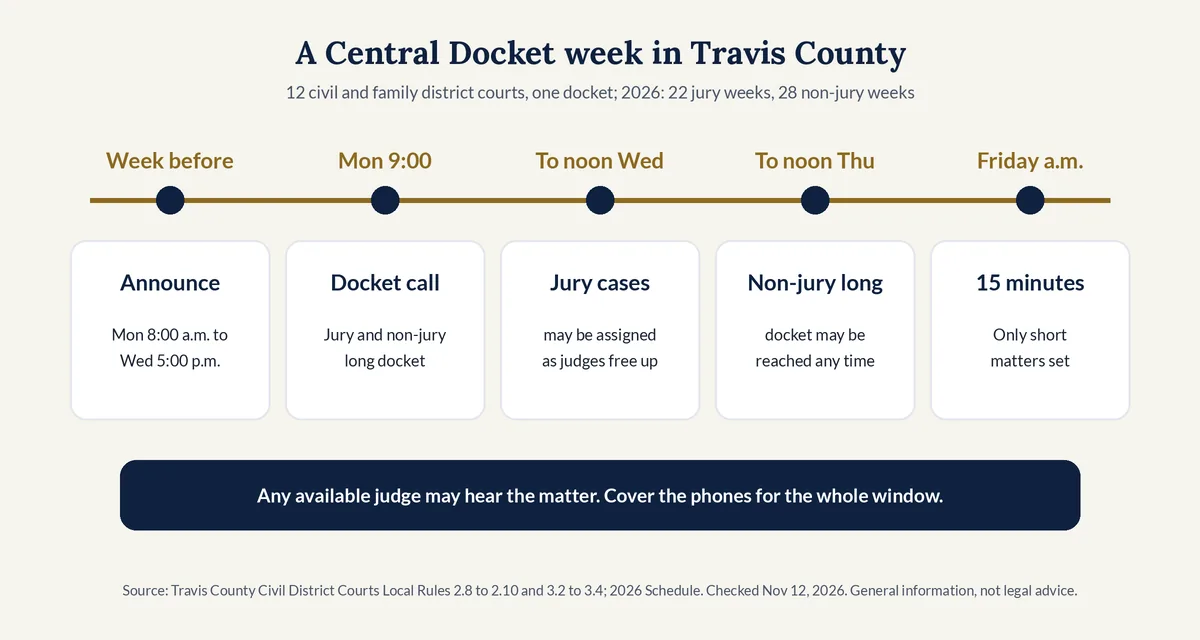
The Court Administrator's 2026 docket schedule alternates weeks: 22 jury weeks and 28 non-jury weeks, with no regularly scheduled dockets March 16 to 20 or Sept 7 to 11. Civil and family hearings are held at the Civil and Family Courts Facility, 1700 Guadalupe St., which opened in December 2022 with 25 courtrooms. Felony cases go to the county's nine criminal district courts and one District Magistrate Court at the Blackwell-Thurman Criminal Justice Center, 509 W. 11th Street.
Three habits help during Central Docket weeks:
- Put the schedule on the service's calendar. Mark jury weeks, your docket mornings and the announcement window as covered hours.
- Keep judge questions with staff. On the Central Docket, the court number in a case name does not tell anyone which judge will hear it, so the service should take a message, not guess.
- Write one rule for emergencies. The local rules send emergency matters to the week's Duty Judge, posted with the weekly docket. Decide which calls count as urgent and who gets them right away.
Practice-specific screening is covered in our guides for family law firms and criminal defense lawyers.
Which languages do Austin callers speak besides English?
Spanish is the main one, but not the only one. In 2024, about 8 of every 100 Austin residents age 5 and up spoke Spanish at home and English less than very well. Among all Austin residents with limited English, about 73% spoke Spanish and about 18% spoke an Asian or Pacific Island language (our math).
Census figures describe residents, not your callers, but they help set expectations for Austin and the counties next door:
| Place (Census 2024) | Residents | Residents age 5+ | Spanish spoken at home | Of those, English below "very well" | Per 100 residents age 5+ (our math) |
|---|---|---|---|---|---|
| City of Austin | 993,771 | 945,676 | 203,613 (21.5%) | 79,620 (39.1%) | 8.4 |
| Travis County | 1,363,767 | 1,287,365 | 286,319 (22.2%) | 106,720 (37.3%) | 8.3 |
| Williamson County | 727,480 | 683,670 | 89,358 (13.1%) | 35,173 (39.4%) | 5.1 |
| Hays County | 292,029 | 275,692 | 55,214 (20.0%) | 18,557 (33.6%) | 6.7 |
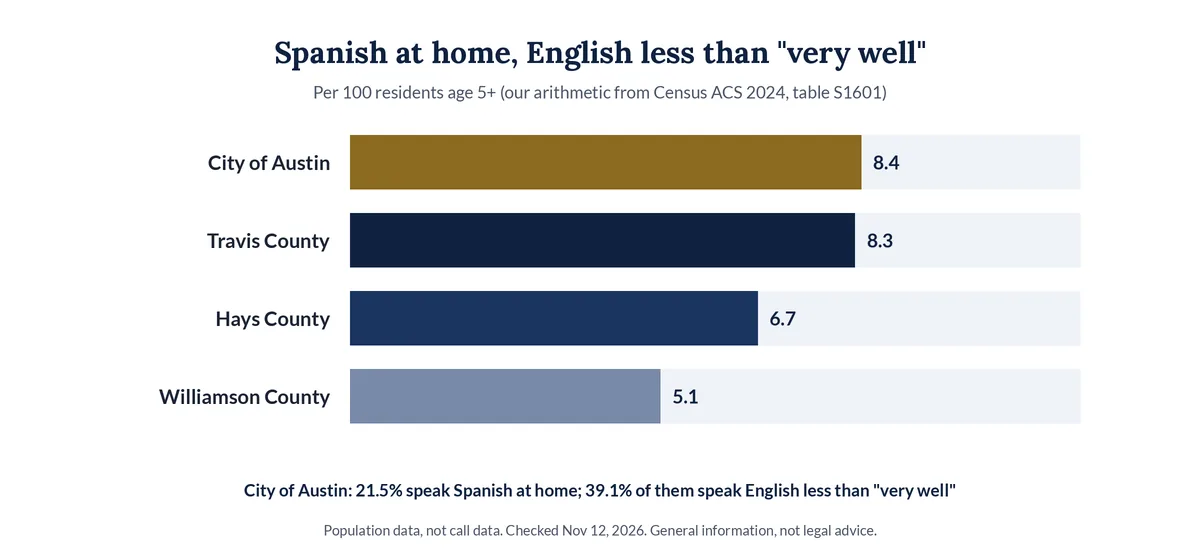
Sources: Census table S1601 for the City of Austin, Travis County, Williamson County and Hays County, plus table B01003 for resident totals. These are survey estimates; the city's Spanish-at-home count carries a margin of error of plus or minus 10,732.
In the City of Austin, 109,152 residents age 5 and up (11.5%) speak English less than very well in any language. Of those, 79,620 speak Spanish and 19,257 speak an Asian or Pacific Island language. Williamson County's mix differs: about 25 in 100 residents with limited English speak an Asian or Pacific Island language there. Legal Touch AI answers in English and Spanish, with Spanish included in Done for You at no extra cost. If your call log shows other languages, decide in advance how those callers reach someone who can help.
Courts plan for this too. Under the Travis County local rules, a party who needs an interpreter must tell the Court Administrator's office when setting the hearing, and may apply for an appointed interpreter under the courts' Limited English Proficiency Plan. For scripts, see our Spanish intake guide for bilingual immigration practices and the Houston guide's questions to ask about Spanish calls.
Can an Austin law firm keep its 512 number?
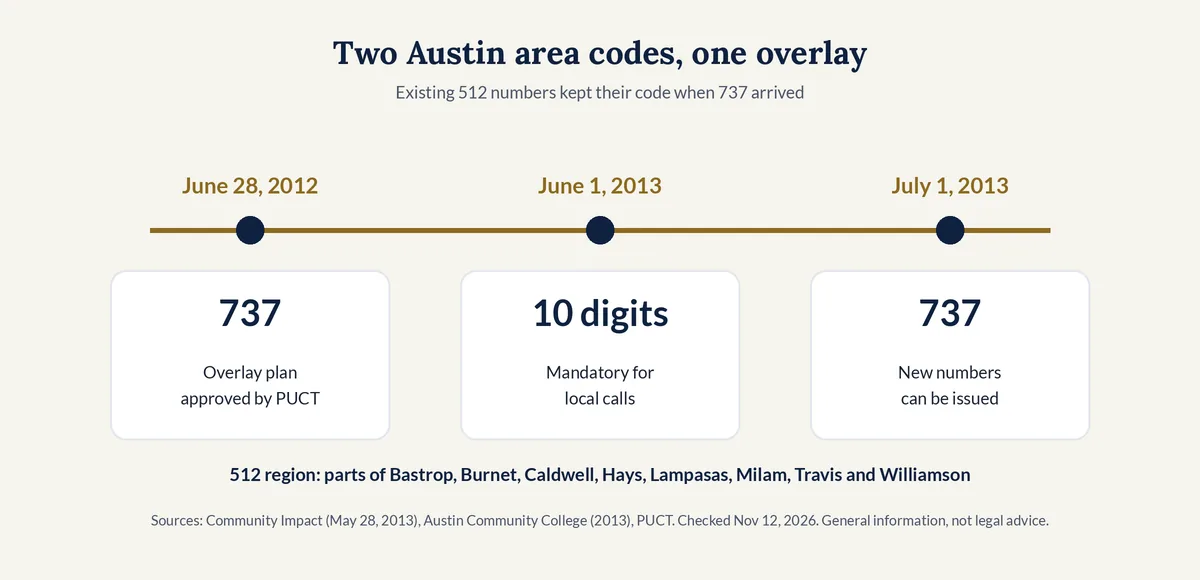
Yes. With call forwarding, an Austin firm keeps its 512 or 737 number and its phone company, and calls ring through to the answering service. Nothing changes for callers. The 737 overlay, added in 2013, gave new lines a second area code for the same region; it did not change any existing 512 number.
The Public Utility Commission of Texas approved the plan to add 737 to the 512 region on June 28, 2012, Community Impact reported in May 2013. Ten-digit dialing became mandatory first, then new numbers followed.
| Date | Event |
|---|---|
| June 28, 2012 | Public Utility Commission approves the 737 overlay plan for the 512 region |
| June 1, 2013 | Ten-digit dialing becomes mandatory for local calls |
| July 1, 2013 | Phone companies can start issuing 737 numbers |
Austin Community College's 2013 notice to employees listed call-forwarding settings and voicemail greetings among the things to update for ten-digit dialing, a useful reminder when you set up forwarding today. The Public Utility Commission's Austin area code page shows the region. Write every number in your scripts and greetings with all ten digits.
Do Williamson and Hays County callers change an Austin firm's intake?
Often, yes. The 512 and 737 region includes parts of Williamson and Hays counties, so an Austin area code does not tell you where the caller lives or where a case is filed. Asking for the county takes seconds and helps the firm decide who calls back and which court's rules apply.
Williamson County had 727,480 residents and Hays County 292,029 in the Census Bureau's 2024 estimates, next to Travis County's 1,363,767. Each county has its own courts and clerks. A caller from Round Rock or San Marcos may describe a case filed in another county's court, not at 1700 Guadalupe, and that can change which attorney should return the call.
Two intake questions cover most of it:
- "Which county do you live in, and which county is the case in?" The answers can differ.
- "Is there already a case number?" If yes, the service records it exactly as the caller reads it. It does not interpret it.
The Dallas guide shows the same idea for Collin County callers, and the San Antonio guide covers Bexar County's Presiding Court for firms with matters there.
How do you set up an answering service for an Austin law firm?
Begin with a month of call logs to see when calls go unanswered, then choose which calls the service should take. Write your intake questions, including county and language. Mark Central Docket weeks as covered hours, forward your 512 or 737 number, and test with real calls before you count on it.
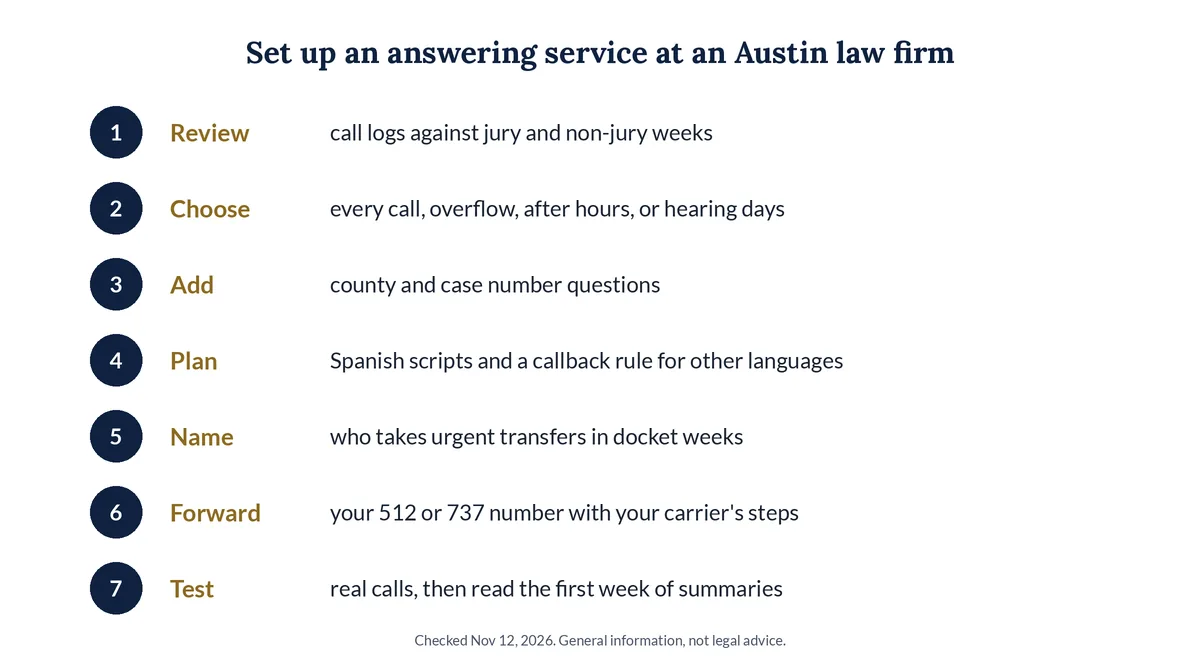
- Review a month of call logs against the 2026 jury and non-jury weeks to find when calls went unanswered.
- Choose your coverage: every call, overflow, after hours, or hearing days.
- Add questions for the caller's county and any existing case number.
- Plan for language: Spanish scripts if your log shows Spanish callers, and a callback rule for other languages.
- Name who takes urgent transfers during docket weeks and who returns routine calls.
- Forward your existing number using your phone company's steps, then confirm the routing.
- Test with calls from a cell phone and a landline, then read the first week of summaries.
Not sure how many calls you lose now? Our guide to why law firms miss calls shows how to count them. Texas rules on recording calls and AI disclosure are covered once, in our Texas guide to AI receptionist rules and setup, and in our call recording consent guide for law firms.
What does an answering service cost an Austin law firm?
Cost depends on how the service bills and how many calls you get. Many AI receptionists charge a monthly fee with a block of minutes; many live services bill per minute or per call. An Austin firm should price its real monthly call volume, any setup fee, and any charge for Spanish before comparing providers.
Legal Touch AI's published pricing:
| Legal Touch AI plan | Monthly price | Setup | Included minutes |
|---|---|---|---|
| Done for You | $495 | $495 one time | 600 a month |
| Done for You Plus (coming soon) | $860 | $495 one time | 1,500 a month |
One rate, $0.28 a minute, applies to included and extra minutes on every plan. See Legal Touch AI plans and what each includes for current details, and our cost comparison of legal answering services to compare published plans at different call volumes.
How does Legal Touch AI answer calls for Austin firms?
Legal Touch AI answers forwarded calls in English and Spanish, says it is an AI assistant, and follows the intake instructions your firm approves. For an Austin firm, setup can include Central Docket hours, county questions and callback rules. Done for You includes live transfers during office hours and consultation booking on your calendar.
From our pricing page and our walk-through of a Legal Touch AI call:
- It says what it is. The greeting identifies the service as AI and includes a recording notice. Your firm approves the wording during setup.
- Transfers and booking. Done for You lists live transfers during office hours with an email alert, and consult booking on your Google or Outlook calendar. Text alerts are coming soon.
- Summaries. Your firm gets a summary of each call, with recording and transcript access under your settings.
- Same number. You keep your 512 or 737 number and your phone company.
- Clear limits. It never gives legal advice or predicts a result, never decides conflicts, never promises your firm will take a case, and never pretends to be a person.
- Hours you choose. After-hours answering is a setting on every plan, so it can cover nights, weekends, or your docket weeks.
Short answers to 25 more questions are in our AI receptionist FAQ for small law firms.
Why we wrote this guide
We wrote this guide for small Austin law firms that lose calls while they announce, wait for, and attend Central Docket settings. The Travis County local rules, the State Bar's county profile, and Census language estimates give local context. Your own call log should set the hours, questions and transfer rules. Read more about Legal Touch AI and how we work.
Want to hear it on a real call? Book a 15-minute Legal Touch AI demo and ask the questions your Austin callers ask.
Frequently asked questions
Can I keep my 512 number if my Austin firm uses an answering service?
Yes. You keep your existing line and phone company and forward calls to the answering service using your carrier's steps. Callers keep dialing the 512 or 737 number on your website and cards. Test the routing before launch and ask your carrier whether forwarding adds any charges.
Can an answering service cover only my Central Docket weeks in Austin?
Often, yes. Many services let you forward calls only during hours you choose or only when nobody picks up. Legal Touch AI treats after-hours answering as a setting on every plan, so it can cover nights, weekends, jury weeks, or the mornings you spend at 1700 Guadalupe.
Will Austin callers know they are talking to an AI receptionist?
Yes, with Legal Touch AI. It identifies itself as the firm's AI assistant and gives a recording notice in its greeting, worded the way your firm approves during setup. With any provider, listen to the exact greeting first and test what happens when a caller asks for a person.
What languages can an Austin answering service handle?
Legal Touch AI answers in English and Spanish, with Spanish included in Done for You at no extra cost. Census estimates show most Austin residents with limited English speak Spanish, but many speak Asian or Pacific Island languages. Check your call log and set a callback plan for any other language.
What should an answering service do with an urgent call for an Austin law firm?
Follow the urgent rule your firm writes. A good setup names who gets transferred calls during docket weeks, alerts that person right away, and takes a full message for everyone else. Legal Touch AI never gives legal advice and never tells a caller what a court or judge will do.
Legal Touch AI is not a law firm and does not provide legal advice. This article is general information, not legal advice. Court rules, schedules and phone rules change, so check current sources before you rely on them. Using Legal Touch AI does not create an attorney-client relationship.
Sources (checked Nov 12, 2026)
- State Bar of Texas, Department of Research and Analysis, Travis County Attorney Statistical Profile 2025-26: https://www.texasbar.com/AM/Template.cfm?Section=Demographic_and_Economic_Trends&Template=/CM/ContentDisplay.cfm&ContentID=71548
- U.S. Census Bureau, American Community Survey 2024 1-year estimates, table S1601, City of Austin: https://data.census.gov/table/ACSST1Y2024.S1601?g=160XX00US4805000
- U.S. Census Bureau, American Community Survey 2024 1-year estimates, table S1601, Travis County: https://data.census.gov/table/ACSST1Y2024.S1601?g=050XX00US48453
- U.S. Census Bureau, American Community Survey 2024 1-year estimates, table S1601, Williamson County: https://data.census.gov/table/ACSST1Y2024.S1601?g=050XX00US48491
- U.S. Census Bureau, American Community Survey 2024 1-year estimates, table S1601, Hays County: https://data.census.gov/table/ACSST1Y2024.S1601?g=050XX00US48209
- U.S. Census Bureau, American Community Survey 2024 1-year estimates, table B01003 (total population): https://data.census.gov/table/ACSDT1Y2024.B01003?g=160XX00US4805000,050XX00US48453,050XX00US48491,050XX00US48209
- Travis County Civil District Courts, Local Rules of Civil Procedure and Rules of Decorum, effective Nov 15, 2024: https://www.traviscountytx.gov/images/courts/Docs/local_rules_civildistrict.pdf
- Travis County Civil and Family District Courts, Overview of Practice (Nov 26, 2024): https://www.traviscountytx.gov/images/courts/Docs/20241126-Overview_of_Practice_in_Travis_County_Civil_and_Family_District_Courts_for_Bench_Book_FINAL.pdf
- Travis County Civil District Courts, 2026 Schedule: https://www.traviscountytx.gov/images/courts/Docs/20250304-2026_jnjschedule_approved.pdf
- Travis County, Civil District Courts: https://www.traviscountytx.gov/courts/civil/district
- Travis County, Criminal District Courts: https://www.traviscountytx.gov/courts/criminal/district
- Travis County, Criminal Courts contact (Blackwell-Thurman Criminal Justice Center): https://www.traviscountytx.gov/courts/criminal/contact
- Community Impact, "Travis County celebrates opening of $333M civil court complex" (Dec 2, 2022): https://communityimpact.com/central-austin/government/travis-county-celebrates-opening-of-333m-civil-court-complex/
- Community Impact, "Mandatory 10-digit dialing for 512 phone numbers starts June 1" (May 28, 2013): https://communityimpact.com/austin/news/mandatory-10-digit-dialing-for-512-phone-numbers-starts-june-1/
- Austin Community College Newsroom, "10-Digit Dialing Begins June 1: What Employees Need to Know" (May 28, 2013): https://sites.austincc.edu/newsroom/2013/05/28/10-digit-dialing-begins-june-1-what-employees-need-to-know/
- Public Utility Commission of Texas, Texas Area Codes, Austin: https://www.puc.texas.gov/industry/maps/areacodes/txareacodes/austin/
- Legal Touch AI how it works: https://legaltouchai.com/how-it-works/
- Legal Touch AI pricing: https://legaltouchai.com/pricing/